How to efficiently machine shaped parts on CNC mill-turn machines?


304 stainless steel has high plasticity and toughness, which leads to significant cutting resistance, making deep hole drilling difficult to process..
During drilling, cutting fluid cannot effectively reach the bottom of the hole, resulting in poor cooling of the drill bit and easy chip adhesion.
Additionally, stainless steel has poor thermal conductivity and generates high cutting temperatures.
Small-diameter deep hole drilling generates heat in a confined space.
Chip removal becomes the primary method of heat dissipation, as the chips carry the heat away.
As a result, machining small-diameter deep holes in 304 stainless steel is particularly challenging.
It places high demands on drilling techniques, parameter selection, and processing efficiency.
The shell part is made of 304 austenitic stainless steel.
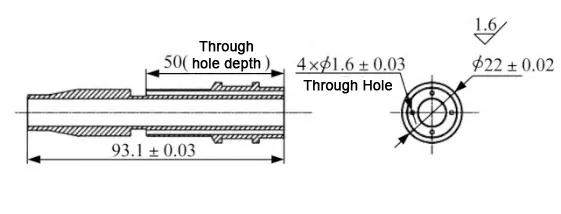
Figure 1 outlines the machining size requirements for the deep hole section of the part.
The hole has a diameter-to-depth ratio of 1:31.25.
Engineers use drilling for machining based on the deep hole structure and processing efficiency requirements.
The Brinell hardness (HBS) of 304 stainless steel does not exceed 187.
Because it contains high levels of chromium, nickel, manganese, and other elements, it undergoes significant plastic deformation during the cutting process.
This increases friction between the material and the tool, generating substantial heat during cutting.
The thermal conductivity of stainless steel is only one-quarter to one-half that of 45 steel, resulting in poor heat dissipation conditions.
Stainless steel maintains high strength at elevated temperatures, which increases cutting forces during machining.
Ordinary steel cutting temperature increases, the strength of a significant decline.
Under conventional cutting conditions, the cutting pressure of 304 stainless steel reaches 2,450 MPa, more than 25% higher than that of 45 steel.
The wear state of the drill bit during the cutting process is shown in Fig. 2.
( 1) Fracture.
When the pecking depth is too large or the chips are too long, drilling generates excessive heat.
The chips can easily clog the drill bit’s spiral groove, hinder chip evacuation, and eventually cause the drill bit to break.
Using a low cutting speed can cause the drill bit to break.
A high feed rate may also lead to breakage.
Additionally, applying a drilling force that exceeds the drill bit’s maximum torque capacity can cause the drill bit to break.
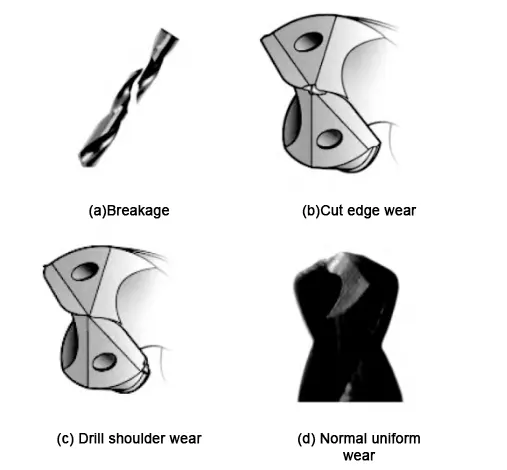
( 2) Wear on the transverse edge.
When the pecking depth is too small, drilling generates less heat and the drill experiences lower torque, making it less likely to break.
However, increasing the number of pecking cycles causes operators to lift the drill more frequently, which reduces processing efficiency.
At the same time, the number of contact impacts between the chisel edge and the hole wall increases exponentially.
This acceleration leads to faster wear on the chisel edge.
( 3) Drill shoulder wear.
Incorrect drilling parameters result in insufficient cooling of the drill bit in deep holes.
For example, a cutting speed that’s too high and a feed rate that’s too low contribute to this issue.
This causes partial annealing of the drill bit.
As a result, wear develops at the shoulder.
This is the intersection of the main cutting edge and the secondary cutting edge.
The wear significantly shortens the tool’s service life.
( 4) Normal uniform wear.
With reasonable cutting parameters, the cutting edges of the drills wear uniformly.
This results in high machining efficiency and a long service life for the drills.
High-speed steel drills offer high toughness, strength, and heat resistance, maintaining their red hardness at temperatures up to 650°C.
They have a good balance of strength and toughness, which enables them to withstand impact and cutting forces during deep-hole drilling.
HSS drills have a moderate balance of strength and toughness.
They can withstand impact cutting forces in deep hole drilling.
As a result, the drill bit does not break easily.
The disadvantage of HSS drills is that they are less abrasion resistant than carbide drills.
Cemented carbide drills are primarily made of tungsten carbide and cobalt.
They maintain red hardness at temperatures between 800 and 1,000°C.
They offer cutting speeds 4 to 7 times higher than high-speed steel drills, resulting in greater cutting efficiency.
In deep hole drilling with insufficient cooling, carbide drills offer better wear resistance.
However, they have disadvantages.
These include low bending strength, poor impact toughness, and brittleness.
They also have a low capacity to withstand impact and vibration.
Reasonable programming of the machining process and drilling parameters can ensure the drill’s stability during drilling.
With reference to the small-diameter deep hole structure of 304 stainless steel, we based our deep hole drilling process design.
We also considered the characteristics of two tool materials.
We then tested the feasibility of drilling using both tools.
This study establishes a theoretical foundation for optimizing cutting parameters in deep-hole drilling.
To enhance overall drill rigidity, we adopt graded pecking drilling.
This method is designed explicitly for small-diameter deep hole structures.
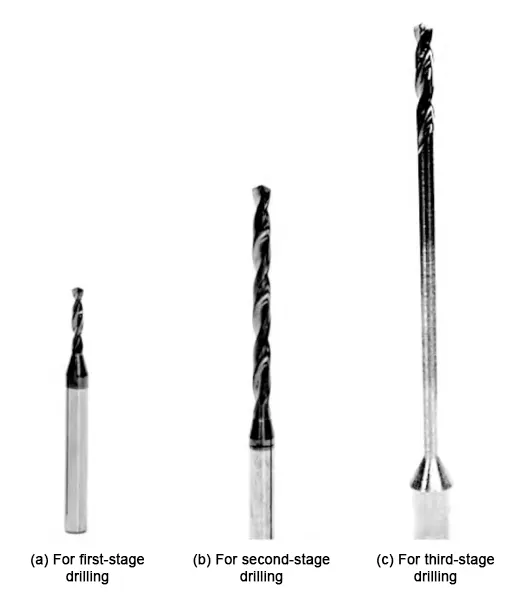
We also customize three carbide drill specifications accordingly.
Simultaneously, we improved the third-stage drilling process.
We achieved this by shortening the original full-flute sub-cutting edge to 4.8 mm, which is three times the diameter of the drill.
This enhancement increases drill bit rigidity and process stability.
The drill structure of graded drilling drill is shown in Fig. 3.
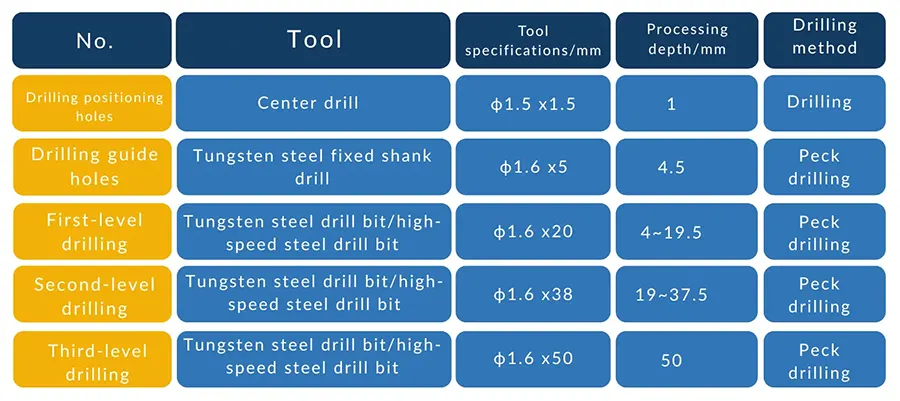
To prevent drilling axis skewing and tool breakage, we divide the process into three stages.
These are positioning, pilot hole drilling, and segmented pecking.
We divide the drilling process into three parts: positioning, drilling the pilot hole, and segmented pecking.
The specific machining process is shown in Table 1.
Cooling and chip removal are essential in deep hole drilling.
Due to the structural limitations of small-diameter drills, it is impossible to use internally cooled drills.
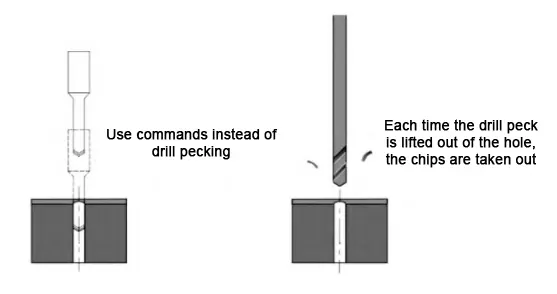
To improve cooling, chip removal, and drilling efficiency, I replaced the G83 pecking instruction with the G81 drilling instruction.
I combined this with the tool path conversion function in the software programming.
At the same time, I increased the drill lift height to raise the drill bit above the hole after each peck, allowing it to cool fully.
Lifting the drill bit out of the hole allows chips to flush away more easily, preventing chip jams that could cause the bit to break.
The drilling process is shown in Figure 4.
Adjustment of drilling parameters can reasonably control the state of the chips.
It also helps achieve better breakage of the chips. Additionally, it facilitates the discharge of the chips.
In the drilling process, there are two main parameters: drilling feed rate and cutting speed.
The drilling feed rate vf is:vf = nFzZ ( 1)
Where: n is the spindle speed; Fz is the feed per tooth; Z is the number of teeth.
The cutting speed vc is:vc = πDcn /1,000 ( 2)
Where: Dc is the tool diameter.
Adjust cutting parameters according to the drill material, its rigidity, and the material of the workpiece.
The basic principle is setting a larger feed per tooth for softer, easier-to-machine materials to improve machining efficiency.
For harder, more difficult-to-machine materials, setting a smaller feed per tooth helps prolong tool life.
Generally, small-diameter carbide drills operate at cutting speeds of 20–30 m/min with a feed per tooth of 0.01–0.04 mm.
In this drilling test, we selected a cutting speed of 25 m/min, corresponding to a calculated spindle speed of 5,000 rpm.
Because small-diameter deep-hole drills have poor rigidity, we select a feed per tooth of 0.01–0.03 mm.
This results in a drilling feed speed of 100–300 mm/min.
Due to the poor rigidity of the small-diameter deep hole drill, we select a feed per tooth of 0.01–0.03 mm.
This selection results in a drilling feed speed of 100–300 mm/min.
Based on the geometric characteristics of the deep holes in the shell parts, we conducted drilling tests.
These tests were performed on 50 mm-thick 304 stainless steel plates.
We compared and analyzed the cutting performance and wear resistance of HSS and carbide drills.
This confirmed that neither tool breaks during deep hole machining.
Additionally, we assessed the deviation of the hole axis resulting from the deep hole drilling and machining processes.
The test results are shown in Table 2.
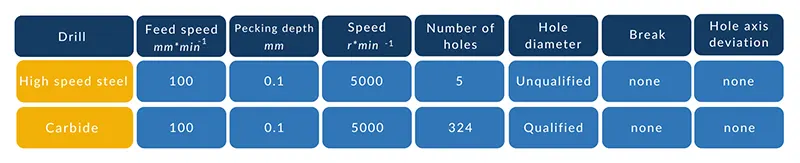
The drilling results show that the graded drilling process combined with pecking drilling using HSS and carbide drills caused no axis deflection or drill bit breakage.
This proves the feasibility of this method for deep-hole machining.
Under the same cutting parameters, the number of drilling operations with a single carbide drill is much higher than with an HSS drill.
Even under insufficient cooling and in a closed environment, carbide drills demonstrate high wear resistance and heat resistance.
Therefore, we excluded HSS drills from the tool selection and chose carbide drills.
Stabilization of the drilling test environment is the key.
To ensure drilling stability, the first phase of the test used conservative peck depth and feed rate settings.
As a result, the drilling process time was quite long.
To improve productivity and reduce drilling time, we conducted a second-phase test.
In this test, we adjusted the drilling parameters and evaluated the ultimate performance of the carbide drill bit.
Throughout, we ensured dimensional accuracy and process stability.
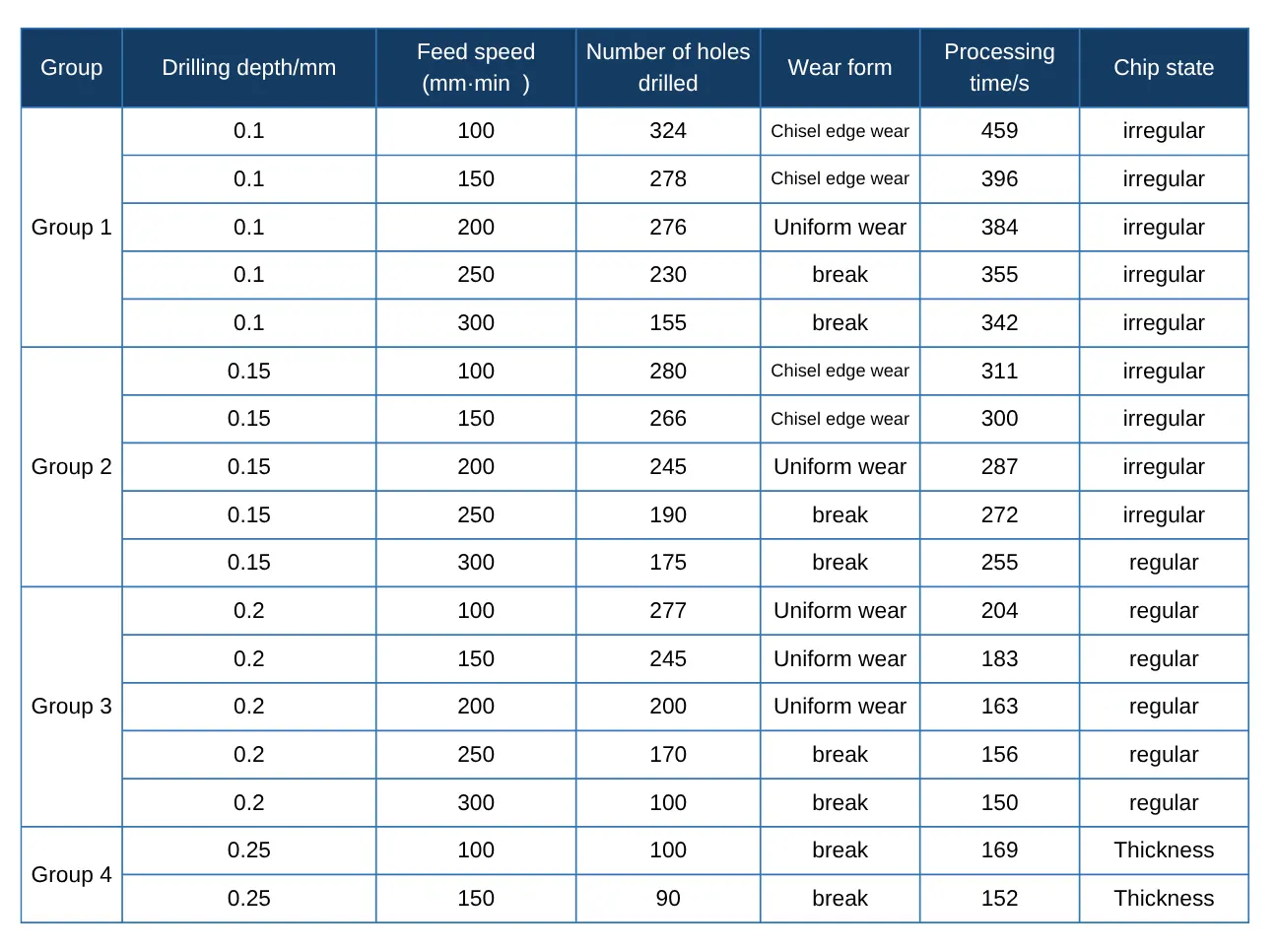
The test was also conducted on a 304 stainless steel plate with a thickness of 50 mm, and the results are presented in Table 3.
In small-diameter deep-hole machining, it is highly inconvenient to observe the cutting status of the drill.
Unlike large-diameter ordinary drills, you cannot judge the reasonableness of the cutting parameters by listening to the drilling sound.
To evaluate the performance of small-diameter deep hole drills, we tested various drilling parameters.
We observed chip shapes and categorized them into three distinct states, as shown in Fig. 5.
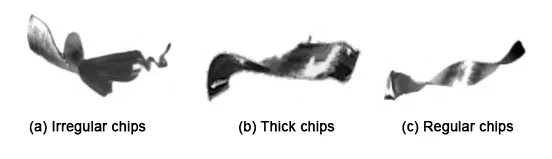
For irregular chips, the chips are not properly shaped.
The pecking volume is too small, and the feed speed is too low.
The cutting speed is too high, causing the cross-cutting edge to wear out easily.
As a result, machining time is prolonged, and machining efficiency is low.
For thick chips, the feed speed is too high. The pecking volume is too large, resulting in chips that are too thick.
This makes the spiral groove prone to clogging, and the drill bit susceptible to breakage.
For regular chips, good shape, reasonable machining parameters, good chip breakage, stable machining conditions, and long tool life.
By analyzing the state of the chips, it is possible to intuitively determine the reasonableness of the drilling parameters based on the chip shape.
This facilitates flexible adjustment of the drilling parameters.
It also compensates for the difficulty in observing the cutting state of the drill bit during small-diameter deep-hole drilling.
Through the exploration and testing of small-diameter deep-hole drilling processes and parameters, we compared and verified the performance of high-speed steel and carbide drills.
Ultimately, we selected carbide drills as the preferred tool for machining small-diameter deep holes.
We carried out the test in three aspects: optimizing the drill structure, verifying the drilling process, and testing the drilling parameters.
We analyzed the test data and observed the drilling process.
Our goal was to identify efficient and low-cost machining parameters suitable for products with a hole depth of 50 mm.
We selected a feed rate of 200 mm/min and a pecking depth of 0.2 mm.
These were used in combination with the depth-graded pecking drilling process for product manufacturing.
After batch verification, we confirmed that the results matched the test outcomes and that the machining process remained stable.
Result from too high feed speed and large pecking volume; causes thick chips that clog spiral grooves and increase the risk of drill bit breakage.