How to efficiently machine shaped parts on CNC mill-turn machines?


Although modern enterprises utilize a large number of high-precision disposable tools, manual sharpening of small- and medium-diameter twist drills remains a relatively standard practice.
This is especially true in small-batch and single-piece production.
For operators of pliers, lathes, and CNC machines, proficiency in twist drill sharpening remains a fundamental essential skill.
You need to sharpen the two main back surfaces of the standard twist drill edge.
The sharpening surface is rounded.
After sharpening, three cutting edges are formed—one transverse edge and two main cutting edges.
Additionally, three corners are created: a top angle of 118° ± 2°, a transverse edge beveling angle of 50° to 55°, and a back angle at the outer edge of 10° to 14°.
It is also required that the heights of the two main cutting edges be as equal as possible.
This makes the twist drill one of the most challenging tools to sharpen manually.
Before sharpening, it is essential to understand the correct angles of a standard twist drill fully.
You can use a larger, new drill as a reference sample. Carefully observe its structure and angles.
During the sharpening process, continuously compare your work with the sample and make corrections as needed.
For novices, it is essential not to rush into sharpening. First, find a disc-shaped part similar to a grinding wheel or use a stationary grinder.
Then, you should practice simulated sharpening exercises using the mnemonic “one angle, two flats, three actions.”
1.”Angle” refers to a 60° angle.
This means the axis of the drill and the surface of the grinding wheel’s outer circle should form a 60° angle.
This corresponds to half of the twist drill’s top angle of 118° ± 2°.
If you are unsure about the angle, you can measure it using an angle gauge or protractor.
It is important to memorize and control this angle.
This angle remains constant throughout the sharpening process, and is a prerequisite for sharpening twist drills to ensure a correct cutting edge .
2.“Two level” means that the drill body and main cutting edge are placed horizontally.
Place your right hand in front and pinch the twist drill’s spiral groove with your fingers, leaving about 20mm of the drill’s tip exposed.
Place your left hand behind and use your fingers to pinch the drill shank.
Rest your right-hand fingers against the grinder bracket, which should be adjusted to the height of the grinding wheel’s center.
Position the drill body so it is level. Then, rotate the twist drill until the main cutting edge is in a horizontal position.
During the sharpening process, ensure that the main cutting edge of the drill is always positioned higher than the centerline of the grinding wheel.
In the beginning of sharpening before placing the correct position, do a good job “a corner two flat”, is the correct sharpening twist drill must be good prerequisites.
3. The “three movements” are “left pressure, forward push, and a slight turn”.
“Left pressure” (active action,) that is, the left hand downward pressure, twist drill with the right hand as the support point, the drill head upward.
“Push forward” (feeding action) that is, both hands push the twist drill to the grinding wheel at the same time.
“Slight rotation” (auxiliary action) means that the twist drill rotates clockwise around its axis.
You must perform these three actions together and complete them simultaneously.
Performing only one or two of them separately will not result in correct twist drill sharpening.
After you complete the “three actions” (one sharpening motion), return the twist drill to the “one angle, two flats” position.
Then, restart the “three actions” and repeat the sharpening process.
Following this cycle ensures you sharpen the cutting edge correctly.
Repeat the sharpening process to obtain the correct cutting edge.
If you don’t maintain the “one angle, two flats” position correctly, the sharpening will become irregular and difficult to analyze due to complex shape changes.
The following analysis assumes that you have correctly achieved the “one angle, two flats” position.
Because you combine the “three actions,” failing to perform any one or two of them correctly will affect the sharpening angle.
The specific analysis is as follows.
The specifics are analyzed as follows.
(1)Reason: If you do not adequately control the “one angle” during sharpening, the 60° clamping angle between the drill bit’s axis and the grinding wheel’s outer surface will change.
(2)Causes of problems: This leads to the top angle being either too large or too small, or causes the main cutting edge to become convex.
These issues affect the twist drill’s top angle and the strength of the outer edge at the cutter tip, ultimately shortening its service life.
(3)Solution: During the sharpening process, always ensure that the drill shaft is held at a 60° angle to the grinding wheel’s outer surface.
Use an angle sample plate to measure and confirm the angle, ensuring you maintain the correct top angle while sharpening.
Specifically analyze the following.
(1)Cause: If your sharpening action is incoherent or you don’t start sharpening at the main cutting edge, problems will occur.
(2)Causes problems: If you cannot accurately control the sharpening angle, the hole diameter and hole wall quality will suffer.
(3)Solution: To sharpen the main and rear cutting surfaces smoothly, it is necessary to practice more than once until the sharpening action is consistent and smooth.
When the twist drill begins to contact the grinding wheel, move it slowly.
Carefully observe whether sparks appear on the front face of the cutter.
If sparks appear, it means you have sharpened the main cutting edge.
Analyzed explicitly as follows.
(1)Cause: When you don’t apply enough “left pressure” movement during sharpening, the rear part of the main rear blade surface remains unsharpened (see Figure 1).
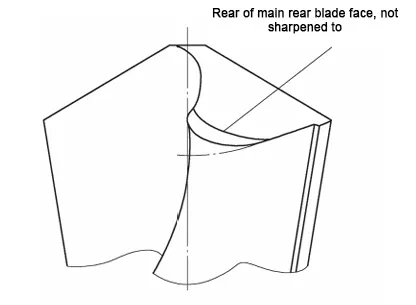
(2)Causes problems: When drilling, this area may be higher than the main cutting edge, preventing the drill from feeding properly.
(3)Solution: Increase the downward pressure with your left hand.
Use both hands to apply more force against the grinding wheel.
This ensures that the entire main rear blade surface is ground evenly.
Specific analysis is as follows.
(1)Causes: If you don’t push the drill forward enough during sharpening, only a small portion of the main back face will be sharpened.
Additionally, sharpening below the center of the grinding wheel can cause the main back angle to become too small or even create a negative back angle.
(2)Problems: You may experience difficulty feeding the drill into the hole properly or increased axial resistance while drilling.
Thin or no chips form, which prevents smooth cutting of the drilled holes.
(3)Solution: The back angle at the outer edge of the twist drill should be 10° to 14°.
When sharpening, after the main cutting edge contacts the grinding wheel, gradually increase the pressure from both hands.
This helps to push the twist drill firmly against the grinding wheel and increase the main back angle.
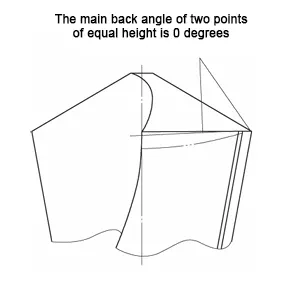
Compare with a standard drill of the same size and adjust the angle to ensure that the main back angle is 0° at the two points of (see Figure 2).
Raise the sharpening position to ensure it is above the center of the grinding wheel.
(1)Causes: The “forward push” action during sharpening is too decisive, or the sharpening position of the grinding wheel is too high, resulting in a large main back angle.
(2)Problems: When drilling, the hole pit appears as a triangular cone or pentagonal cone, with grooves in the hole wall.
The weak wedge angle at the outer edge reduces the drill bit’s life, increases the number of sharpenings, and reduces productivity.
(3)Solution: When sharpening, after the main cutting edge contacts the grinding wheel, gradually reduce the pressure both hands apply to the twist drill.
This helps to form the main back angle properly.
Specific analysis is as follows.
(1)Cause: The amplitude of the “slight rotation” action during sharpening is too large, resulting in the bevel angle of the transverse edge being <50°.
(2)Problems: When the drill body rotates excessively during sharpening, the bevel angle of the cross-cutting edge decreases.
This causes the cross-cutting edge to lengthen.
In some cases, part or all of the main cutting edge may be worn away, resulting in a dull cutting edge.
As a result, the hole will not be adequately drilled.
The cutting force and axial resistance increase considerably.
(3)Solution: When sharpening, rotate the twist drill clockwise around its axis with a small amplitude.
Gradually increase the cross-blade bevel angle during this rotation.
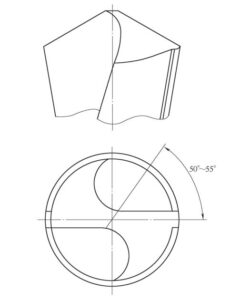
Ensure that the cross-blade bevel angle reaches between 50° and 55° (see Figure 3).
Specific analysis is as follows.
(1)Cause: The range of motion of the “slight turn” during sharpening is too small.
(2)Causes problems: Cross-edge rake angles > 55° cause the front angle of the cross edge to become smaller, again leading to an increase in cutting forces and axial resistance.
(3)Solution: When sharpening, slightly increase the clockwise rotation of the twist drill around its axis.
This gradually increases the bevel angle of the cross blade.
The specific analysis is as follows.
(1)Reason: When sharpening, you cannot accurately determine the amount of material removed from the two main rear cutting surfaces.
This problem worsens if you don’t carefully inspect the visual appearance or control the height of the two main cutting edges properly.
(2)Problems: When you drill a hole, a single cutting edge forms, and chips appear only on one side.
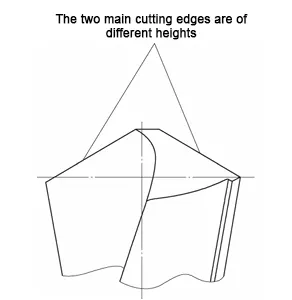
Because the two main cutting edges are not equal in height (see Fig. 4), the center of the drill shifts.
This can cause serious problems such as poor drill bit centering, workpiece vibration, and enlargement of the hole diameter.
(3)Solution: After sharpening both surfaces, raise the drill bit to eye level.
Carefully observe the height of the two main cutting edges against a soft light source.
Rotate the drill bit 180° repeatedly to compare the edges.
You can also use a measuring tool to check their height.
The sharpening and application of the twist drill should be built based on being able to sharpen the standard twist drill skillfully.
You base the sharpening of a standard twist drill on the fundamental condition of “one angle, two flats.”
It requires coordinating three actions: left pressure, forward push, and a slight rotation.
The “one angle, two flats, and three movements” method provides beginners with a solid foundation for sharpening.
It helps them master the sharpening of a standard twist drill more quickly.
The standard twist drill sharpening mnemonic is as follows: Place the drill shaft diagonally to set “one angle.”
The grinding position should be higher than the center of the wheel.
Position the main edge of the drill body flat in “two flats.”
This completes the initial setup for sharpening.
Use your left hand to press down with a slight rotation, while both hands push the drill backward along the corner.
Coordinate these “three actions” together, gradually and gently grinding the edge.
Coordinate between the “three movements”, and start grinding the blade lightly.