How to efficiently machine shaped parts on CNC mill-turn machines?


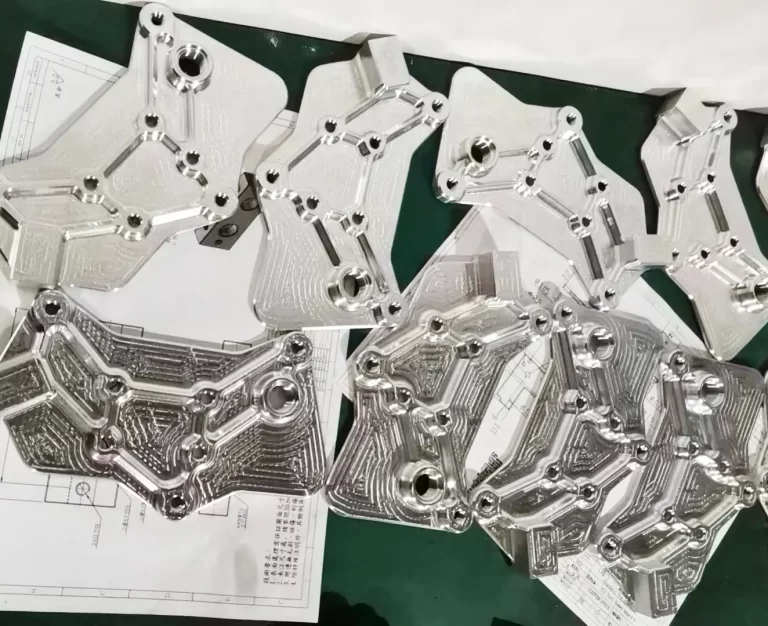
Mold elbow joints are critical connecting components in injection molds, widely used in the injection molding industry.
These joints feature complex structures, typically composed of multiple curved pipes, designed to connect different components or systems for fluid transmission or control functions.
For instance, within the extremely compact internal space of an injection mold, elbow joints can bypass intricate oil or water lines. This forms compact connection loops to ensure stable system operation.
Given their critical importance in mold applications, these fittings demand exceptionally high machining precision and quality standards. Even minor defects can cause entire system failure.
Therefore, selecting appropriate machining tools and techniques is crucial for enhancing both the processing efficiency and quality of mold elbow fittings.
Traditional ball-end mills, constrained by their geometric structure and rigidity, face limitations in accessibility, efficiency, and stability.
These issues become particularly evident during the high-precision machining of mold elbow fittings. As an innovative milling tool, the lollipop cutter features a unique structure and cutting performance.
Leveraging its structural flexibility and superior cutting capabilities, the lollipop cutter has become a key tool.
It is particularly efficient for high-precision machining of mold bend pipe joints. This tool is especially suited for complex geometries, deep cavities, and difficult-to-machine materials.
By optimizing toolpaths and cutting parameters, manufacturers can further harness its potential.
This helps to shorten manufacturing cycles for mold connection components, while also enhancing quality reliability.
In recent years, lollipop milling cutter applications have primarily focused on 3D deburring and chamfering techniques.
Their use in pipe processing represents a frontier application area with limited research reports and has yet to gain widespread adoption.
For instance, a Suzhou-based enterprise employed lollipop milling cutters for reaming operations. These were used in its aerospace pipe fitting production line.
As a result, the company achieved a 40% reduction in per-part processing time.
Additionally, tool life increased by 50%, and annual cost savings exceeded one million yuan.
The manufacturer uses 7050 aluminum alloy for the injection-molded elbow joint.
This alloy offers exceptional strength, lightweight properties, outstanding corrosion resistance, and excellent machinability.
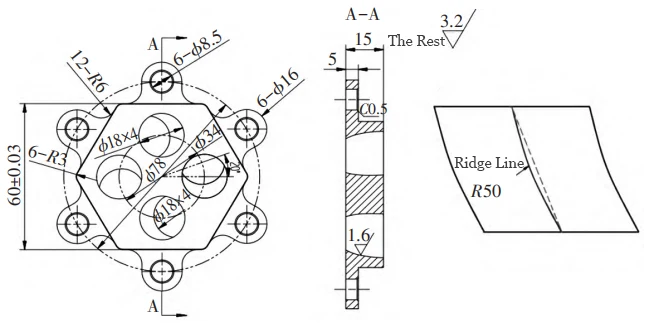
It plays a vital role in applications such as mold connection joints. Figure 1 shows the part drawing for the mold bend pipe joint.
The drawing specifies all dimensions, including diameter, wall thickness, surface roughness, and technical requirements.
The four central bend pipes serve as critical contact areas, requiring high surface quality with a roughness of 1.6 μm.
The upper and lower four holes are rotation bend holes with a 20° rotation angle, evenly distributed.
The ridge line bending radius of the circular holes is R50mm.
These dimensions are critical manufacturing parameters requiring strict control to ensure joint performance.
For the four central curved tubes, conventional tools such as cylindrical end mills, tapered end mills, and ball-nose end mills cannot effectively machine the curved cylindrical surfaces.
This presents significant machining challenges. The unique structure and cutting performance of the lollipop milling cutter make it a promising solution to this challenge.
Its distinctive cutting-edge shape and adjustable cutting angle enable better adaptation to complex surface machining requirements.
This adaptability enhances both machining efficiency and quality.
This study will explore the specific application effectiveness of the lollipop milling cutter in the machining of injection-molded bent pipe joints through simulation analysis.
Based on the design drawings of the injection-molded elbow fitting, create a 3D model using CAD/CAM software (UG software is used in this paper).
Export the model as an X-T format file, then import the 3D model into ESPRIT EDGE software.
Correctly set up the workpiece and blank. In machine tool setup, strict control over the correct machining of the 5-axis machine is required.
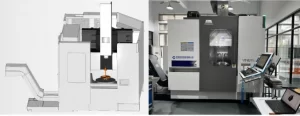
In the experiment, the machine tool, fixture, and tool models were imported.
All models, as shown in Figure 2, perfectly match the actual machining equipment at a 1:1 scale, achieving virtual-physical consistency and enhanced controllability.
Based on the machining process, we prepared four tools.
These included a φ10mm carbide keyway milling cutter for aluminum, an 8.5mm high-speed steel drill bit, an SR8mm lollipop milling cutter, and a φ6mm chamfering tool.
The critical machining challenge lies in the central pipe section, which requires processing with the lollipop milling cutter.
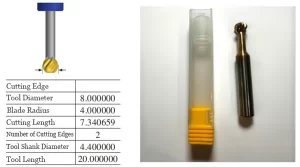
Software tool parameters match the actual tool dimensions.
Since both the side and bottom cutting edges of the lollipop cutter engage simultaneously, we must introduce geometric correction factors and tool inclination angles to calculate the cutting forces.
This enables determining the appropriate tool model for different materials, setting suitable cutting parameters in the software, and creating the lollipop cutter parameters as shown in Figure 3.
ESPRIT EDGE software stands as one of the most powerful 5-axis simulation solutions available today, employing feature-driven operations corresponding to 3D solid machining.
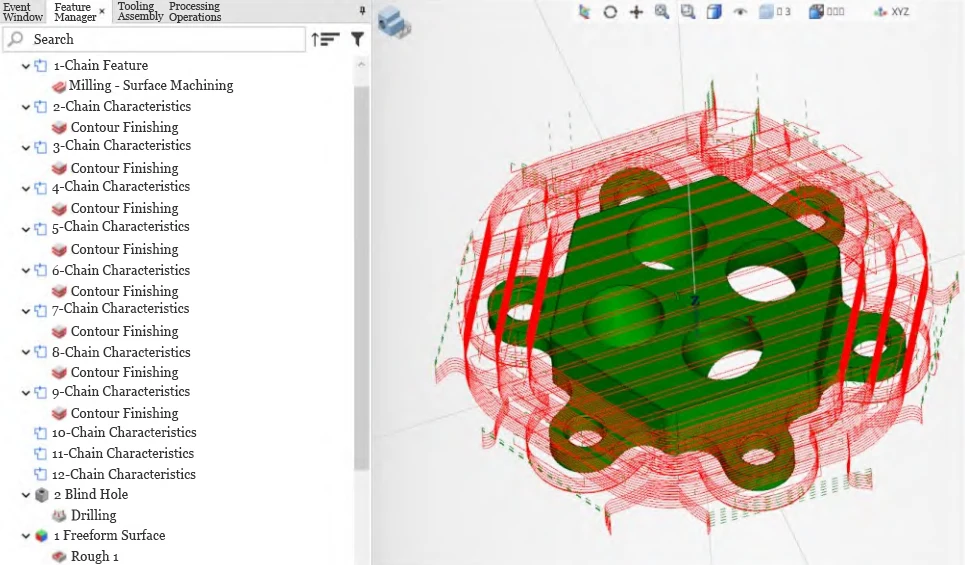
Following the machining sequence, establish surface features, 3D contour features, side wall features, hole features, chamfer features, freeform surface features, etc.
Create corresponding operations for each feature type. You can copy and paste identical operations directly onto similar features.
Figure 4 shows the preceding operations, completing roughing, finishing, drilling, and chamfering of the product’s outer periphery.
5-axis pipe roughing is the key machining step for this part. First, establish the free-form surface feature inside the pipe.
The centerline typically refers to a virtual line distributed along the part’s symmetry axis or geometric center.
In bent pipe machining, the centerline identifies the channel’s central axis.
During 5-axis machining of injection-molded elbow fittings, the tool performs continuous interpolation along the centerline.
This process prevents dry cutting or chatter, which can be caused by abrupt angular changes.
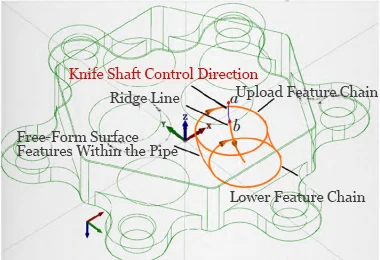
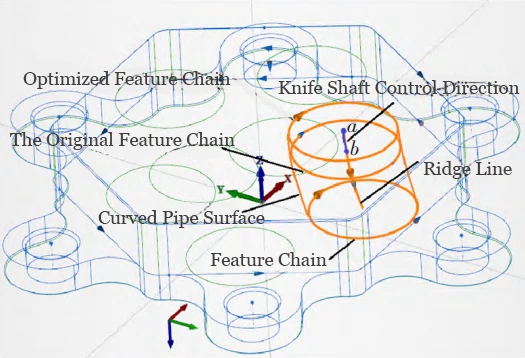
Using ESPRIT EDGE’s Surface Curve tool, extract the pipe centerline (see Figure 5). Define the extracted center ridge line as a chain feature.
Designate the inner pipe wall as a free-form surface feature, the pipe opening curve as the upper feature chain, and the pipe bottom curve as the lower feature chain.
Extend the center ridge line 5mm along the curvature direction.
The direction from the extended point a to point b will serve as the tool axis control direction for subsequent 5-axis machining.
Select the pipe roughing function in ESPRIT EDGE software’s surface machining module.
In the pipe roughing dialog box, choose the previously set lollipop cutter as the tool. Set roughing speed to 5,000 rpm and feed rate to 500 mm/min.
Enable the RTCP tool radius automatic tracking function for part offset transfer.
Configure the toolpath with a machining tolerance of 0.1 mm and a machining allowance of 0.3 mm.
In the impeller geometry definition, select the ridge line, start wheel, and end wheel as the ridge line, upper feature chain, and lower feature chain, respectively, as shown in Figure 5.
The cutting depth is 2 mm, and the step size is 40%.
Due to the confined internal space and irregular curvature of the injection-molded elbow pipe joint, machining the inner wall is prone to collisions or overcutting.
The challenge in 5-axis pipe machining lies in tool axis control parameter settings.
These settings require continuous simulation debugging to strictly control the tool axis direction and restriction angles.
After debugging, we select point A in Figure 5 as the tool axis starting point and point B as the tool axis end point.
This defines the initial tool axis feed direction from point A to point B.
During subsequent machining, we restrict the tool axis oscillation within the 0–30° range, and the software adjusts the direction adaptively based on the complex pipe wall surfaces.
After completing all parameter settings, we generate the toolpath for the bent pipe machining, as shown in Figure 6.
The generated 5-axis roughing operation for the pipe undergoes collision detection and full-model verification within the simulation environment.
During full-model simulation, a collision warning triggered by tool interference occurred when the lollipop milling cutter initiated the feed.
Analysis revealed that the tool’s ball nose point followed a feed path too close to the workpiece surface without sufficient buffer distance, causing the software to detect a collision warning.
This could damage the tool during actual machining. Therefore, we should not directly generate this toolpath into post-processed code for on-machine processing.
Appropriately increase the feed buffer distance to ensure machining proceeds without collision warnings.
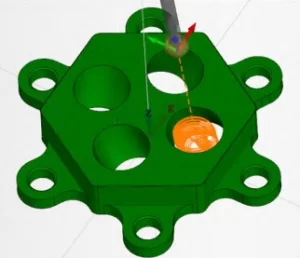
The 5-axis roughing of the pipe represents the machining challenge for this part.
Due to feed interference warnings, the upper opening of the bent pipe requires specialized handling.
Using ESPRIT EDGE’s surface extension tool, we extend the pipe’s upper opening along the curvature direction.
We extend the surface outward by 5mm to establish a new upper feature chain, ensuring that the extension distance exceeds the radius of the lollipop milling cutter, as shown in Figure 7.
Following the 5-axis pipe roughing menu, the upper feature chain was reselected as the new starting contour while retaining all other parameters.
After generating the toolpath, a full model simulation was performed again.The simulation showed no alarm warnings.
The animation clearly demonstrated a spiral-shaped tool approach, with a depth progression from shallow to deep.
This ensured a smooth transition and effectively prevented rigid collisions during tool entry.
Since ESPRIT EDGE employs feature-driven programming, the remaining three bent pipes share identical features with the current debug hole.
Simply copy the debugged operation and paste it under the respective features to rapidly create machining operations for the remaining holes.
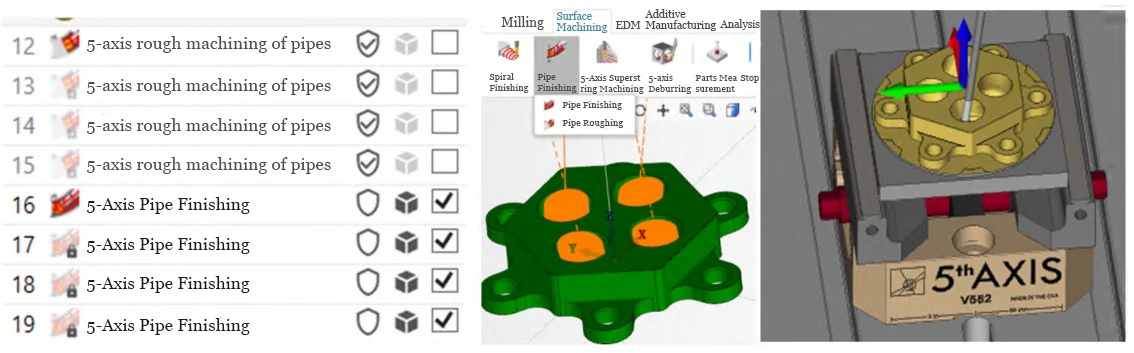
After rough machining, directly utilize the 5-axis pipe finishing function provided by ESPRIT EDGE software for pipe finishing.
Set the spindle speed to 10,000 rpm, feed rate to 1000 mm/min, cutting step to 0.1 mm, and machining accuracy to 0.01 mm.
Other parameters should be configured according to rough machining settings.
The final simulated toolpath and full machine model simulation verification are shown in Figure 8.
During finishing, the lollipop milling cutter demonstrated its unique advantages.
Its blade geometry and adjustable cutting angle enabled superior adaptation to the complex surface machining demands of the injection-molded elbow fitting.
Simulation analysis revealed smooth, continuous toolpaths with stable spindle control, effectively preventing collisions and overcutting.
To further validate the practical application effectiveness of the lollipop milling cutter, machining experiments were conducted.
These experiments focused on the 5-axis machining of injection-molded elbow fittings, using the Shenyang VMU635 multi-axis machine tool.
During the experiments, operations strictly adhered to the pre-established machining process and simulation parameter settings to ensure successful verification in a single attempt.
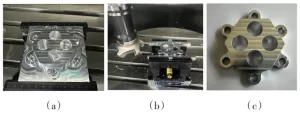
Figure 9 illustrates the 5-axis machining process for the injection-molded elbow fitting.
Figure 9a depicts the front-side machined part of the injection-molded elbow fitting.
Here, the workpiece is clamped in a 5-axis self-centering vise, with each structural feature formed sequentially.
The four elbow holes are rough-machined by the lollipop milling cutter, following pre-set tool paths.
The finishing machining is then performed to ensure the machined surfaces meet the required precision and surface roughness specifications.
Figure 9b shows the machined reverse side of the injection-molded elbow fitting. Bottom features require flipping the part for completion.
During reverse-side machining, a dial indicator is used to verify parallelism between the upper and lower surfaces meets specifications.
Figure 9c shows the final physical part of the injection-molded elbow fitting. As seen, the entire part exhibits a smooth appearance with clear contours.
The transitions between each bent pipe section are natural, with no visible machining marks.
Lollipop milling cutters, with their unique geometry (cylindrical shank + spherical or rounded nose), are well-suited for deep cavities and complex internal bore machining.
However, their long overhang and lower rigidity necessitate careful parameter selection.
Excessively high feed rates can induce chatter, leading to increased surface waviness.
This study innovatively proposes a 5-axis simultaneous machining strategy based on lollipop milling cutters.
The focus is on overcoming the bottleneck in machining the complex hole wall surfaces of aluminum alloy bent pipe joints.
By constructing a collaborative optimization model, it integrates ‘tool path-tool axis vector-collision protection’ through ESPRIT EDGE software.
This approach achieves minimum cutting force trajectory planning and provides dynamic interference early warning.
Experiments demonstrate that, compared to traditional ball-end mills, the lollipop milling cutter achieves significant improvements.
It reduces the total machining cycle time for bent tube inner walls by 70%, lowers surface roughness to Ra 1.6 μm, and extends tool life by over 150%.
This solution establishes a new process benchmark for machining complex flow channels in injection joints, successfully resolving the challenge of processing intricate curved surfaces in intermediate bent tubes.
This research not only provides an innovative approach for machining injection-molded bent tube joints, but also offers a valuable reference for processing other similar complex components.
It demonstrates broad application prospects in injection joint manufacturing.
Currently, this research is limited to 7050 aluminum alloy and lacks universal validation for special materials such as high-temperature alloys and composites.
Future efforts will focus on industrial production line verification.
The goal is to establish 5-axis machining process standards for complex flow channels in industrial fittings.
Additionally, applications will be extended to precision components like injection tubing.