Comparative analysis of various connection methods for sheet metal chassis structural components
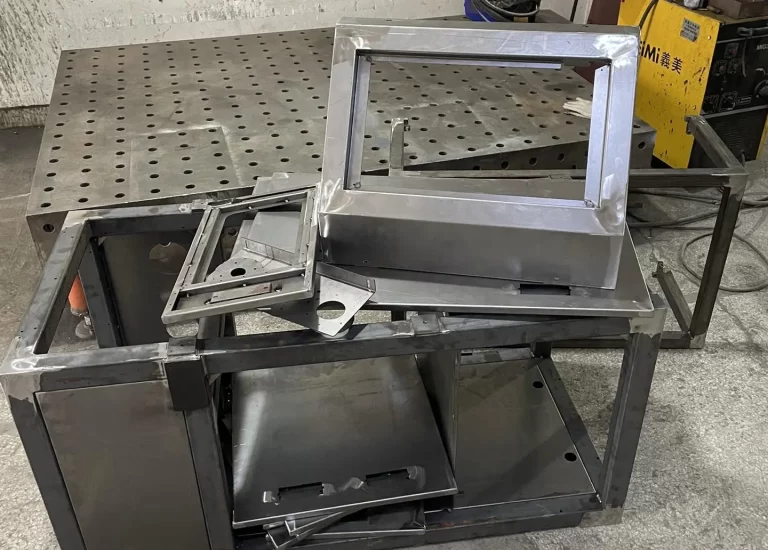


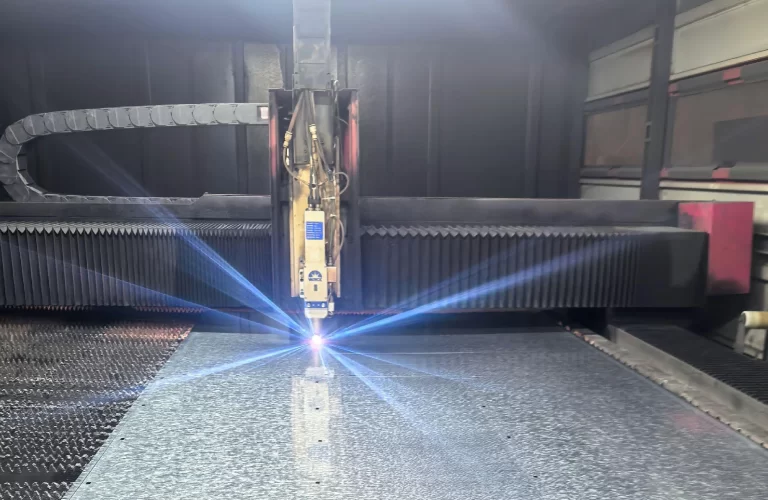
Laser welding, with its advantages of high energy density and minimal heat-affected zone, is widely applied to components such as car doors and frames.
However, defects like porosity and cracks frequently occur during actual production, compromising joint strength and driving safety.
Therefore, systematically analyzing quality-influencing factors, establishing a scientific inspection system, and proposing effective optimization strategies are crucial for ensuring body quality and enhancing corporate profitability.
Automotive sheet metal components must balance strength, toughness, and lightweight design. Differences in weldability among various materials directly impact joint quality.
For example: Common hot-dip galvanized steel grades SGCC and SGHC feature zinc coatings 5–15μm thick, significantly enhancing corrosion resistance.
However, the zinc layer’s boiling point is only 907°C, causing zinc vapor to evaporate during welding.
If this vapor cannot escape promptly, it leads to porosity in the weld seam. Process optimization is required to minimize residual zinc vapor.
Laser welding utilizes a high-energy-density beam generated by a laser source, commonly employing fiber lasers with a wavelength of 1064 nm or CO₂ lasers at 10.6 μm.
Upon striking the workpiece surface, the light energy rapidly converts to heat, melting a localized area to form a molten pool.
As this pool cools and solidifies, it creates the weld seam.
Based on energy input intensity and melt pool morphology, laser welding can be categorized into two types:
Conduction welding utilizes lower laser energy, melting only the workpiece surface.
Heat diffuses inward via conduction, resulting in shallow penetration depths typically <1mm.
This method is suitable for lap or seam welding of sheet metal components <1mm thick.
Deep penetration welding, also known as keyhole welding, occurs when the laser energy density exceeds the material’s threshold.
The workpiece surface rapidly vaporizes into a keyhole, allowing the laser to penetrate deep into the workpiece interior.
This creates welds with a depth-to-width ratio of up to 10:1, suitable for butt or fillet welding of sheet metal parts with thicknesses between 1 and 3 mm.
This method effectively ensures the connection strength of the weld.
Material composition directly determines weldability. In low-carbon steel, carbon content exceeding 0.15% causes hardening in the weld zone, increasing susceptibility to cold cracks during cooling.
In aluminum alloys, imbalanced magnesium and silicon content compromises weld strength. Material thickness must precisely match laser power.
Using lasers >3kW on sheet metal <1mm thick risks burn-through due to excess energy.
Conversely, lasers <2kW on sheet metal >3mm thick may cause incomplete fusion, typically resulting in penetration depth <70% of thickness and severely compromising joint strength.
Contaminants like oil, oxide films, and rust on sheet metal surfaces hinder effective laser energy absorption, compromising weld quality.
Residual lubricants and oils from stamping processes burn at high welding temperatures, producing gases.
If trapped in the molten pool, these gases solidify upon cooling, forming weld porosity.
The Al₂O₃ oxide layer on aluminum alloy surfaces has a melting point significantly higher than the base material.
If not removed before welding, it forms inclusions in the molten pool.
Rust on galvanized steel surfaces disrupts the uniform distribution of the zinc coating.
During welding, localized areas with excessively high zinc vapor concentrations can easily cause porosity clusters.
Process parameters are central to controlling weld quality. Key parameters affect joint integrity as follows:
– Insufficient laser power results in inadequate penetration depth.
For example, steel welding with power <1.5 kW fails to produce welds meeting strength requirements.
Excessive power may cause burn-through or enlarged heat-affected zones.
For example, welding aluminum at >4 kW significantly increases deformation risk.
For 2 mm cold-rolled steel butt welding, the optimal power range is 2–2.5 kW, achieving penetration depths of 1.5–1.8 mm to meet strength requirements.
Excessively slow scanning speeds increase heat input, amplifying workpiece deformation.
Deformation issues become particularly pronounced at speeds below 0.5 m/min.
Conversely, excessively high speeds shorten the molten pool residence time, causing incomplete fusion.
For 2mm aluminum alloy welding, the optimal speed is 1–1.5 m/min, which ensures penetration depth while controlling deformation.
Defocusing refers to the distance between the focusing lens’s focal point and the workpiece surface.
Positive defocusing disperses energy, resulting in insufficient penetration depth.
Negative defocus (focus inside the workpiece) risks burn-through due to concentrated energy.
Thin sections typically use positive defocus (+1–2 mm), while thick sections employ negative defocus (-0.5 to -1 mm).
Additionally, shielding gas selection must match the material.
To comprehensively and accurately evaluate joint quality, non-destructive testing and destructive testing must be integrated.
The applicable scenarios and technical parameters for different inspection methods are outlined in Table 1.
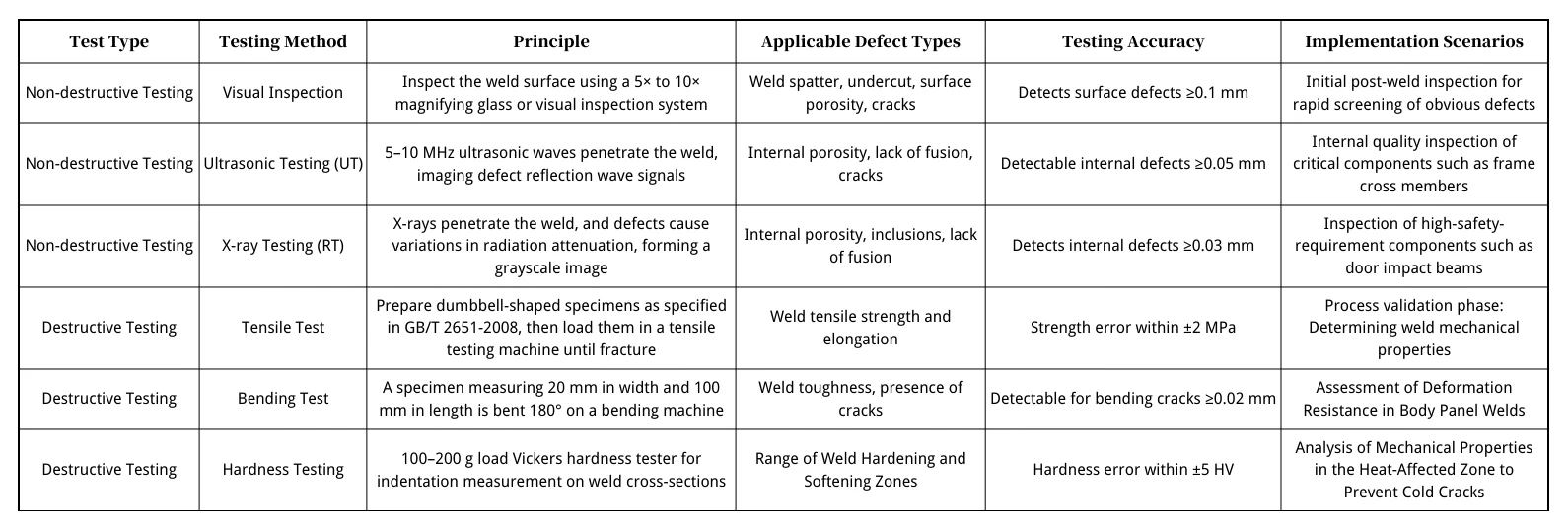
Non-destructive testing enables quality screening without damaging the workpiece.
Visual inspection, as the initial testing procedure, can rapidly identify obvious surface defects.
While destructive testing consumes the workpiece, it precisely obtains mechanical property data of welds.
Combining these two testing methods allows for a comprehensive evaluation of joint quality.
According to automotive industry standards such as ISO 13919-1 and GB/T 3323-2005, the connection quality of laser-welded automotive sheet metal components must meet multidimensional criteria.
For visual criteria, weld surfaces must remain flat with undercut depth ≤0.1 mm, weld bead height ≤0.2 mm, and surface porosity ≤1 pore/dm².
Internal criteria require internal porosity diameter ≤0.2 mm, individual defect area ≤0.04 mm², and total defect area not exceeding 1% of weld area.
Critical defects such as lack of fusion or cracks are strictly prohibited.
For mechanical properties, the weld tensile strength must be no less than 80% of the base material.
Taking 2mm DC01 steel as an example, the weld tensile strength must be ≥300 MPa.
Additionally, the weld must exhibit no cracks after 180° bending, and the heat-affected zone hardness must not exceed 120% of the base material hardness to prevent weld embrittlement due to hardening.
To address surface condition issues, establish standardized pretreatment procedures to ensure welding quality.
For degreasing, use a 5%–8% alkaline cleaner at 50–60°C for 5–10 minutes immersion.
Subsequently, rinse the workpiece surface with high-pressure water at 0.8–1 MPa, followed by hot-air drying at 80–100°C to ensure residual oil contamination ≤5 mg/m².
For oxide film removal on aluminum alloys, employ either a 10%–15% phosphoric acid solution at 40–50°C for 3–5 minutes of acid pickling, or mechanical grinding with 120–180 grit sandpaper.
Welding must commence within 30 minutes after oxide removal to prevent secondary oxidation and new film formation.
For zinc coating treatment, employ the “reserved gap method” by setting a 0.1–0.15 mm butt joint gap to allow zinc vapor escape.
Alternatively, create a 0.2 mm wide, 0.3 mm deep vent groove on the weld back to further reduce zinc vapor retention and minimize porosity formation.
Using the orthogonal experimental design method, the optimal combination of process parameters can be efficiently determined.
Taking the butt welding of 2mm hot-dip galvanized steel (SGCC) as an example, the experimental factors selected were laser power, scanning speed, defocus amount, and shielding gas flow rate.
Each factor was set at three levels. Through range analysis, the optimal parameter combination was determined to be A2, B2, C2, D2.
Under these parameters, the weld porosity rate was <0.5% and tensile strength ≥320 MPa, fully meeting quality requirements.
Additionally, parameters must be tailored to material properties:
For aluminum alloy welding, employ “pulsed laser” mode with a pulse frequency of 50–100 Hz and a duty cycle of 50% to reduce heat input and minimize workpiece deformation.
For welding sheet metal components thicker than 3 mm, utilize a “multi-pass welding” process:
The first pass uses high power (approximately 3 kW) to ensure penetration depth.
The second pass uses low power (approximately 2 kW) to repair surface defects and enhance overall weld quality.
Fixture improvements should focus on three key areas: enhancing rigidity, optimizing positioning accuracy, and compensating for thermal deformation.
For rigidity enhancement, reduce the support spacing between fixture plates to below 150mm.
Construct the fixture body using 7075 high-strength aluminum alloy to ensure fixture rigidity ≥ 5×10⁵ N/m, thereby preventing workpiece vibration during welding.
For positioning accuracy optimization, use interference-fit locating pins with clearance ≤0.01mm and equip pneumatic clamping devices with 80–100N force to ensure workpiece alignment gap ≤0.1mm, guaranteeing weld positional accuracy.
For thermal deformation compensation, elastic supports (e.g., spring plates) with stiffness of 1×10⁴ N/m are integrated into the fixture to absorb thermal deformation during welding, minimizing workpiece warpage to ≤0.05 mm.
A dual “visual + temperature” monitoring system enables real-time control of the welding process.
A high-speed camera with a frame rate of 1500 fps captures real-time molten pool images.
Image processing algorithms, such as edge detection, analyze molten pool size variations to ensure fluctuations remain within ±0.1mm.
Simultaneously, an infrared thermometer with ±2℃ accuracy monitors the molten pool temperature.
For steel welding, the temperature is controlled between 1500–1600℃; for aluminum welding, it is maintained at 660–700℃.
When temperatures exceed the set range, the system automatically adjusts the laser power with an adjustment range of ±0.1kW, forming a closed-loop control system.
This enables real-time correction of deviations during welding, ensuring stable weld quality.
This study demonstrates that material properties, welding process parameters, and fixture positioning accuracy are the core factors influencing laser welding quality.
A combination of non-destructive and destructive testing provides a comprehensive quality assessment.
Standardized pre-treatment orthogonal optimization processes, improved fixtures, and dual monitoring systems can significantly reduce defects and enhance weld quality.