How to efficiently machine shaped parts on CNC mill-turn machines?


A steam turbine is a rotary power machine that converts the thermal energy of high-temperature, high-pressure steam into mechanical energy.
It is now widely used in numerous fields, including thermal power generation, nuclear power generation, marine propulsion, and petrochemicals.
Within the turbine’s structural composition, the tooth-shaped single-start thread serves as the core connection between the turbine body and valves.
The machining quality of this thread significantly determines the sealing performance between the high-pressure outer cylinder and the main steam valve.
The effectiveness of this sealing directly impacts the overall performance and operational efficiency of the entire turbine unit.
Therefore, ensuring the precision and quality of tooth-shaped single-start thread machining holds critical and irreplaceable significance for the stable operation and high-efficiency performance of steam turbines.
The dimensions of single-start threads encompass multiple specifications, including pitch sizes of 5 mm, 9 mm, and 20 mm.
Corresponding profile dimensions and tolerance requirements vary across these pitches.
Figure 1 illustrates the thread dimension parameters, and Table 1 provides the detailed specifications.

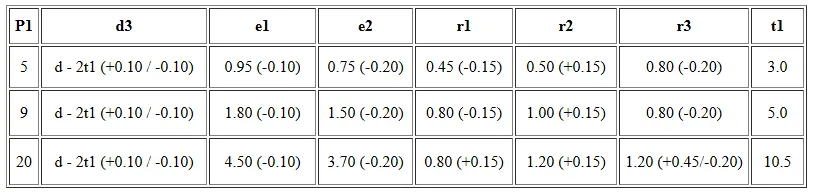
Note:
P₁ = single-start thread pitch
d₃ = thread root diameter
t₁ = tooth depth
d, e₁, e₂, r₁, r₂, and r₃ = see details in the table
Compared to conventional thread machining, single-start threads present the following machining challenges:
1) The profile surface structure of single-start threads is complex, with thread contours composed of multiple curves, increasing machining difficulty and complexity.
Additionally, the larger thread dimensions and substantial machining allowance of the workpiece render conventional threading methods unsuitable.
Consequently, engineers must develop multi-depth machining strategies to ensure both efficiency and precision throughout the process.
2) Single-start tooth-shaped threads demand exceptionally high surface quality.
Manufacturers must strictly control the surface roughness (Ra) of the bearing surfaces, as well as the inner and outer thread diameters, to 1.6 μm.
Meeting the Ra 1.6μm requirement demands meticulous tool selection and cutting parameter configuration.
3) To accommodate multiple pitch specifications, CNC programming must prioritize versatility, enabling adaptation to diverse thread dimensions.
4) Thread pitch tolerances of ±0.02 mm impose stringent demands on machine tool precision and machining techniques.
Standard series thread machining typically employs multiple passes with forming tools, utilizing the tool’s contour to complete tooth profile machining.
However, the tooth structure of single-start threads is unique, rendering this method unsuitable.
For such specialized tooth profiles, manufacturers must adopt rotary machining methods such as turning and boring.
Multiple incremental passes using a copy-milling process produce the desired thread shape.
Based on detailed process analysis, this study developed a layered helical turning process plan.
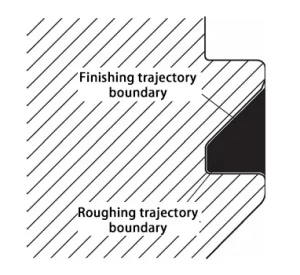
It comprises roughing and finishing operations, with the roughing/finishing boundaries for the single-start thread shown in Figure 2.
The black area indicates the roughing zone, where a 0.2mm roughing allowance is set.
During roughing, layered cutting removes excess material layer by layer.
For finishing, a single-pass turning method ensures final thread precision and surface quality.
The material for the high-pressure outer cylinder of steam turbines is chromium-molybdenum-vanadium cast steel, a high-performance alloy cast steel with a typical hardness of 25–40 HRC.
Due to its high hardness, tool life during machining is reduced by 30%–50% compared to machining ordinary carbon steel.
Additionally, this material exhibits work-hardening tendencies and poor thermal conductivity, characteristics that increase machining difficulty and complexity.
The process selected carbide-coated tools to enhance wear resistance and thermal shock resistance.
Simultaneously, heat dispersion reduces localized tool temperatures.
Considering the high surface quality requirements for single-line thread profiles, contouring radius inserts were chosen to effectively improve machining accuracy and reduce surface roughness values.
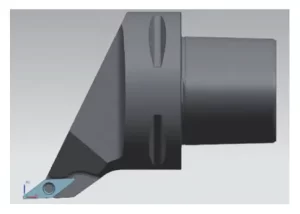
After a comprehensive evaluation, the study selected a 35° rhombic turning tool from a specific brand (see Figure 3), as its performance and geometric parameters meet the requirements of high-precision machining.
Following tool selection, the study conducted a thorough interference verification of the tool’s motion trajectory to ensure that no interference occurs between the tool and the workpiece during machining (see Figure 4).
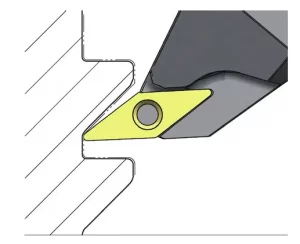
For thread features with pitches of 9 mm and 20 mm, the root radius r1 = 0.80 mm, and inserts with a tip radius of 0.8 mm can be selected.
For thread features with a pitch of 5 mm, the root radius r1 = 0.45 mm, and inserts with a tip radius of 0.4 mm can be selected.
The key parameter calculation involves determining the X and Z coordinates of the starting point.
The process divides the X-axis into equal-distance layers, and calculates the X-coordinate by incrementing it according to the specified step size.
The Z-coordinate calculation involves first determining the Z-axis start and end points corresponding to the X value.
After establishing these points, the process calculates the coordinates for each starting point based on the Z-axis step increment.
According to the tooth profile characteristics, the tooth shape can be divided into five segments L1 to L5 for separate calculation (see Figure 5).
Among these, the root radius r1 represents the tool tip clearance and does not require calculation, so segment L3 can be disregarded.
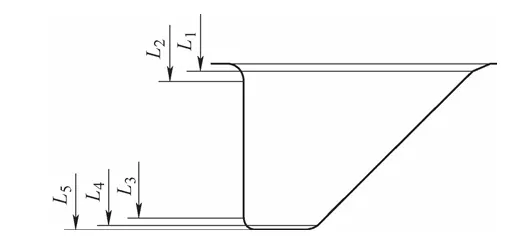
Using common variables in CNC machine tool systems, set the straight edge of the thread profile as the Z-axis reference, with an X-coordinate value of R24.
The tool tip radius is R11, and the pitch is R40. Define t1, e1, e2, r1, r2, and r3 as R41, R42, R43, R44, R45, and R46 (refer to Figure 1 for details of t1, e1, e2, r1, r2, and r3).
The calculation program is as follows.
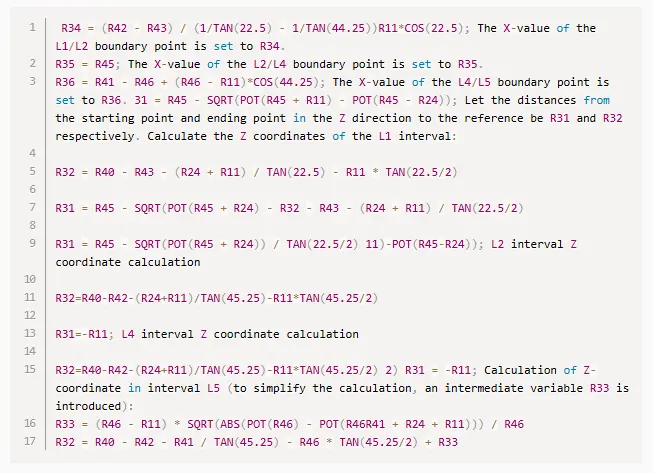
The program categorizes parameters into four types: primary input parameters, machining parameters, tooth profile parameters, and calculation parameters.
Engineers must specify the primary input parameters during programming based on drawing dimensions.
Machining parameters derive from trial cuts and actual machining experience and generally require no modification.
Engineers define tooth profile parameters according to vertical sawtooth thread standards, and these parameters are typically non-modifiable.
Calculation parameters represent variables used in program computations and do not require initial value specification. The program is as follows.
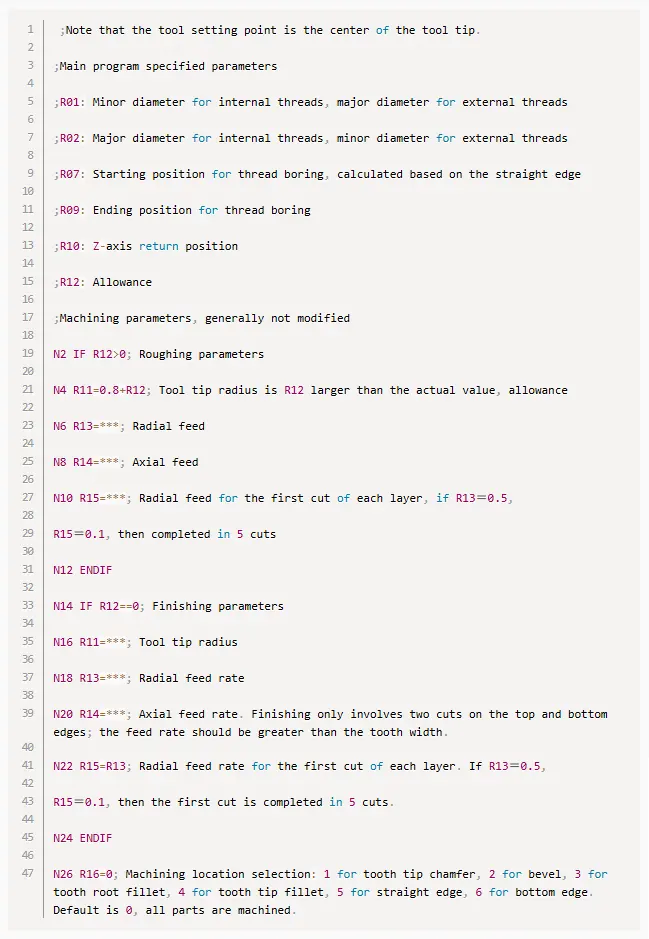
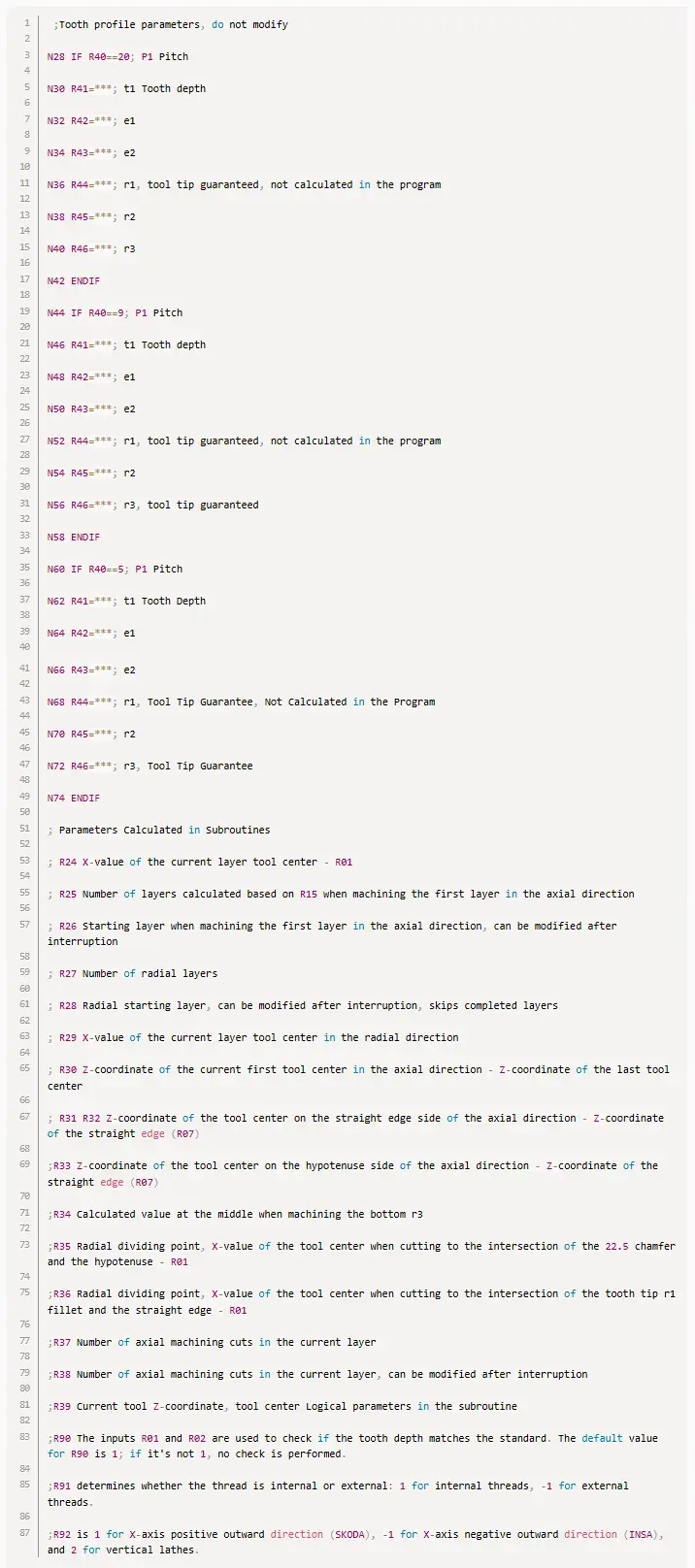
The main program for thread machining must be modified according to different thread types, while subroutines remain fully fixed.
Simply compile the main program based on specific requirements and call the fixed subroutines.
After completing the above tasks, the process programs the X and Z axes cycles according to the predefined interval divisions, ultimately finalizing the machining program for vertical sawtooth threads.
When machining external threads, processing proceeds from outer to inner diameters, starting with a larger diameter and ending with a smaller one.
For internal threads, machining proceeds from inner to outer diameters, beginning with a smaller diameter and concluding with a larger one.
The process divides the machining program into roughing and finishing operations.
For simplified usage, engineers consolidate these operations into a single subroutine.
During program execution, decisions are made based on the allowance parameter: if Allowance > 0, the program jumps to the roughing segment; if Allowance = 0, it jumps to the finishing segment.
In special cases, it may be necessary to machine only a specific section of the thread rather than the entire tooth profile.
To accommodate this, the subroutine includes a section selection parameter.
Based on this parameter, the program can directly jump to the desired section for individual machining.
Simulation verification was conducted using simulation software for the completed CNC macro program.
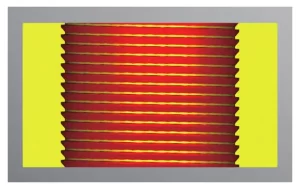
The simulated machining process is shown in Figure 6, while the simulated results for the single-line thread profile are presented in Figure 7.
These simulation results further validate the accuracy of the CNC macro program.
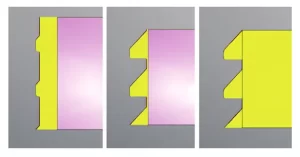
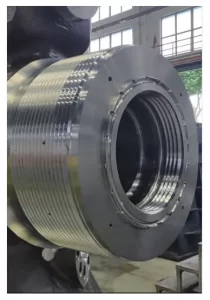
The actual machining results of the single-line thread profile are shown in Figure 8.
Inspection and measurement confirm that all machined dimensions meet the technical requirements specified in the drawings, validating the effectiveness of this machining method.
To address the challenges of machining single-start threads for turbine teeth, engineers have proposed a contouring machining process based on CNC macro programs.
By rationally selecting cutting tools, optimizing machining parameters, and utilizing macro programs to achieve precise machining of complex thread profiles, both machining efficiency and quality have been effectively enhanced.
This approach meets the high-precision machining requirements for single-start threads in turbine teeth.