How to efficiently machine shaped parts on CNC mill-turn machines?
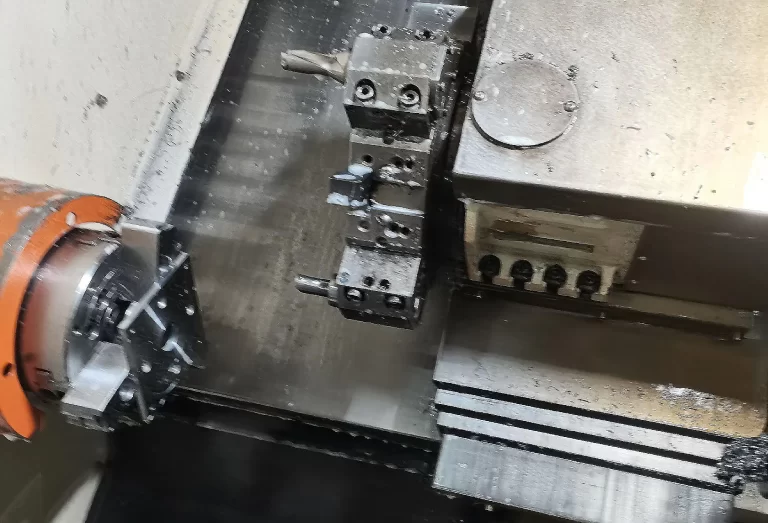


The lower housing component for a certain aircraft is made of difficult-to-machine stainless steel.
It features a complex structure typical of hemispherical thin-walled parts and imposes specific requirements on material strength and toughness.
Its machining quality directly impacts assembly quality and service life.
As shown in Figure 1, the primary geometric elements of this aerospace lower shell component are the mounting base and hemispherical section.
Its hemispherical, thin-walled structure poses challenges for positioning and clamping during machining.
Furthermore, the stainless steel material is soft and sticky, requiring substantial material removal.
If internal stresses do not relax adequately, they can cause deformation during processing, requiring a detailed manufacturing plan.
First, understand the material properties. Then analyze the part’s shape, dimensions, and relative positions.
After establishing the locating benchmarks, draft the machining sequence and plan.
Select appropriate machine tools, cutting tools, and cutting fluids, and determine machining allowances and process dimensions.
Leverage the characteristics of CNC machining to rationally choose machining methods and cutting parameters to ensure product accuracy.
Finally, program the machining process.
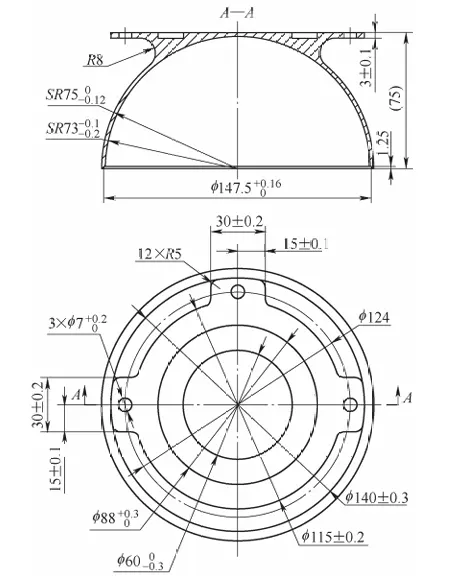
Since the part must withstand a liquid pressure of 2–5 MPa, it requires sufficient strength, toughness, and corrosion resistance.
Therefore, stainless steel is the most suitable material. Machining the inner and outer hemispherical arcs presents a challenging clamping issue.
Engineers can machine the inner and outer hemispheres by clamping the part onto a properly sized machining step added at one end of the fixture.
They then design a dedicated fixture to remove this machining step, ensuring the part achieves its final form.
Based on production requirements and structural characteristics, 1Cr18Ni9Ti stainless steel is selected as the lower shell material, conforming to GJB 2294A—2014 “Specification for Stainless Steel and Heat-Resistant Steel Bars for Aviation Use.”
Engineers specify the blank dimensions as φ175 mm × 100 mm.
Blanks undergo forging and solution treatment.
Forging eliminates defects such as casting porosity formed during smelting, optimizes microstructure, and preserves intact metal flow lines to meet production requirements.
To enhance material properties, 1Cr18Ni9Ti stainless steel further undergoes solution treatment for softening.
Engineers heat the stainless steel to approximately 950°C and hold it to fully dissolve carbides and various alloying elements uniformly into the austenite.
It is then rapidly water-quenched. This prevents carbon and other alloying elements from precipitating, resulting in a pure austenitic structure.
This process also prevents the decomposition of carbides formed by stabilizing elements (TiC and NbC).
Functions of solution treatment:
① Uniformly homogenizes the microstructure and composition of the blank.
② Eliminates work hardening, facilitating subsequent cold working.
③ Restores the inherent corrosion resistance of stainless steel.
Given that the machinability characteristics of stainless steel significantly impact processing, understanding and mastering the material’s properties and features is crucial for manufacturing.
This material has a relative machinability rating of 0.3 to 0.5, classifying it as a difficult-to-machine material.
Its machining characteristics primarily include the following aspects:
① High cutting forces and elevated cutting temperatures.
② Severe work hardening.
③ Prone to tool adhesion.
④ Rapid tool wear.
The dimensional tolerance grade of the part ranges from IT7 to IT12, indicating relatively low requirements.
The positional tolerance for the φ7mm hole is φ0.1mm.
To successfully manufacture the part, it must comply with the manufacturability requirements of mechanical production.
When designing the machining process, four key issues require attention:
① The part has substantial machining allowances; how to ensure machining quality.
② The part’s hemispherical shape necessitates ensuring rigidity of the machining step and facilitating subsequent removal processes.
③ The part is made of difficult-to-machine material; understanding the properties and characteristics of stainless steel is essential for selecting appropriate machining allowances.
④ Due to the part’s unique structure, ensuring dimensional stability during final shaping after removing the machining step is critical.
The principle for selecting a rough reference is to provide a reasonable positioning reference for subsequent processes, ensuring sufficient and appropriately distributed allowances on all machined surfaces.
Since the rough reference serves as the positioning reference for the first machining operation on the blank, it is highly dependent on the condition of the blank.
For this part, engineers clamp one end of the blank bar in a self-centering chuck on a lathe to serve as the rough reference, and then machine the end face and outer diameter from this reference.
When selecting finishing fixtures, it is essential to ensure stable and reliable clamping and securing of the workpiece.
Following these principles, engineers use the machined end face and outer diameter as precision benchmarks to produce the machining step and annular groove.
Subsequently, the inner circle and end face of the machining step serve as precision benchmarks to machine the part’s hemispherical section.
Engineers fabricate fixtures using the hemispherical end face and inner hemispherical arc for positioning, enabling them to remove the machining step by milling and achieve the required shape and dimensions.
Employ CNC machine tools with specialized cutting tools and design dedicated fixtures.
Prioritize process concentration or mutual reference principles to enhance production efficiency.
Adhere to the machining sequence of internal-to-external and rough-to-finish operations to improve precision.
When gauges such as vernier calipers, outside micrometers, and inside micrometers cannot measure dimensions, arrange coordinate measuring machine (CMM) inspections to obtain accurate dimensional and positional tolerances.
For components with special requirements (e.g., pressure-bearing applications), engineers must perform X-ray flaw detection after finishing to prevent cracks and slag inclusions.
The proposed process route is: blanking → heat treatment → CNC turning → X-ray inspection → machining center processing → inspection → welding. Specific operations are detailed below.
1) Cutting. Bar stock dimensions: φ175mm × 100mm, solution treated.
2) Turn end face to a smooth finish.
3) Turn φ152mm outer diameter, ensuring dimension of 65.5mm.
4) Drill φ34mm hole, ensuring tool tip depth of 73.2mm.
5) Turn the workpiece to machine the opposite end face, ensuring total length of 95.5mm.
6) Turn the process step with φ172mm outer diameter.
7) Drill and bore the process step with φ154mm inner diameter, ensuring 20mm dimension.
8) Turn axial ring grooves, ensuring dimensions of φ88mm and φ60mm with 3mm depth.
9) Turn the workpiece to finish-turn the end face, ensuring a total length of 95mm.
10) Bore a φ147.5mm hole, ensuring a diameter of 1.25mm.
11) Turn the SR73mm inner spherical surface.
12) Turn the SR75mm outer spherical surface, ensuring an arc transition radius of R8mm and a thickness of 3mm.
13) Perform X-ray inspection.
14) Drill φ7mm through hole.
15) Mill away machining steps.
16) Mill outer profile, ensuring dimensions φ115mm, φ140mm, 15mm, 30mm, 15mm, 30mm, and 12 locations with R5mm.
17) Deburr.
18) Inspect.
19) Weld.
The turning section of the part features substantial machining allowances, complex structure, and thin walls prone to deformation.
It demands high machine tool power and repeat positioning accuracy, making it difficult for conventional machines to meet the part’s precision requirements.
Engineers selected a CNC lathe, model SKT21, manufactured by Kia Corporation.
It features a 15kW spindle motor, spindle speed of 4000 r/min, with a turning diameter of 350mm, chuck diameter of 10in (1in = 0.0254m), XZ-axis travel of 210mm × 550mm, positioning accuracy of 0.01mm, and equipped with the FANUC Series 18i-TB control system.
This fully meets the machining requirements for the part. The milling section involves minimal material removal, primarily consisting of drilling and profiling operations.
The selected Kia VX500 three-axis machining center features a 15kW spindle motor, 8000 rpm spindle speed, 292 N·m spindle torque, 500mm × 1200mm worktable dimensions, 0.01mm positioning accuracy, and FANUC 0i-MC control system, fully meeting the machining requirements for the part.
Cutting fluids effectively reduce friction during machining, improve heat dissipation, thereby lowering cutting forces, cutting temperatures, and tool wear.
They enhance tool life, cutting efficiency, and machined surface quality while reducing production costs.
Different cutting processes for various parts involve distinct metal cutting characteristics, necessitating tailored cutting fluid selection.
① For turning operations, where larger machining allowances result in greater cutting depths and feed rates, significant cutting heat is generated and tool wear is severe.
Water-based cutting fluids, primarily selected for their cooling effect while also providing cleaning, lubrication, and rust prevention, are ideal.
They promptly dissipate cutting heat, lower cutting temperatures, and thereby extend tool life.
Extreme pressure emulsions generally yield the best results.
② Boring shares similar machining principles with turning but involves internal hole processing with poorer heat dissipation.
Engineers use emulsions as cutting fluids, increasing the flow rate and pressure appropriately during operation.
③ Milling involves intermittent cutting where the depth of cut per tooth constantly varies, easily causing vibration and significant cutting forces.
Milling conditions are more challenging than turning.
For high-speed milling with high-speed steel tools, cutting fluids with excellent cooling and lubricating properties, such as extreme pressure emulsions, are required.
At low milling speeds, engineers typically select cutting oils with superior lubricating performance.
For stainless steel, they may use cutting oils containing sulfur or chlorine. Common cutting fluids are listed in Table 1.

The blank material for the part is stainless steel.
Because of the substantial turning allowance and high cutting heat, engineers select an emulsion as the cutting fluid to rapidly dissipate heat and minimize thermal deformation during machining.
For milling operations, which involve low-speed chip-breaking milling requiring excellent lubrication, a cutting oil is chosen as the cutting fluid.
When machining inner hemispherical arcs on turned parts, two boring tools with different angles are used for roughing and finishing operations.
The rough boring tool should feature a smaller main rake angle and larger insert tip radius to enhance tool rigidity, prevent chatter, and extend tool life.
The finishing boring tool should feature a larger main rake angle and a smaller insert tip radius.
This facilitates rapid chip evacuation, reduces friction, improves part accuracy and surface finish, and minimizes thermal deformation caused by cutting heat.
Additionally, when machining the deepest section of the inner hemispherical arc, the outer hemispherical arc, or the intersection with the R8mm radius, improper tool angle selection may cause interference.
For rough machining of the inner hemispherical arc, select a boring tool with a 107° main rake angle.
Use Mitsubishi’s CVD-coated insert, model DCMT11T304-MV US-735, with a 0.4mm tip radius.
For finishing, a boring tool with a 122° main rake angle is selected, using a CVD-coated insert manufactured by Mitsubishi, model DCMT11T302-MV US-735, with a 0.2mm tip radius; For external hemispherical arc turning, a 35° external turning tool is selected.
The inserts are CVD-coated inserts manufactured by Mitsubishi, model VCMT16404-SM IC907, with a tip radius of 0.4mm.
This series of inserts does not contain the element Ti, offering good thermal stability and wear resistance, making them suitable for machining stainless steel materials.
Based on the force analysis of milling operations, engineers should reduce the radius of the milling cutter’s tip.
Select milling cutters with sharp tips and large helix angles.
Increasing the helix angle achieves an oblique cutting edge effect, improving surface finish and reducing tool compression.
Enlarging the tool’s rake angle sharpens the cutting edge, minimizes deformation of the cut metal layer, reduces friction resistance as chips flow over the rake face, lowers cutting heat and force, and decreases workpiece thermal deformation.
Engineers should also increase the tool’s rake angle appropriately to reduce friction between the rake face and the workpiece.
This prevents excessive friction contact area caused by elastic and plastic recovery of the machined stainless steel surface.
Comparisons between cemented carbide tools and cobalt-coated super-hard high-speed steel tools reveal that high-speed steel tools possess high thermal hardness, high wear resistance, and sufficient toughness.
They maintain high hardness even under high temperatures generated during high-speed cutting.
Cobalt high-speed steel milling cutters are commonly used for machining difficult-to-cut materials with excellent results.
Comparative analysis of machining efficiency indicates that cobalt high-speed steel milling cutters achieve cutting speeds and depths comparable to carbide tools.
Comprehensive evaluation concludes that selecting cobalt-coated super-hard high-speed steel tools offers greater cost-effectiveness, reducing tool expenses while meeting cutting requirements, with minimal difference in machining efficiency between the two.
The final selection includes: – A φ6mm high-speed steel milling cutter with 10° front angle, 15° back angle, and 45° helix angle – A φ10mm milling cutter with 20° front angle, 35° back angle, and 50° helix angle – A φ16mm milling cutter with 20° front angle, 35° back angle, and 50° helix angle The tooling list for the lower housing machining is shown in Table 2.
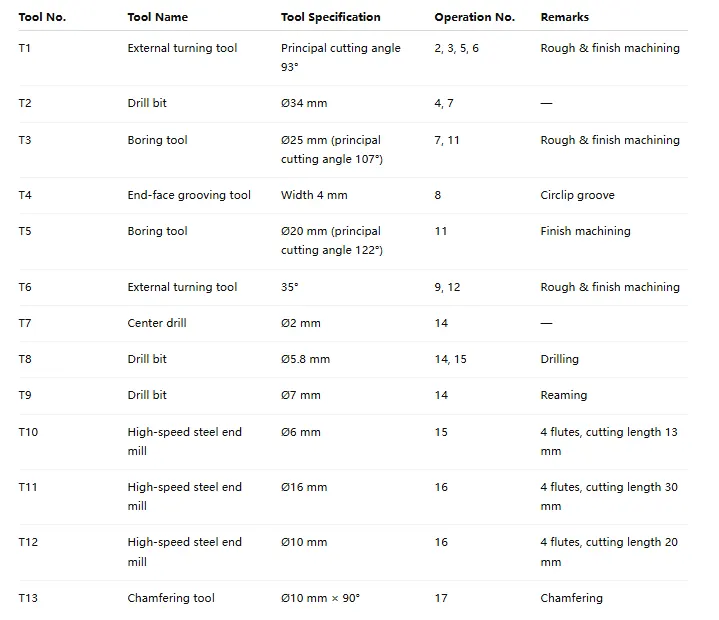
Adhering to the principle of roughing before finishing and machining internal features before external ones during the machining process helps ensure part machining accuracy and improve production efficiency.
The machining allowances and process dimensions for the lower housing are shown in Table 3.
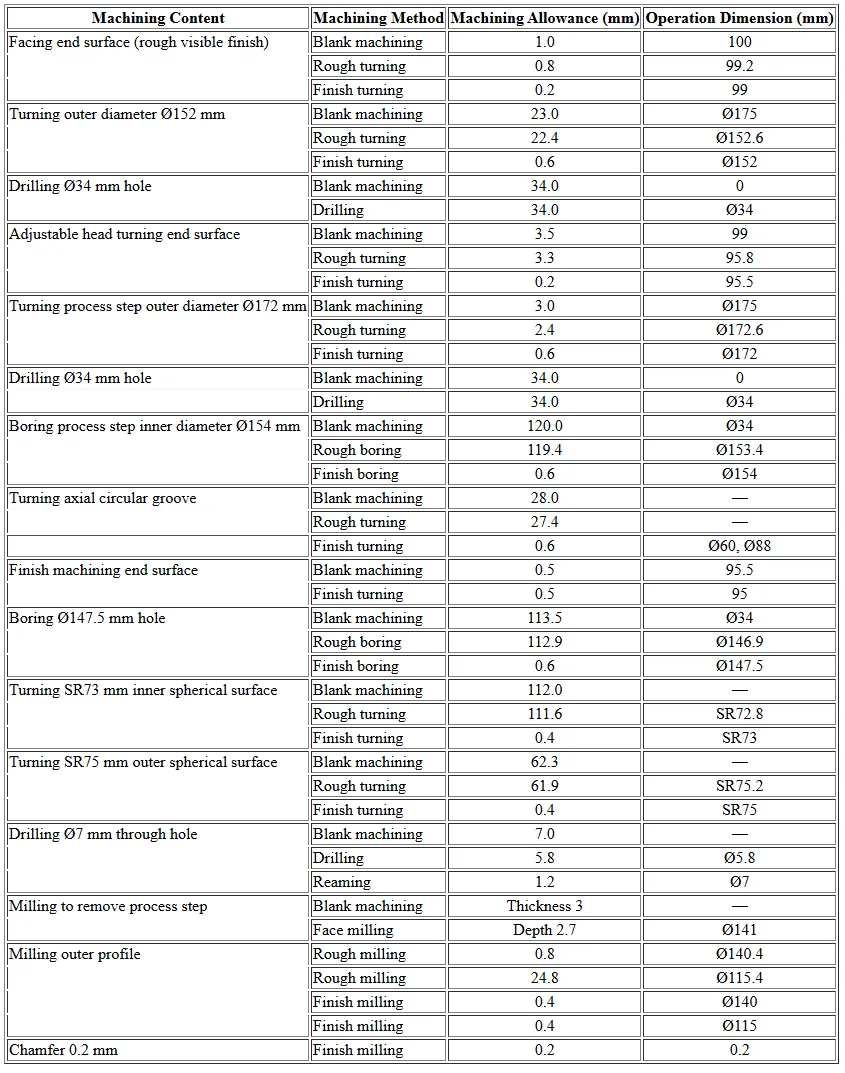
Leveraging the adaptability and flexibility of CNC machining, engineers adopt a segmented approach to turn the SR73 mm internal spherical surface in process 11 of the lower housing.
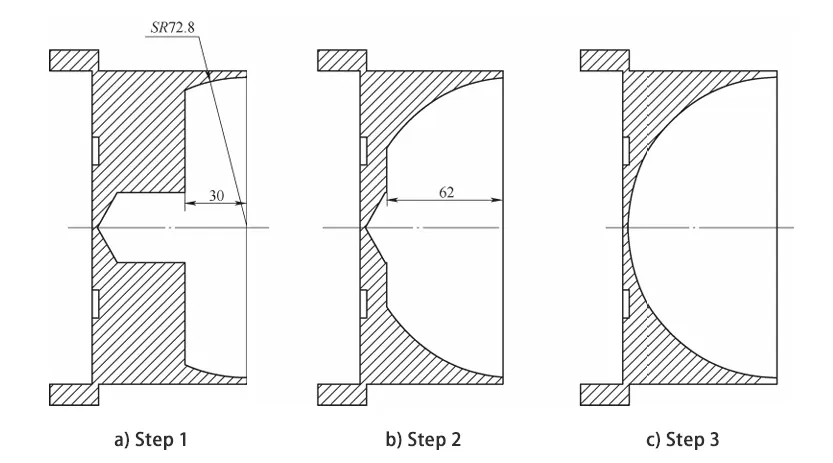
They divide the rough machining of the inner hemisphere into three sections, with the specific steps illustrated in Figure 2.
Using two boring tools with different angles to machine the inner hemisphere arc enhances part precision and surface quality.
Segmented machining maximizes the effectiveness of cutting fluid, reduces thermal deformation caused by cutting heat, extends tool life, and allows the part to gradually and fully release internal stresses, ensuring machining accuracy.
Step 1 (see Figure 2a): Using a rough boring tool with the G71 contour composite cycle command, machine the inner hemisphere arc to a depth of 30mm.
The hemisphere arc dimension is set to SR72.8mm, with a single-side allowance of 0.2mm.
This removes excess material while increasing chip clearance space for subsequent operations.
Step 2 (see Fig. 2b): Continue machining the inner hemispherical arc using the rough boring tool and G71 profile composite cycle command.
With a 0.2mm single-side allowance on the inner hemispherical arc, machine the part to a depth of 62mm; Step 3 (see Fig. 2c): Use the rough boring tool to machine the remaining arc section to a depth of 72.8 mm.
Finally, employ the finish boring tool to machine the part to the inner hemisphere arc dimension of SR73 mm.
Due to a 147.5mm diameter, 1.25mm deep step present on the inner hemispherical arc, direct measurement of its dimensions is impossible.
By analyzing the drawings, engineers incorporate part tolerances into the machining program.
They use a precision boring tool to simultaneously cut the step and form the inner hemispherical arc.
This approach allows them to verify that the hemispherical arc dimensions are within tolerance by inspecting the step’s dimensional accuracy.
Leveraging the high production efficiency of CNC machining, engineers adopt the milling method in process 15 of the lower housing to remove the machining step.
It is evident that the large cutting allowance inevitably increases tooling costs and reduces production efficiency.
Furthermore, due to the part’s poor rigidity, the internal stresses accumulated from heavy cutting conditions constantly compromise the quality of thin-walled components.
Therefore, selecting the appropriate machining method becomes critical for this process.
The final solution involves removing the step using helical ramp milling.
This approach reduces tooling costs, significantly shortens processing time, and minimizes the impact of internal stresses on thin-walled part deformation.
Figure 3 illustrates the milling process used to remove the step in Process 15.
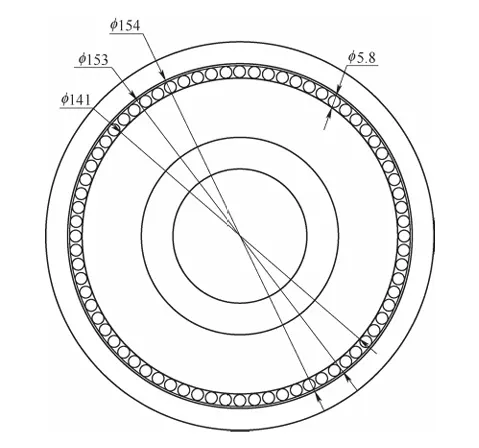
Step 1:Engineers use a φ6 mm milling cutter and employ a helical ramp milling process along the inner diameter (φ154 mm) of the process step to mill a ring groove (outer diameter φ153 mm, inner diameter φ141 mm), leaving a 0.3 mm allowance at the bottom.
This CNC machining method minimizes tool contact force on the part, preventing deformation caused by excessive stress.
Step 2: Using a φ5.8mm drill bit, drill holes along the annular groove, leaving a gap between each hole.
Step 3: Use a flathead screwdriver to chisel through the connecting sections between holes, removing the process step.
The machining of lower housings employs both manually written macro programs and automatically generated programs using software such as NX and Mastercam.
By leveraging the strengths of each approach and integrating manual and automated programming, we achieve rapid and efficient results.
Manual programming is a type of CNC programming where all steps—from analyzing part drawings, determining machining processes, performing numerical calculations, writing part machining programs, creating control media, to program verification—are completed manually.
It requires programmers to not only be familiar with CNC commands and programming rules but also possess CNC machining process knowledge and numerical calculation skills.
For parts featuring holes, columns, grooves, and similar geometric elements, manually creating macro programs offers speed, accuracy, broad applicability, and reduced machine tool memory usage.
For instance, Operation 15 employs a manually developed spiral ramp milling macro to remove process steps.
This approach ensures uniform tool loading during feed, minimizing tool wear and thereby lowering tooling costs.
Helical ramp milling employs a layer-by-layer milling approach.
The program allows flexible setting of the cutting depth (Q) for each layer according to machining requirements, without needing to consider divisibility, ensuring machining to the specified depth. The macro program is as follows.
0999;
#5=[#1-#3]/2; Calculate annular groove radius
G52 X#24 Y#25; Offset local coordinate system to annular groove center coordinates
G90 G80 G40 G0 X#5 Y0; Rapid traverse to annular groove X coordinate, Y0
G1 Z[#18+2]F1000; Linear interpolation at F1000 to R+2 plane
G1 Z#18 F150; Linear interpolation at F150 to R starting plane
#6=-#26+#18; Calculate groove depth
#7=FIX[#6/#17]; Calculate number of grooves by rounding
#8=1; Assign value 1 for 1 revolution
WHILE[#8LE#7]DO1; When revolutions ≤ total revolutions, execute program segments between DO1 and END1
G3I-#5Z[#18-[#8*#17]]F#9; Mill annular groove counterclockwise per revolution
#8=#8+1; Increment by 1 revolution
END1; End of program segment 1
G3I-#5Z#26F[#9/2]; At final groove depth, perform finishing cut at F/2
G3I-#5Z#26; Repeat
G90 G80 G40 G0 Z100; Rapid traverse to Z100
G52 X0 Y0; Set local coordinate system to X0, Y0
M99; Subroutine end
The calling method in the CNC program is:
G65 P999 X0 Y0 Z-2.8 R0 Q0.5 A153 C6 F180
Where X is the X-coordinate of the center of the circular groove;
Y is the Y-coordinate of the center of the circular groove;
Z is the Z-coordinate of the circular groove;
R is the starting plane of the circular groove;
Q is the cutting depth per revolution (arbitrarily set);
A is the major diameter of the circular groove;
C is the tool diameter;
F is the feed rate.
Engineers contrast automatic programming with manual programming.
It utilizes specialized computer software to generate CNC machining programs.
Programmers only need to input part drawing specifications using CNC language, after which the computer automatically performs numerical calculations and post-processing to generate the part machining program.
Engineers then transmit the program directly to the CNC machine tool via communication channels to control its operations.
In modern machining manufacturing, automatic programming has become the primary source of programs and an essential component of contemporary machining processes.
For example, engineers can automatically program the external contour milling operation (Process 16) using software such as NX or Mastercam.
The machining of the lower housing requires fixtures for numerous processes.
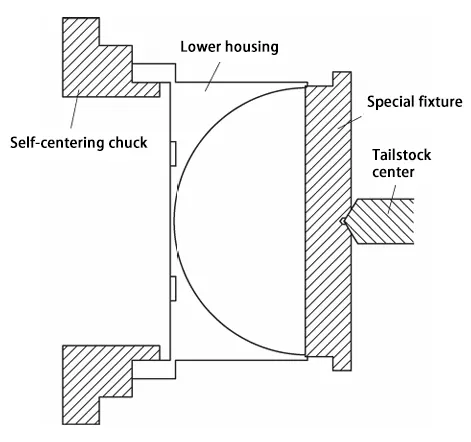
For instance, during Process 12 (turning the outer spherical surface), as the outer hemispherical arc gradually forms into a 2mm-thick thin wall, the workpiece’s rigidity progressively deteriorates.
Under cutting forces (particularly radial cutting forces), vibration and deformation easily occur, compromising dimensional accuracy, positional accuracy, and surface roughness.
This also adversely affects tool life. A specialized fixture is required, consisting of a locating circle at one end and a center hole at the other.
Engineers use a φ147.5 mm circle as the locating circle and support the workpiece with the tailstock center of the machine tool via this fixture, effectively countering vibration and deformation.
The clamping arrangement for the dedicated fixture in Process 12 is shown in Figure 4.
Processes 14, 15, 16, and 17 are all machining center operations.
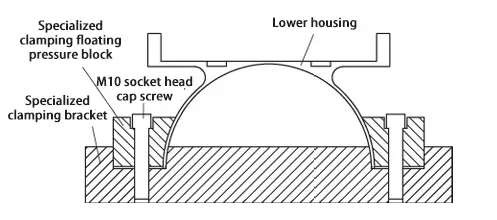
The lower housing’s hemispherical thin-walled end exhibits poor rigidity, making part clamping the key challenge for these processes.
Engineers must design a fixture that is both simple and quick to set up and effectively controls deformation.
The fixture setup for processes 14, 15, 16, and 17 is shown in Figure 5.
The specifications for the dedicated fixture are as follows.
1) The two upper clamping blocks are used to secure the workpiece.
An SR75mm arc surface is milled on the inner side of the clamping blocks to ensure tight contact between the blocks and the outer hemispherical arc of the workpiece.
2) The lower support bracket cavity is 15mm deep with a 15mm-high central protrusion.
An SR73mm arc surface is milled on the protrusion to ensure tight contact with the part’s inner hemispherical arc.
3) The two M10 threaded holes on the left and right sides beneath the support bracket allow the clamping block to secure the part to the bracket using hexagon socket head cap screws.
4) The two M10 threaded holes on the left and right sides above the support bracket enable bolts to push the clamping block out from the rear after part machining, facilitating part removal.
Based on the material properties and machining characteristics of the lower housing component, this paper establishes the manufacturing process and heat treatment method for 1Cr18Ni9Ti stainless steel.
It selects appropriate roughing reference surfaces and subsequent finishing reference surfaces, develops a detailed machining sequence and process plan, determines cutting parameters, and rationally selects equipment, tools, and machining methods to reduce the production cycle.
In terms of CNC machining, fixture design, and macro programming, this approach has simultaneously reduced processing costs and enhanced machining efficiency, laying a foundation for future production of similar components.