
Non-standard tee fittings demand high precision in military and medical applications. Traditional manufacturing methods like casting and welding struggle to achieve high-quality inner wall roughness, which can adversely affect flow rates.
This paper studies this product, utilizing an advanced LM600 five-axis machining center for physical processing.
This approach enhances both the external form and internal quality beyond what traditional methods can achieve.
It also fully leverages the superior capabilities of five-axis simultaneous machining technology and Powermill software in programming complex component manufacturing.
Five-Axis Machining of Irregular Tee Fittings
Irregular tee fittings feature highly complex geometries, combining curved transitions, intersecting cavities, and multi-directional machining surfaces.
These characteristics make them a representative challenge in precision manufacturing.
Achieving both external contour accuracy and internal dimensional consistency requires advanced machining strategies that go beyond the limitations of conventional three-axis or four-axis equipment.
Technical Challenges and Key Focus Areas
The complex external shape and internal structure feature numerous undercut surfaces, requiring multi-angle conversion for comprehensive machining.
Existing three-axis or four-axis equipment struggles to accomplish this task.
Even with custom fixtures, multiple setups result in low overall efficiency and subpar machining quality.
To achieve smooth external contours and internal walls, five-axis machining with a single setup is essential.
This approach must resolve fixtureing and programming challenges.
The part’s structure necessitates a 3+2 fixed-axis configuration for localized roughing, multi-axis drilling, and five-axis simultaneous machining of both external contours and internal walls.
Concurrently, surface finish improvement is required, making this a representative five-axis machining case study.
Processing and Fixturing Solution
1. Fixturing Solution
The raw material for this product is a φ110mm x 125mm round bar, made of 2A12 aluminum alloy.
A 45# steel fixture designed for use with a three-jaw chuck is employed.
The end face core is positioned by locking the blank from the rear with three screws, restricting movement to 6 degrees.
The tool setting point Z-value is set at the core end face, while the X and Y values are set at the core center, ensuring the workpiece process datum coincides with the machining datum.
2. Required Tooling Preparation
(1) T1D16 end mill;
(2) T2D8 end mill;
(3) T3D10A 90° end mill;
(4) Center drill, T4DZ2.3A 118° drill bit;
(5) T5DZ4A 118° drill bit;
(6) T6D8R4 ball-nose end mill.
Machining Processes and Part Programming
1.Rough Machining
The blank is a bar-type material. Rough machining only requires roughing the front face to the upper edge of the base.
Using a 3+2 fixed-axis configuration, rotate the tool axis to a position perpendicular to each pipe end face to perform roughing on the residual model.
Select the model area clearing strategy. Pay attention to avoiding collisions between the spindle head, fixture, and worktable during tool spatial movement transitions.
Specific parameters are as follows.
Tool: φ16mm aluminum roughing face mill, 80mm length with 62mm protrusion.
Machining parameters: Spindle speed S3800, Feed rate F2500.
Machining Strategy: Model area clearance strategy. Tool Axis: 3+2 fixed axis.
Roughing Pass Spacing & Step: ae: 12mm, ap: 1.5mm, Allowance: 0.3mm.
Tool-Workpiece Clearance: Clamping gap, tool holder gap: 2mm. Primary programming approach involves 3+2 axis positioning for roughing.
Establish a cylindrical rapid traverse safety zone, defining the vector direction perpendicular to the programming coordinate system.
2. Secondary Roughing
After primary roughing, as shown in Figure 1, substantial stock remains distributed across undercut surfaces and areas inaccessible to primary tools.
A φ8 flat-end end mill is selected for secondary roughing in confined zones, while a φ10 A90° NC center drill is used for center drilling. Tool parameters are as follows:
Tooling: φ8 aluminum end mill, tool length 75mm, protrusion 35mm; φ8 extended end mill, tool length 100mm, protrusion 60mm; φ10A90° NC center drill, tool length 50mm, protrusion 25mm.
Tool Parameters: φ8 end mill: Spindle speed S6500, Feed rate F3000; φ10A 90° NC center drill: Spindle speed S3500, Feed rate F200.
Machining Strategy: Residual model area clearance, contour finishing, single-pass peck drilling. Cutting Mode: Arbitrary path, from outer to inner. Step Size: ae: 6mm, ap: 0.5mm.
Spindle Configuration: 3+2 fixed-axis. Machining Allowance: 0.15mm. Tool-to-Workpiece Clearance: Clamping gap, tool holder gap 2mm.
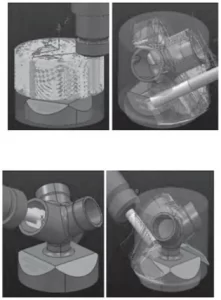
3. Semi-Finishing and Finishing
After the second roughing operation, the use of flat-bottomed cutters results in stepped residual stock of varying heights on areas with concentrated curved surfaces.
A φ8 ball-nose end mill is required to remove this surface residual stock, leaving a uniform 0.08mm allowance on all machined surfaces for the finishing operation.
4. Finishing
Since the cradle-type five-axis machining center spindle head can process workpieces at any angle greater than 0° pitch, the optimal tool angle relative to the workpiece is selected.
For undercut cavity positions, machining is performed using a tilted tool orientation.
Here, a φ6 ball-nose end mill is chosen for finishing, with the toolpath trajectory shown in Figure 2. Specific parameter settings are as follows.
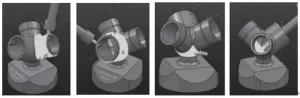
Cutting Tools: φ6 aluminum finishing ball end mill, tool length 80mm, extended shank 80mm, protrusion 40mm;
φ8 aluminum finishing ball end mill, tool length 80mm, extended shank 80mm, protrusion 45mm;
φ4 A118° drill bit, tool length 60mm, protrusion 35mm; φ10 A90° NC center drill, tool length 50mm, protrusion 25mm.
Tool Parameters: φ6 ball end mill: Spindle speed S11000, Feed rate F2200;
φ8 ball end mill: Spindle speed S10000, Feed rate F2000;
φ4A118° drill: Spindle speed S1300, Feed rate F60; φ10A90° NC center drill: Spindle speed S3000, Feed rate F560.
Machining Strategy: Surface projection, point projection, 2.5D flat chamfering, profile contour machining.
Cutting Mode: Climb milling with helical feed. Surface pitch: ae: 0.15mm.
Tool axis: Outer contour: Point-oriented, Inner wall: Self-pointing.
Machining allowance: 0.0mm. Tool-to-workpiece clearance: Clamping gap, tool holder gap 1.5mm.
When using self-point and point-facing tool axis controls, enable automatic collision avoidance and restrict the pitch angle orientation in the tool axis limits to 10°–90°.
If toolpaths appear sparse or overlap, adjust the tool axis point position to generate optimal toolpaths.
5. Simulation
Load the simulation machine tool to simulate the machining results of all tool paths, checking for any overcutting or collision occurrences.
6. Finished Product Processing
After program verification confirms safety, proceed directly to machine operation.
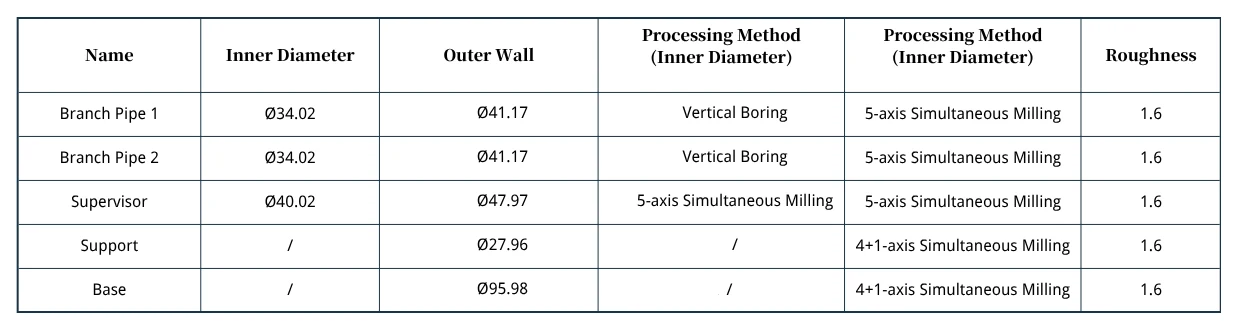
During machining, perform in-process inspection of critical dimensions as shown in Table 1, including tolerances for three internal bore dimensions and the outer diameter.
Utilize the HEIDENHAIN probe for measurement.
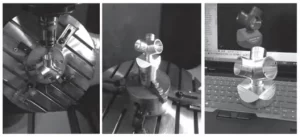
If any dimension falls below tolerance, adjust the program locally. The final sample part is depicted in Figure 3.
Conformity Analysis
Based on the coordinate measuring machine (CMM) data corresponding to the above table, dimensional accuracy and geometric tolerances are within specified limits.
Theoretical dimensional requirements are met: surface roughness at 1.6 μm satisfies application requirements.
Comparison between traditional and five-axis machining processes is as follows.
Traditional process: The main and branch pipes form a 30° angle with the horizontal base plane, featuring a reverse-threaded surface.
Roughing requires multi-directional tool axis rotation to maintain perpendicularity to each machined surface.
Using a 3-axis or 4-axis machining center only permits front-side roughing or 90° fixed-axis roughing.
It is impossible to achieve optimal tool orientation perpendicular to all three pipes within a single setup.
Particularly challenging are the two reverse-taper features on the main pipe.
This necessitates either custom fixtures or an indexing head with tilt capability, requiring multiple setups.
The final shape is achieved through multiple tool changes at different angles, introducing inherent errors and unavoidable tool change marks that compromise surface quality and roughness.
Comparison with 5-axis simultaneous machining:
Under a single setup, the 3+2 fixed-axis configuration requires only four swivel adjustments to achieve tool axis perpendicularity to the machining zone, maximizing material removal.
Most crucially, during both external contour and internal wall machining, the 5-axis simultaneous mode ensures all feature surfaces are continuously milled with the tool maintaining optimal contact.
This eliminates discontinuous cutting or angle-shifting tool changes, guaranteeing the external shape is achieved in a single operation.
The resulting dimensions and precision are highly satisfactory, with exceptionally high surface roughness.
Conclusion
Through this research, we demonstrate that advanced five-axis machining technology applied to tee fittings enables precision processing of high-accuracy products.
Compared to traditional methods, five-axis machining achieves maximum stock removal around the entire workpiece in a single setup.
For complex-shaped components with stringent requirements, adjusting the tool axis orientation ensures continuous milling contact with the feature surface.
This guarantees single-setup completion without multiple clamping operations, eliminating positioning errors from repeated setups and ensuring excellent surface finish.
Thus, five-axis technology demonstrates high efficiency, precision, and adaptability for complex part machining.