How to efficiently machine shaped parts on CNC mill-turn machines?
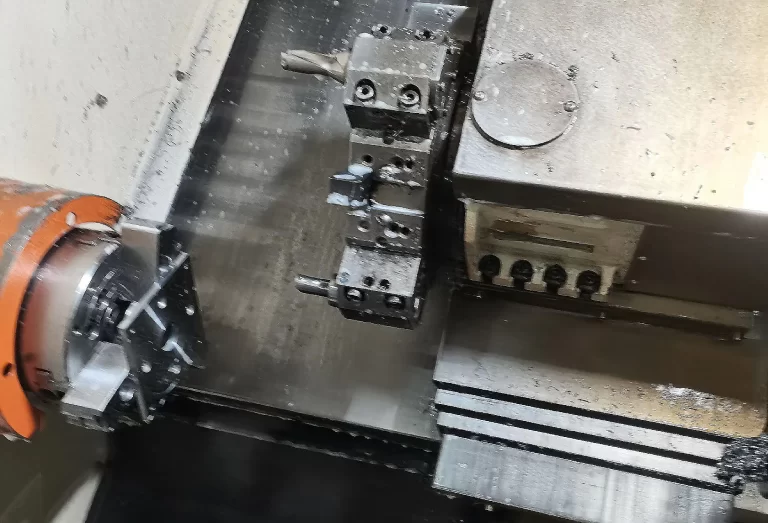


Turning-milling composite machining centers can perform integrated turning and milling operations, reducing clamping and process steps while enhancing machining efficiency.
Manufacturers widely adopt them in modern mechanical processing.
These centers feature complex structures with numerous axes.
Collisions or abnormal external forces can severely compromise the equipment’s geometric accuracy, causing deviations in the concentricity of the main and sub-spindles.
In severe cases, this may even result in complete loss of geometric precision.
Traditionally, addressing such issues required contacting specialized engineers for adjustments, a time-consuming and labor-intensive process.
Practitioners have developed practical techniques through accumulated experience, significantly reducing adjustment time and labor intensity and effectively ensuring the smooth operation of machining production.
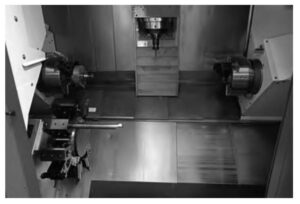
The working area of EMCO’s HYPERTURN65 turning and milling composite machining center, as shown in Figure 1, features dual spindles, a single-sided lower tool turret, and a high-speed milling spindle.
Combined with the linear axes driving the high-speed milling spindle and turret movement, it possesses a substantial number of axes.
The machine’s main and sub-spindles demand high precision in speed control and angular positioning.
During operation, the main spindle, sub-spindle, high-speed milling motorized spindle, and lower tool turret achieve coordinated movement.
This complex, high-precision structure necessitates stringent adjustments for machine accuracy.
During operation, an error in the operator’s coordinate calculations caused a collision during machining.
While no mechanical damage was found upon inspection, the concentricity, parallelism, and other related accuracies of the main and sub-spindles underwent significant changes.
Measurements revealed severe deviations of approximately 1 mm.
While contacting the manufacturer’s engineers, we actively explored methods to restore accuracy.
Ultimately, we successfully completed the precision adjustment and restoration of this machine tool.
Multi-axis adjustment first requires establishing a reference axis.
Technicians calibrate subsequent axes in a logical sequence after adjusting the reference axis.
Select the milling axis (Z-axis) as the reference axis and proceed with adjustments in the following order: spindle → sub-spindle → milling axis → turret.
Precision inspection of main and sub-spindles primarily involves measuring radial runout, axial runout, and end runout.
During inspection, first clean the spindle bore and end face.
Use a dial indicator for measurement.
Attach the dial indicator to the milling spindle, press the indicator head against the spindle bore, and manually rotate the spindle to measure radial runout.
Technicians detect axial play using a calibration rod with a steel ball.
Place the steel ball into the tapered hole at the rod’s end, press the dial indicator onto the ball, and rotate the spindle to measure axial play.
Measure the spindle end face with the dial indicator while rotating to obtain end runout (Figure 2).
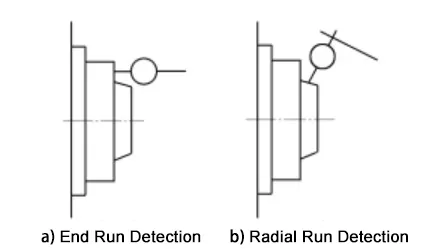
Verification testing confirms the above spindle accuracy falls within permissible error limits.
Technicians subsequently mounted a calibration bar on the spindle to inspect the upper and side profiles, as well as the remote radial runout.
Results indicate the remote radial runout remains within 0.01 mm, while the upper and side profiles exhibit significant deviation requiring adjustment.
Technicians measured the coaxiality between the main and sub-spindles after completing the main spindle precision adjustment.
Due to the collision, the impact forces affected both spindles, inevitably altering their concentricity.
Therefore, the adjusted main spindle must serve as the reference to accurately complete the coaxiality precision adjustment for both spindles.
When adjusting spindle precision, first loosen the spindle housing clamping screw (do not fully loosen it; instead, after loosening, reverse-rotate it half a turn to maintain slight tension).
Initially adjust the vertical direction perpendicular to the spindle’s horizontal plane.
Since the upper generatrix error reached 0.04/300 mm—a significant deviation—precision adjustment could not be achieved solely by adjusting the clamping screw.
Technicians employed a copper shim method by inserting a 0.01 mm copper shim near the spindle end.
They then tightened the screw and repeatedly pulled the reference bar to calibrate the main line, ultimately adjusting the upper main line precision to within 0.01/300 mm.
After completing the upper busbar adjustment, the lateral busbar precision required adjustment.
Based on the measured lateral busbar deviation, adjustments were made by manipulating the horizontal adjustment screws.
Technicians fine-tuned the lateral busbar by repeatedly pulling and calibrating it with the calibration rod until its precision fell within 0.01/300 mm.
Following the spindle precision adjustment, the coaxiality between the main and auxiliary spindles needed calibration.
Adjustment method: Clamp a long dial indicator rod onto the main spindle.
Press a dial indicator against the inner bore of the sub-spindle.
Rotate the main spindle to measure the concentricity deviation between the main and sub-spindles.
Through repeated measurement and adjustment of the regulating screws, bring the concentricity of the sub-spindle to within the permissible error range.
After adjustment, lock the fastening screws securely.
The milling spindle primarily verifies parallelism with the X-axis.
Using an HSK63 mandrel as the calibration rod, attach a dial indicator to the spindle to measure the mandrel’s lateral profile.
Observe the numerical deviation on the dial indicator as it moves between the mandrel’s top and bottom ends by shifting the X-axis.
Measurement results indicate the milling spindle’s parallelism deviation with the X-axis falls within permissible tolerance limits.
If technicians need to adjust the spindle, they loosen the spindle locking screw and tap the spindle with a wooden mallet to induce vibration.
Through iterative adjustment and measurement, ultimately align the milling spindle parallelism with the X-axis within acceptable error margins.
After completing the adjustment, tighten the fastening screw.
Re-inspect the alignment after tightening to ensure the fastening process did not compromise precision.
Following a collision on the HYPERTURN65 turning-milling composite machining center, the concentricity accuracy of the lower turret tool disc exhibited significant deviation.
Remove the turret end cover. Attach a dial indicator to the milling spindle, with the indicator needle pressed against the turret’s center fixing hole.
Rotate the turret to measure its centering deviation. Measurement revealed a deviation of 1 mm, all originating from the clearance of the fixing screws.
Technicians loosened the central fastening screws to adjust the turret disc centering deviation.
A wooden mallet was used to tap the turret for centering adjustment.
Technicians fine-tuned the turret disc centering accuracy to within 0.015 mm through repeated measurement and tapping cycles.
The fastening screws were then tightened to complete the turret disc adjustment.
This concluded the precision adjustment for all axes of the turning-milling composite machining center.
The JOBS gantry milling machine is an imported machine tool procured in 2002, equipped with a Siemens 840D CNC system.
It employs a fixed worktable with gantry-moving motion configuration, featuring an overall gantry frame structure.
Technicians bolt the crossbeam and columns together, designing the gantry crossbeam as a split structure.
During operation, force application can cause uneven movement between the two columns, leading to verticality deviation between the X and Y axes.
Over extended use, these deviations gradually accumulate, degrading the JOBS gantry milling machine’s geometric accuracy and compromising machining precision.
The X-axis employs dual-screw, dual-motor servo control with dual-encoder feedback.
The system configures the X-axis for linked operation, preventing operators from independently controlling the X1 and X2 axes.
Research indicates that modifying parameters to disable X-axis linkage significantly simplifies the traditional X/Y axis perpendicularity adjustment process.
This approach not only reduces risks but also substantially improves adjustment efficiency.
When accuracy issues previously occurred on JOBS gantry milling machines, a square was first used to measure the perpendicularity between the X and Y axes.
This measurement served as the basis for adjusting the X1 and X2 axes.
The adjustment procedure was as follows: Loosen the connecting screws between both side columns and the gantry crossbeam, return the X-axis to zero, and utilize the X-axis zero return point as an adjustment tool to level the movement deviation of the X1/X2 axes.
This adjustment process was time-consuming, labor-intensive, and carried the risk of runaway movement during zero return.
After extensive consultation and research, engineers released the binding between the X1 and X2 axes by modifying axis parameters to address this issue.
This enabled independent control of the X1 and X2 axes, effectively simplifying the adjustment procedure.
Consequently, it reduced labor intensity while enhancing operational efficiency.
First, use a square to measure the verticality of the X/Y axes.
Then, loosen the connecting screws between the gantry columns and crossbeam on both sides.
Modify the axis parameter “37100 GANTRY_AXIS_TYPE” to “0” to unlock the X1/X2 axes, enabling independent control of these axes.
Control the movement of the X1/X2 axes based on the verticality deviation values measured by the square ruler to level the X/Y axis verticality deviation.
Technicians repeat this process multiple times until they eliminate the verticality deviation.
After completing the above steps, retighten the screws, restore the original parameter settings, and restart the system.
Compared to previous adjustment methods, this new approach achieves leveling through fine-tuning, reducing risks while enhancing efficiency.
After completing the X/Y axis perpendicularity adjustment, inspection using a 400×400 square gauge revealed an X/Y perpendicularity of 0.005/400 mm.
The machine tool’s machining accuracy now meets operational requirements.
Additionally, engineers resolved the excessive load on the X1/X2 axis motors that resulted from the previously excessive X/Y axis perpendicularity.
Adjusting the geometric accuracy of CNC equipment significantly impacts machining precision, particularly for imported equipment like turning-milling composite machining centers.
These machines feature multiple axes and high precision, making their accuracy adjustments intricate, complex, and demanding.
Similarly, large-scale machining equipment such as JOBS gantry mills, with their substantial spans and weights, also require rigorous adjustment procedures.
During the adjustment process of turning-milling centers, consulting manufacturer engineers and tailoring the sequence and methods of precision adjustments to the equipment’s characteristics is crucial for enhancing efficiency and ensuring accurate calibration.
Traditional adjustment methods for gantry milling machines are time-consuming and labor-intensive.
Technicians significantly reduce the time and manpower required for equipment calibration by optimizing adjustment protocols.
This enhances equipment utilization rates and safeguards production schedules.