How to efficiently machine shaped parts on CNC mill-turn machines?


The axle (also known as the axle housing) is a core component of the vehicle chassis’ running gear system, performing critical mechanical power transmission and load-bearing functions within the overall vehicle structure, as shown in Figure 1.
Structurally, the axle achieves flexible connection to the vehicle frame via the suspension system.
Its ends precisely mount wheel assemblies through hub units, forming a complete power transmission chain.
As the pivotal hub for force and torque transfer, the axle must simultaneously withstand complex loads from three dimensions: vertical body weight and impact loads, longitudinal driving/braking torque, and lateral turning forces.
This multidirectional loading characteristic makes it a critical assembly influencing the vehicle’s overall performance.
Its quality and precision directly determine the vehicle’s performance and load-carrying capacity, significantly impacting the vehicle’s power, stability, and load-bearing capabilities.
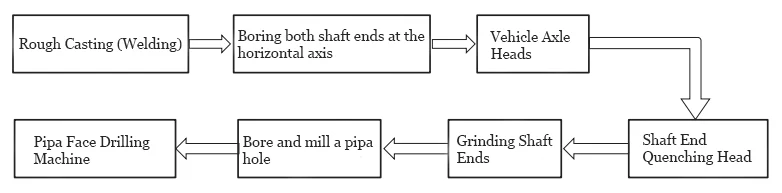
Bridge housing machining primarily involves processing the two support shafts (i.e., axles), boring and milling the bearing holes, and drilling screw holes.
Figure 2 illustrates the main process steps.
The two axle heads of the axle housing serve as the mounting reference for wheel hubs and bearings.
Their geometric accuracy (roundness, cylindricity) and positional accuracy (coaxiality, axial runout) directly impact wheel dynamic balance and driving stability.
Insufficient machining accuracy may cause poor component dynamic balance.
For instance: – Excessive shaft end roundness (>0.02 mm) generates centrifugal forces during high-speed wheel rotation, leading to steering wheel vibration or vehicle body resonance.
Abnormal bearing wear causing non-compliant shaft end cylindricity (>0.01 mm) results in uneven force distribution on the bearing inner ring, shortening its service life.
Wheel alignment inaccuracies, resulting in shaft end coaxiality deviation (>0.05 mm), may cause uneven tire wear and compromise vehicle straight-line stability.
Therefore, machining both shaft ends is the core process determining axle housing quality, requiring strict precision control.
Specialized axle housing lathes are costly and lack flexibility, being suitable only for large-scale production of a single product type.
For small and medium-sized enterprises or multi-product, small-batch production models, purchasing dedicated machine tools is economically inefficient.
Designing specialized tooling and fixtures enables manufacturers to complete these machining processes on standard CNC lathes.
The purpose of using tooling is to ensure stable part quality, enhance production efficiency while meeting technical requirements, and achieve favorable economic benefits.
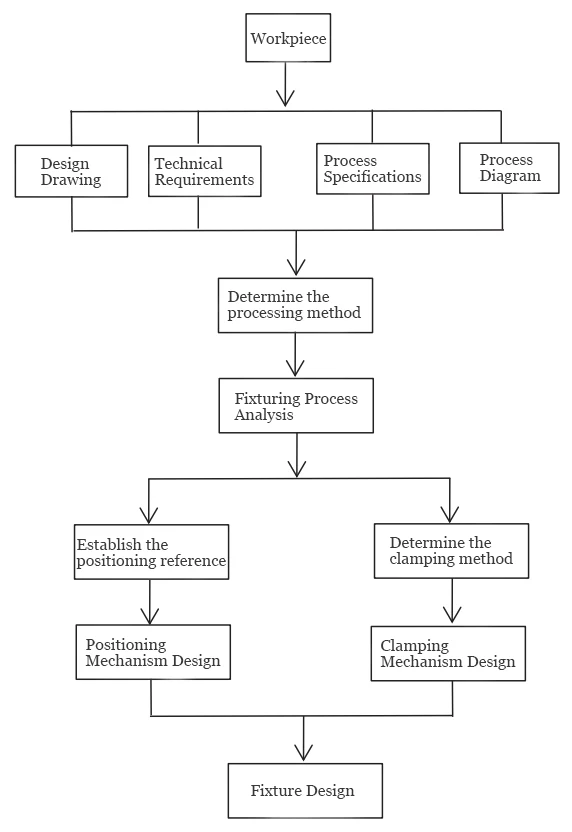
Fixture design typically follows the steps illustrated in Figure 3: First, determine the machining method based on the workpiece’s design drawings, technical requirements, process specifications, and process diagrams.
Analyze the workpiece’s clamping process, establish locating benchmarks and clamping methods, and proceed with fixture design.
The axle housing is a critical component affecting vehicle stability and drivetrain performance. Its irregular shape and precise shaft features make turning the preferred machining method to ensure accuracy, surface finish, and assembly reliability.
Manufacturers form bridge housing components through casting, steel plate stamping and welding, and classify them as irregular shaft-type parts.
Their machining process requires rational positioning and clamping, making turning the preferred processing method.
As the support shafts serve as critical mounting points for wheel hubs and bearings at both ends of the bridge housing, their machining accuracy directly impacts wheel alignment and driving smoothness.
The typical machining sequence includes: Finish turning:
Employing high-precision CNC lathes for precision machining to ensure shaft diameter tolerances within ±0.02 mm and surface roughness Ra ≤ 1.6 μm;
Grinding: Using external cylindrical grinders for precision grinding of bearing mounting surfaces, ensuring roundness ≤ 0.005 mm to meet bearing assembly requirements;
Heat treatment strengthening: Certain heavy-duty axles undergo high-frequency quenching or carburizing to enhance shaft neck wear resistance and fatigue life.
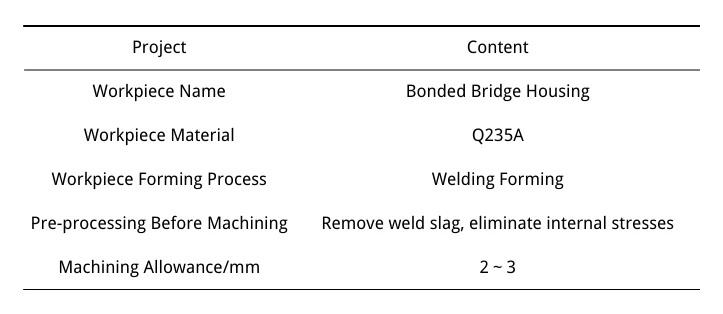
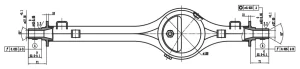
The basic information of the workpiece is shown in Table 1. The machining drawing of the welded bridge housing is shown in Figure 4.
Based on the workpiece’s structural characteristics and precision requirements, the process employs a vertical four-station tool turret to enhance processing efficiency and ensure quality.
Driven by servo motors, the turret enables rapid and precise tool position switching with repeat positioning accuracy of ±0.005 mm.
The process divides the machining sequence into two stages: rough machining and finish machining.
The roughing stage employs high feed rates and large cutting depths to rapidly remove stock, utilizing wear-resistant carbide tools.
The finishing stage adopts small cutting depths and feed rates with high-precision diamond tools to ensure the workpiece surface roughness meets accuracy requirements.
This staged approach maximizes tool performance while effectively controlling deformation, guaranteeing dimensional accuracy and geometric tolerances.
Additionally, the four-station tool holder design enables simultaneous clamping of multiple tools, reducing tool change time and significantly boosting production efficiency.
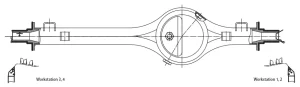
Process 1 is illustrated in Figure 5.
Station 1:The process uses the unmachined bore of the bridge housing blank as the rough reference and achieves automatic centering and clamping through a hydraulic expansion mandrel or an adjustable internal support fixture, ensuring an initial positioning concentricity of ≤ 0.1 mm.
A right-hand tool rough-turns the outer diameter, rapidly removing most stock while leaving a finishing allowance of 0.5–0.8 mm, with surface roughness Ra ≤6.3 μm.
Station 2: Right-hand tool performs finish turning of the outer diameter.
Operators adjust the cutting parameters to ensure the workpiece surface roughness meets precision requirements.
Station 3: Left-hand tool performs rough turning of the outer diameter, rapidly removing most of the stock.
Station 4: Left-hand tool performs finish turning of the outer diameter, ensuring the workpiece surface roughness meets precision requirements.
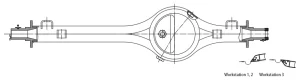
Process 2 is shown in Figure 6. Using the finished outer diameter of one shaft end as the reference, complete positioning and clamping.
Support the other end’s finished outer diameter with a center rest.
At Station 1, rough-turn the inner diameter to rapidly remove most of the stock, leaving a finishing allowance of 0.5–0.8 mm with a surface roughness Ra ≤ 6.3 μm.
Station 2 adjusts cutting parameters for finishing the inner diameter, ensuring the workpiece surface roughness meets precision requirements.
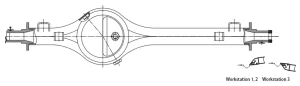
Process 3 is shown in Figure 7. Operators turn over the workpiece and use the finished outer diameter of the opposite shaft end as the reference for positioning and clamping.
The center rest supports the finished outer diameter of the opposite end.
At Station 1, operators perform rough turning of the inner diameter to rapidly remove most of the stock, leaving a finishing allowance of 0.5–0.8 mm and achieving a surface roughness of Ra ≤ 6.3 μm.
Station 2 adjusts cutting parameters for finishing the inner diameter, ensuring the workpiece surface roughness meets precision requirements.
Effective fixture design is essential for ensuring machining accuracy, repeatability, and operational efficiency.
For axle housing components, the fixture must not only secure the workpiece firmly but also allow for quick setup, adaptability to different part sizes, and integration with automated systems.
Properly designed fixtures reduce vibration, minimize workpiece deformation, and support high-precision turning and grinding operations, forming a critical part of the overall manufacturing process.
To meet these requirements, the fixture design focuses on precision, stability, adaptability, and maintainability, forming the foundation for reliable axle housing machining.
Fixtures must ensure precise positioning, reliable clamping, and excellent precision retention.
High-precision positioning components are tightly fitted to the bridge housing reference surface, with positioning errors controlled within ±0.02 mm.
The clamping mechanism employs a hydraulic/pneumatic linkage system, delivering uniform and stable clamping force to prevent workpiece displacement during machining.
Critical contact surfaces undergo quenching and grinding treatment, ensuring annual wear on locating surfaces remains below 0.01 mm after prolonged use.
Combined with regular precision calibration, this guarantees sustained machining accuracy meeting process requirements for 5 years.
The fixture is easily interchangeable to accommodate bridge housing machining of various dimensions.
Its modular quick-change design enables rapid switching between the spindle front end and fixture modules via standardized interfaces, with the entire changeover process completed within 15 minutes.
Automatic clamping and unclamping reduce machining auxiliary time to meet cycle time requirements.
Equipped with automatic loading/unloading, it enables full automation.
Integrated PLC-controlled hydraulic servo system achieves clamping/unclamping in ≤3 seconds, interlocked with the machine tool CNC system for automated machining cycle control.
Rational fixture design ensures excellent manufacturability and assembly ease.
Wear parts are easily replaceable, facilitating routine maintenance.
Centralized lubrication points and fault diagnosis interfaces are provided; weekly grease replenishment and monthly bolt retightening suffice for routine upkeep.
Based on the machining process analysis, operators can perform processes two and three using a general-purpose CNC lathe with chuck clamping and center support positioning.
Process one requires the design of a dedicated fixture. The fixture must accommodate axle end positioning of the axle housing and internal bore expansion.
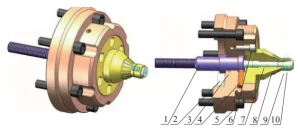
Combining the above analysis with fixture design principles, the axle housing fixture design is shown in Figure 8.
The axle housing fixture primarily consists of the following components: pull studs, connecting plates, sealing rings, anti-rotation pins, screws, expansion mandrel shafts, locating bodies, springs, and expansion blocks.
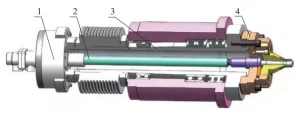
Operators mount the fixture on the lathe spindle, as shown in Figure 9, and rigidly connect it to the spindle using a high-precision flange.
An integrated hydraulic rotary cylinder at the spindle tail end links with the fixture’s expansion mandrel shaft through a tie rod, enabling axial clamping and release actions.
Manufacturers construct the entire fixture from alloy steel and apply quenched treatment.
Critical mating surfaces (such as tapered surfaces and locating holes) undergo grinding to ensure dimensional stability during long-term use.
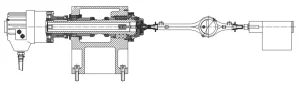
The bridge housing clamping on the lathe is shown in Figure 10.
A gantry manipulator (or operators manually) transports the axle housing to the lathe spindle end position using a dedicated lifting device.
The tailstock hydraulic center extends and mates with the center hole on the axle housing end face to achieve axial pre-positioning.
The housing is centered by the tapered surfaces of the locating fixture and the lathe tailstock center.
The rotary cylinder at the tailstock end tightens the mandrel shaft via a draw pin.
Under the action of the mandrel shaft’s taper, the expansion blocks connected to the mandrel shaft extend radially within the locating fixture’s positioning holes, expanding to clamp the housing bore.
This completes the clamping and positioning of the housing, allowing the lathe’s multi-station tooling to sequentially perform the turning operations.
Upon completion, the workpiece is clamped by a manipulator or manually. The rotary cylinder extends, pushing the mandrel forward.
Under spring force, the expansion blocks retract radially, releasing the clamping of the bridge housing.
The hydraulic tailstock center retracts. Manually or via a manipulator, the workpiece is moved axially along the bridge housing to disengage from the positioning fixture.
The workpiece is then removed, concluding the machining process.
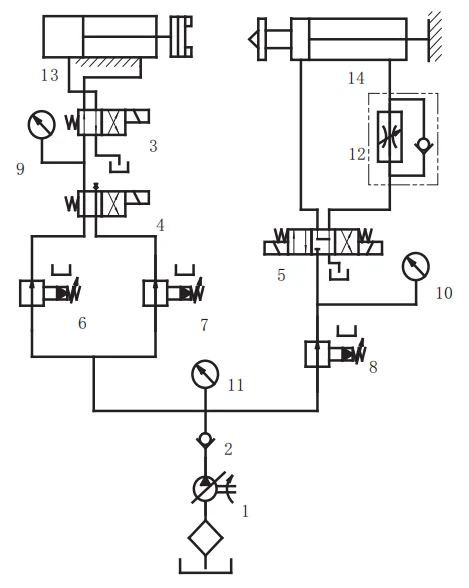
The hydraulic schematic of the fixture is shown in Figure 11. The entire hydraulic system utilizes a variable displacement pump as its power core.
By adjusting its output flow characteristics, it can meet pressure demands under various operating conditions.
The system employs a dual-circuit control architecture, with two independent control circuits each responsible for driving different actuators.
1. The primary control circuit connects to the rotary cylinder via hydraulic lines, primarily controlling workpiece clamping and release.
Upon receiving a clamping command, pressurized hydraulic fluid from the variable displacement pump switches flow direction through a directional control valve.
This drives the rotary cylinder piston clockwise, tightening the chuck to secure the workpiece.
For release, a reverse oil path causes the piston to rotate counterclockwise, releasing mechanical restraint.
2. The second control circuit drives the tailstock’s extension and retraction.
To advance the tailstock, pressurized oil linearly extends the tailstock cylinder piston rod until the center point contacts the workpiece end face.
Retraction occurs by switching the oil circuit via an electromagnetic directional control valve, causing the piston rod to return to its initial position.
Both control circuits achieve logical interlocking through an integrated hydraulic valve manifold, preventing operational interference.
Equipped with pressure sensors for real-time monitoring of circuit loads, this ensures the entire clamping system operates in a safe and reliable state.
1. Apply lubricating grease between the expansion mandrel and locating body; replenish grease periodically via the grease cup on the locating body.
2. Cut fine grooves on the locating taper surface of the locating body to increase friction with the workpiece; perform surface hardening to enhance hardness and wear resistance.
3. Replace locating bodies and expansion blocks with different diameters for workpieces of varying inner diameters.
Locating body specifications are marked on their surfaces and correspond to the bridge housing.
After employing specialized turning fixtures, appropriate cutting parameters and clamping forces were selected.
Machine tools, fixtures, and cutting tools were calibrated, followed by continuous processing of 60 pieces.
Upon completion, the machined parts underwent precision inspections against the bridge housing acceptance standards.
Test results met the technical requirements specified in the drawings, confirming the fixtures fulfilled design specifications.
This specialized fixture for axle housings utilizes tapered surface positioning and expansion clamping to convert standard CNC lathes into dedicated axle housing machining centers.
It meets machining process requirements, enhances processing efficiency, and reduces equipment investment costs. The designed fixture is simple, reliable, and easy to use.
By replacing a series of chucks, it can accommodate machining of axle housings of various specifications and other shaft-type workpieces requiring internal hole positioning and clamping.