How to efficiently machine shaped parts on CNC mill-turn machines?


With the advancement of modern industrial technology, industries are increasingly applying high-strength mechanical equipment.
It is increasingly used in fields such as aerospace and energy power systems.
Assembly and joining technologies are critical components of mechanical manufacturing.
They exert a decisive influence on product performance and reliability.
Currently, related research primarily focuses on optimizing the performance of single joining methods.
It lacks systematic investigations into composite joining technologies.
Therefore, in-depth research into high-strength mechanical assembly and joining technologies is essential.
It plays a significant role in enhancing manufacturing capabilities and improving product competitiveness.
Research on assembly and connection technologies in high-strength mechanical manufacturing focuses on the DZ2040 CNC gantry five-face machining center.
Germany’s Waldrich Coburg produces this machine.
The high-precision CNC machine adopts an irregular triangular design for its column-to-bed connection structure.
In this design, the two side columns and four guideways are not coplanar, which poses significant assembly challenges.
Operators must control the perpendicularity between the columns and the bed within 0.003 mm.
The assembly process involves complex positioning and adjustment mechanisms.
It imposes stringent requirements on connection strength and assembly accuracy.
The overall structure of this machining center is shown in Figure 1.
It adopts a separated bed-column design, where the two side columns and the bed form the primary load-bearing frame of the entire machine.
This structural design imposes extremely high demands on assembly precision.
The design places the columns in an irregular triangular configuration, as shown in Figure 2, and secures them with high-strength bolts (B-1).
Engineers select Grade 12.9 bolts and calculate a preload of 320 N·m.
The guideways on both side columns undergo precision grinding with a surface roughness of Ra 0.4, ensuring a contact surface profile error of less than 0.002 mm.
Engineers employ a special composite connection method with the bed to overcome the effects of thermal deformation.

The assembly process design focuses on solving the challenge of column verticality control.
This is achieved through an innovative equal-length tube positioning device and a multidimensional measurement system for real-time monitoring.
Engineers establish multiple process inspection points at critical locations and use digital dial indicators and laser alignment instruments for real-time measurement.
Operators control column preload using specialized hydraulic fixtures to ensure uniform force distribution across all connection points.
Engineers validated this assembly solution in the production of 50 DZ2040 machining centers.
They achieved a 98% assembly pass rate and delivered stable, reliable machine tool operational precision.
The application of composite connection technology in the assembly of the DZ2040 machining center is based on load analysis and stress distribution optimization.
Research indicates that during heavy-duty cutting operations, the column experiences radial forces reaching 15 kN and axial forces of 8 kN.
These forces are coupled with alternating impact loads.
Engineers designed a composite connection solution based on multi-dimensional degree-of-freedom control to address these operational characteristics.
The innovation of this composite connection lies in its indirect coupling between the column and bed.
Engineers position both columns using specialized equal-length tube assemblies, placing two precision tubes on each side.
Engineers fix one end of each tube to the machined process surface of the column, while the other end runs parallel to the bed guideway.
Engineers achieve precise adjustment of guideway perpendicularity by controlling the uniformity of the gap between both ends.
The guideway contact area reaches 2800 mm², with surface profile error controlled within 0.004 mm through precision grinding.
Stress distribution within the composite connection structure satisfies the following relationship:
.jpg "(1)")
In the equation, σc represents the composite connection stress, σb denotes the bolt preload stress, σf indicates the interference fit stress, k is the stress superposition coefficient, and σi signifies the stress induced by the working load.
Using this stress distribution model, engineers secure the bearing housing with M16 high-strength bolts arranged in a circular pattern with a spacing of 85 mm and set σb to 520 MPa.
Engineers determine the interference fits between the bearing inner and outer rings and the housing through stress interference calculations.
The values are 0.018 mm for the inner ring and 0.025 mm for the outer ring.
Engineers use specialized hydraulic assembly fixtures during installation.
They maintain heating at 120°C to prevent plastic deformation of interference-fit components.
Engineers equip each assembly station with high-precision torque wrenches and angle sensors during implementation.
They use these tools to achieve precise control of bolt preload.
Stress mapping test results indicate that σc reaches 95% of the theoretical calculated value.
The stress distribution is uniform, and the maximum stress concentration factor is reduced to 1.8.
The intelligent assembly system for the DZ2040 machining center adopts a modular design architecture.
It comprises three major components: a precision measurement unit, an intelligent control platform, and an automated execution mechanism.
The measurement unit integrates a German Leica AT960 laser tracker with a Swiss TESA digital probe for real-time monitoring of column verticality.
It achieves a measurement accuracy of ±0.003 mm while maintaining stability under high-load conditions.
The intelligent control platform centers on a Siemens S7-1500 PLC.
It utilizes a PROFINET industrial bus for real-time data exchange among functional modules, achieving a system response time under 10 ms.
During assembly, multi-sensor fusion technology enables real-time safety monitoring of critical parameters.
For column assembly, German HBM’s U10M force sensor and HEIDENHAIN angle encoder collect preload data.
Feedback algorithms automatically adjust hydraulic system output, employing a staged loading control strategy.
Preload progressively increases from 100N to 320N, with the system analyzing assembly quality in real-time via torque-angle curve analysis.
Engineers integrate an intelligent bolt assembly sequence recognition and guidance function based on the Cognex In-Sight 8000 vision system.
Combined with FANUC robots, this enables automatic feeding and positioning of critical components, significantly reducing assembly errors.
The system also features real-time data acquisition and analysis capabilities.
It automatically generates assembly quality reports to provide data support for process optimization.
The assembly quality control of the DZ2040 machining center employs a full-process parameter monitoring approach.
It establishes a quality control system centered on column assembly precision.
As the critical component bearing the machine tool’s accuracy, the column plays a key role in performance.
Its verticality and connection stability directly impact the equipment’s machining capabilities.
Engineers achieve real-time quality traceability during assembly by introducing multi-dimensional parameter monitoring technology.
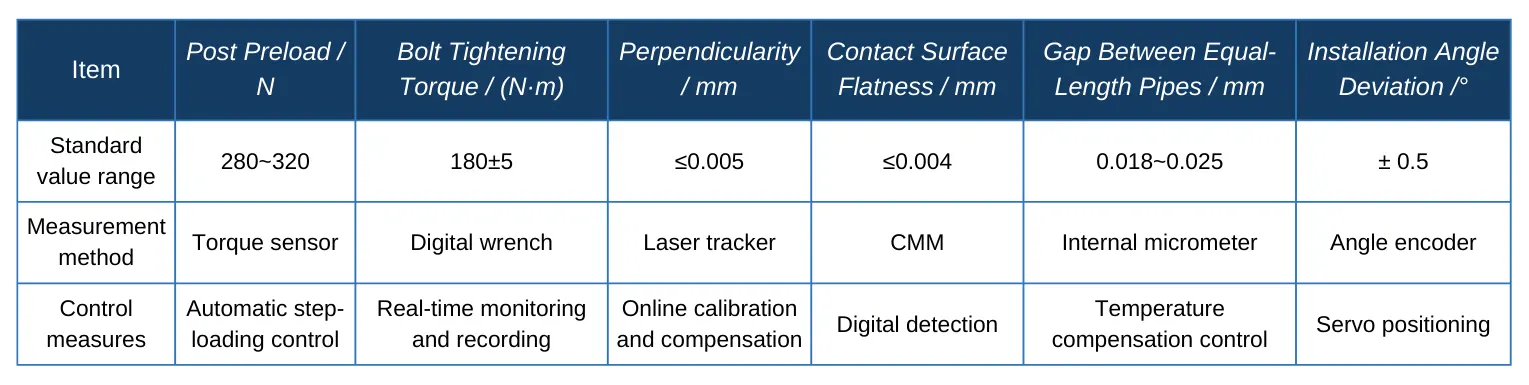
Key assembly parameters and their control standards are listed in Table 1.
In practical application, the system prioritizes monitoring two core indicators: column preload force and verticality.
Preload control employs a segmented loading strategy, achieving high-precision torque control at 0.5 N·m using a digital torque wrench.
Verticality measurement utilizes dynamic compensation via a laser tracker, ensuring assembly accuracy consistently remains within technical specifications.
Based on big data analysis, the system established an assembly quality prediction model.
Statistical analysis of 320 assembly datasets revealed that when the column preload is controlled between 280–320 N and verticality deviation does not exceed 0.005 mm, equipment operational precision improves by 45%, and service life extends by 30%.
Engineers establish digital inspection stations at critical assembly nodes.
Coordinate measuring machines perform full-dimension scanning of contact surfaces, enabling seamless monitoring throughout the assembly process.
Engineers establish a comprehensive quality traceability system.
This system allows them to query assembly parameters for each unit via QR codes and provides reliable references for subsequent maintenance and quality improvements.
The assembly accuracy evaluation of the DZ2040 machining center employs a multidimensional testing approach.
By establishing mathematical models to perform quantitative analysis on various measurement parameters, the assembly accuracy evaluation index P can be expressed as:
.jpg "(2)")
In the formula, wi represents the weighting coefficient for each parameter, xi denotes the measured value, n indicates the number of measurements, and σi signifies the standard deviation.
The testing process employed a Hexagon Global Silver coordinate measuring machine to inspect critical dimensions of the column, with a sampling frequency set at 200Hz.
Single-point repeatability achieved an accuracy of 0.002mm.
The assembly precision evaluation focused on column verticality and the flatness of the bed contact surface.
System evaluation of 50 units yielded an average column-to-bed mating surface perpendicularity of 0.004 mm.
The maximum deviation per unit did not exceed 0.006 mm.
Analysis of the overall data showed a well-defined normal distribution.
Dynamic rotational accuracy testing at 2000 r/min operating speed employed a dial indicator array.
This setup allowed simultaneous data collection at four critical measurement points.
Results confirmed maximum column runout controlled within 0.008 mm, achieving P4-grade dynamic accuracy standards.
Continuous monitoring of verticality revealed significantly enhanced stability of assembly accuracy over time.
Data from a 90-day tracking period showed that column verticality drift did not exceed 0.002 mm, validating the reliability of the composite connection technology.
The comprehensive assembly accuracy evaluation index P-value reached 0.92, substantially exceeding the design requirement of 0.75.
The structural strength validation of the DZ2040 machining center employs a graded loading test method.
It combines this with ANSYS finite element simulation analysis for experimental optimization design.
Tests were conducted on an MTS-810 hydraulic servo testing machine, performing static and dynamic load tests on the column connection structure.
Comparisons were made between traditional bolted connections and the composite connection solution proposed in this paper.
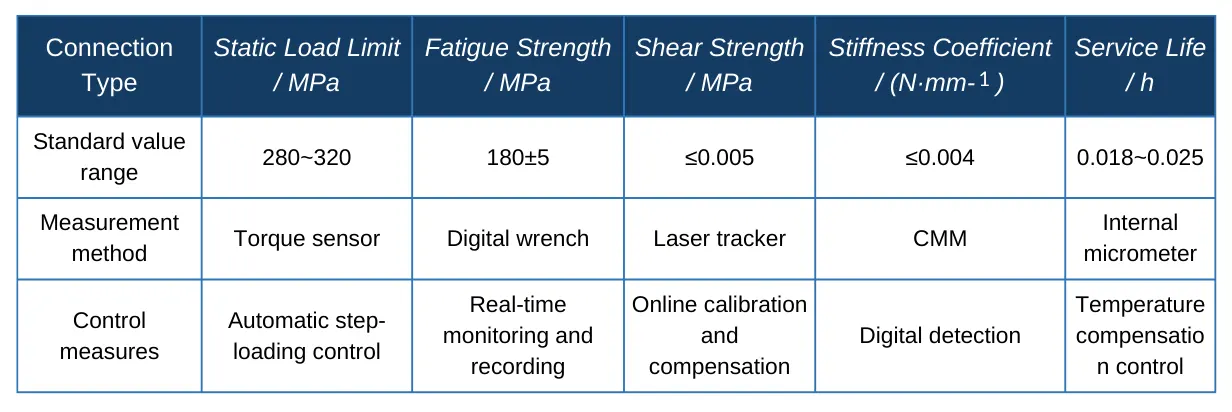
Test data is shown in Table 2.
In static load testing, the composite connection achieved a 25% increase in ultimate strength compared to the traditional connection, reaching 850 MPa.
Fatigue testing employed a loading frequency of 10 Hz within a load range of 100–500 MPa.
After 10⁶ load cycles, no fatigue damage was observed in the composite connection structure.
Real-time monitoring throughout the entire test process using acoustic emission detection technology revealed no microcracks in the composite joint structure during loading.
Section analysis demonstrated good surface integrity at the contact interface with no material damage detected.
Long-term durability test data indicated the composite joint achieved a service life of 8,500 hours, representing a 63% improvement over traditional joints.
Under high-frequency vibration conditions (50 Hz, amplitude 0.1 mm), the dynamic stiffness of the composite connection structure increased by 54% compared to traditional connections.
This demonstrates excellent vibration suppression capability.
Furthermore, under conditions simulating actual cutting loads, the composite connection structure exhibited superior deformation recovery capability.
The residual deformation was reduced by 45%.
Research on the assembly technology of the DZ2040 CNC gantry five-face machining center demonstrates that the innovative composite column connection technology is effective.
When combined with an intelligent assembly system, it successfully resolves high-precision assembly challenges.
Test data confirms that employing equal-length tube positioning devices and multi-dimensional precision control schemes has elevated column verticality control accuracy to 0.004 mm.
It has also increased the static load strength of the composite connection structure by 25% and extended fatigue life by 63%.
A systematic quality control framework elevated assembly pass rates to 96.5%, significantly boosting production safety and efficiency while reducing per-unit assembly cycles by 40%.
These findings have been implemented across multiple DZ2040 machining centers.
Future research will focus on applying intelligent assembly technologies to larger machine tool models and further exploring AI-based adaptive optimization methods for assembly parameters.