
With the continuous advancement of aerospace product development and the leap in performance requirements, a large number of complex monolithic aluminum alloy structural components are being widely adopted in next-generation aerospace products.
Research on aluminum alloy structural brackets primarily focuses on enhancing machining efficiency, optimizing manufacturing processes, and improving machining precision.
For instance, efficient machining of these components is achieved by optimizing cutting parameters, improving tool design, and employing advanced CNC programming techniques.
Simultaneously, proactive advancement in smart manufacturing and digital transformation—through the introduction of advanced CNC equipment and information management systems—enhances automation and intelligence in machining processes, further boosting efficiency and quality.
This paper introduces CNC machining techniques for bracket-type aluminum alloy structural components, using a specific stabilizer servo bracket as an exemplar.
Part Structure
The stabilizing servo bracket enhances the motion precision and stability of aviation products.
Its quality determines whether the servo can operate stably in various complex environments, thereby influencing the overall motion performance of the aviation product.
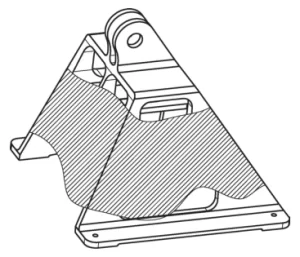
The stabilizing servo bracket component shown in Figure 1 has external dimensions of 210mm x 210mm x 190mm.
Its overall pyramid-shaped structure features multiple open cavities, resulting in relatively low overall strength.
Machining Challenges
The machining challenges for the stabilizing servo bracket are as follows:
1) Given the part’s structural characteristics, traditional A/B-axis CNC machining requires multiple setup stations.
This not only increases operator workload but also compromises machining accuracy due to repeated clamping and positioning.
2) With the material thickness at 190 mm, machining necessitates extensive use of long-reach cutters with a length-to-diameter ratio exceeding 5.
Excessive cutting forces can induce severe tool vibration, significantly compromising surface finish quality.
3) Multiple open cavities within the part compromise overall structural stability.
During finishing operations, tool vibration frequently occurs, severely impacting machining accuracy and surface quality.
4) The ear slot machining requires high precision, with a slot width tolerance of 13+0.110 mm.
Traditional Machining Process
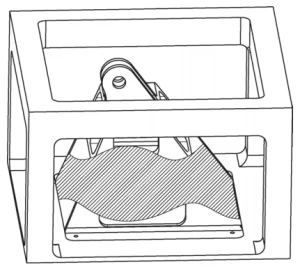
The traditional machining process for the part shown in Figure 2 is as follows:
1) Rough-machine the blank into a hexagonal shape.
2) Set the blank’s apex as the machining coordinate origin. Use an A/B swivel-angle CNC machine with clamping plate positioning.
3) Prioritize machining the large open bottom cavity. After achieving finish-machining accuracy, perform stress relief treatment.
4) Flip the blank, re-clamp and re-position it, then continue finishing the lugs at the top end of the part.
5) After this operation is complete, perform multiple re-clamping and re-positioning operations to machine the remaining four faces and deep cavities.
Optimized Process Plan
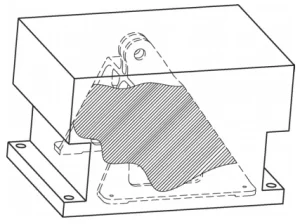
The traditional process plan has been optimized. The optimized process plan for machining is shown in Figure 3, with the specific process flow as follows:
1) Fabricate a custom process block with four M12 bolt holes and two φ16H8 locating holes drilled into it.
2) Mill slots on both sides of the blank, with slot width sufficient for four M12 screws to move freely in and out.
3) Prioritize machining the larger cavities on the part’s bottom surface. Schedule stress relief treatment.
Drill four M12 bolt holes and two φ16H8 locating holes around the blank’s perimeter, ensuring effective engagement with the custom-made pad.
4) Select an A/C swivel-angle five-axis machining center. Secure the blank to the custom pad using the two φ16H8 locating holes and locating pins, along with four M12 bolts.
5) Employ a combined short/long tool machining strategy during a single setup: – Use a short tool to finish-machine the top lug area. – Utilize the CNC machine’s 90° swivel angle to finish-machine the smaller central cavity. – Finally, use a long tool to finish-machine the bottom contour.
Processing Method Comparison
Material Cost
Traditional processing methods require maintaining the strength and stability of the blank structure during multiple clamping and positioning operations while preserving a defined machining coordinate origin.
This necessitates retaining a portion of the blank frame. In the optimized process, the blank only needs to maintain a partial allowance along the part’s length to accommodate bolt fastening requirements.
Regarding material cost, the optimized process yields a slight advantage over the traditional method.
Time Cost
(1) Setup Time:
The setup time and machining difficulty for roughing out a hexagonal blank far exceed those for slotting a blank.
The setup time for multiple part clamping and positioning significantly exceeds that for single-clamp setup.
(2) Programming Time:
The programming time for part finishing is essentially the same.
However, due to the larger rough blank in the traditional machining scheme, the roughing time is slightly longer than in the optimized process scheme.
In terms of time cost, the optimized process scheme demonstrates clear advantages over the traditional approach.
Although the self-made shims in the optimized scheme also involve material and time costs, they can be reused repeatedly over the long term with only one initial setup during batch production.
In summary, from a long-term perspective, the optimized process scheme is superior to the traditional one.
Machining Strategy
To address the machining challenges of the part, the following solutions are implemented:
1) Utilize custom-made shims for single-setup clamping and positioning.
This reduces the number of clamping and positioning operations during CNC machining, effectively preventing positioning errors caused by operator mistakes while shortening setup time during part processing.
2) Employ a combination of long and short cutting tools to avoid using solely long tools with high length-to-diameter ratios for overall part machining.
Utilize short tools’ superior rigidity, stable cutting conditions, and high cutting speeds to first machine shallower areas of the part.
This approach enhances both machining efficiency and part precision.
3) Select high-speed CNC milling machines.
Leverage the characteristics of low cutting forces and rapid heat dissipation during high-speed cutting to effectively mitigate tool vibration caused by high cutting forces and thermal deformation caused by excessive cutting heat.
This indirectly improves part surface quality and machining accuracy.
4) After rough machining the lug slots and outer contours, schedule stress relief treatment.
Once the lugs have fully settled, proceed with slot finishing.
Utilize the “shallow cuts at high feed rates” characteristic of high-speed cutting to uniformly remove stock from both inner sides of the slots, minimizing the impact of cutting forces on surface quality.
5) Employ CATIA CNC programming software and VERICUT CNC machining simulation software to develop and simulate CNC programs, optimize toolpath trajectories, minimize idle tool travel, and enhance machining efficiency.
Select appropriate cutting tools and apply scientific cutting parameters to reduce tool cutting forces, prevent plastic deformation of aluminum alloy materials, and improve machining accuracy and surface quality.
Implementation Results
Following batch processing and practical verification, the optimized manufacturing process achieved the following expected outcomes:
① Product form accuracy and dimensional accuracy meet design specifications.
② Surface quality meets the design requirement of surface roughness Ra=3.2μm.
③ Machining efficiency increased by 36% compared to the traditional process.
Conclusion
This paper presents an in-depth study and process optimization of CNC machining techniques for aluminum alloy structural components used in brackets.
By employing custom-made shims or self-fabricated milling fixtures, the number of clamping and positioning operations was reduced.
Combining long and short cutters enhanced machining efficiency, while adopting high-speed milling minimized tool vibration and deformation. and employed CNC simulation software to optimize toolpath trajectories.
These approaches resolved challenging aspects of part machining and were successfully extended to the practical CNC processing of other aluminum alloy structural components.
This not only shortened the research and production cycle but also advanced the application of CNC machining technology.