
Certain components in mechanical equipment are commonly manufactured using CNC machine tools.
During machining, operators typically use universal fixtures to clamp and position the workpieces.
However, for specific parts, standard universal fixtures often fail to meet efficiency requirements.
Consequently, engineers must design specialized fixtures to clamp and position workpieces rapidly, thereby enhancing productivity and meeting machining demands.
Figure 1 depicts a stop block component mounted on a milling machine to limit movement along the X and Y axes.
This part undergoes batch production with a requirement to process four units within one hour.
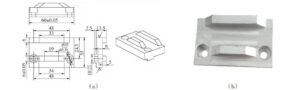
a——Stopper Component Drawing
b——Stopper Component Actual Photo
Part Analysis and Process Requirements
The stop block component shown in Figure 1 has a length of 60.0mm with a tolerance range of ±0.05mm; with a width of 35.0mm and a total height of 16.0mm.
Its front face features two trapezoidal partition strips and two symmetrical countersunk holes.
The upper partition strip measures 19.0 mm in length, while the lower one measures 34.0 mm in length.
Both strips have a height of 5.0 mm and a width of 6.0 mm.
The tolerance requirement is ±0.05 mm, with a center-to-edge distance of 24.5 mm.
The long spacer measures 33.0mm top and 48.0mm bottom, with a height of 5.0mm and width of 6.0mm.
The countersunk holes have diameters of ϕ10.0mm and ϕ5.5mm respectively, with a countersink depth of 6.0mm and a center-to-center distance of 48.0mm.
The reverse side features a longitudinal strip with a height of 2.5mm, length of 60.0mm, width of 10.0mm, and tolerance range of -0.05 to -0.15mm, centered with a margin of 24.5mm.
All other unmarked dimensional tolerances comply with GB/T 1804-m requirements: dimensions >0.5–6mm have a tolerance of ±0.1mm; dimensions >6–30mm have a tolerance of ±0.2mm.
The material is hard aluminum alloy, supplied as a blank measuring 63×35×20mm.
Four parts must be machined within 1 hour.
After analyzing the part’s key features, dimensions, tolerances, and technical requirements, the engineers classified its machining precision as medium-precision.
Machining this part requires two-side clamping.
Considering the existing equipment, engineers select a CNC milling machine to process the part.
Issues Encountered During Machining
The machining process for the stop block part is not difficult, with moderate machining accuracy.
A CNC milling machine is used for machining, and the clamping method employs a universal vise, as shown in Figure 2.
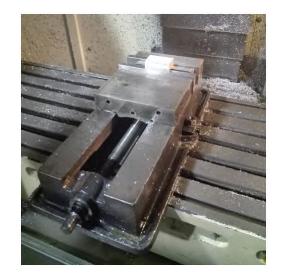
The machining process involves first machining the reverse side, then flipping the workpiece to machine the front side.
Programming is performed using NX 8.5 software.
The machining operations are:
① FACE_MILLING: Face milling finish operation, ϕ20mm flat-bottomed cutter;
② PLANAR_MILL: Contour milling operation, ϕ20mm flat-bottomed cutter;
③ PLANAR_MILL contour machining, ϕ12mm flat-bottom cutter;
④ FACE_MILLING face milling finish machining, ϕ12mm flat-bottom cutter;
⑤ CONTOUR_AREA contour area machining, ϕ12mm flat-bottom cutter;
⑥ SPOT_DRILLING standard drilling, ϕ1.5mm center drill;
⑦ SPOT_DRILLING standard drilling – depth, ϕ5.5mm drill bit;
⑧ SPOT_DRILLING standard drilling – depth, ϕ10mm drill bit.
After establishing the process and program, conduct on-site machining tests and record processing times:
① Front-side clamping and tool setting: 3 min;
② Front-side machining: 3 min;
③ Rear-side clamping, centering, and tool setting: 8 min;
④ Rear-side overall rough machining: 2 min;
⑤ Back-side flat surface finishing, 1 min;
⑥ Bevel machining, 2 min;
⑦ Drilling (center drill, hole drilling, and tool change time), 6 min. Total time: 25 min.
Actual processing time per stop block part: 25 min.
Processing 4 parts requires approximately 1h40min, failing to meet the quantitative requirement of 4 parts within 1 hour.
Therefore, two additional clamping tests were conducted: one using a single vise to clamp 2 parts, setting two machining coordinates G54 and G55, with the clamping diagram shown in Figure 3;
The second method utilized two vices to clamp and machine four workpieces simultaneously, setting four machining coordinates: G54, G55, G56, G57, and G58.
Problem Solving – Fixture Design
During actual machining trials, skilled technicians operated the machine tools.
The actual machining time per part was as follows: 3 minutes for reverse machining.
Roughing the front face took 2 minutes.
Flat surface finishing required 1 minute.
Bevel machining took 2 minutes.
Drilling operations required 6 minutes.
The total machining time per part was 14 minutes.
However, clamping, tool changes, and tool alignment took 11 minutes.
Similarly, when machining two or four parts per setup, fixture mounting and tool change/alignment remained time-consuming.
Reducing tool change/alignment time while achieving rapid, stable, and secure clamping is critical to ensuring the completion of four parts within one hour.
Having identified the critical issue and considering the feature requirements of the stop block part, a dedicated fixture was designed.
This fixture allows clamping four workpieces in a single setup.
Its design drew inspiration from the slider structure characteristics in molds, as shown in Figure 3.
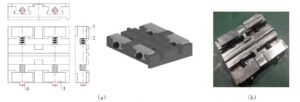
a——Fixture Assembly Drawing
b——Fixture Actual Drawing
- Fixture Body
- Spring
- I-shaped Slider
- M8 Hex Socket Screw
The specialized fixture consists of a main body and two symmetrical I-beam sliders.
By tightening the M8mm hex socket bolts, the symmetrical sliders clamp the blank, achieving the clamping purpose.
The spring functions such that after machining is complete, loosening the bolts allows the spring to expand, causing the support sliders to retract backward, facilitating the removal of the workpiece.
This fixture features a simple yet ingenious design that is easy to manufacture.
Its mounting mechanism incorporates a T-shaped recess machined into the base of the main body, forming a stop-and-positioning structure.
This design enables quick, stable, and secure clamping onto a vise.
The fixture is lightweight overall, making it easy to carry, install, and disassemble.
Modified Drilling Tooling
When machining stepped holes in stop block components, the drilling process involves: first center-point drilling, followed by a 5.5mm through-hole, then a 10mm countersunk hole with a 6mm depth.
This operation requires three tool changes and alignment, resulting in prolonged setup time.
Additionally, when using a 10mm drill to create a 6mm-deep countersunk hole, the bottom forms a tapered surface rather than a flat bottom.
To achieve a flat bottom, an extra tool change is required, increasing both machining and tool change/alignment time.
Alternatively, a 10mm flat-bottomed tool could be used directly to ensure a flat countersink bottom, though this still requires three tool changes.
Reducing tool change frequency is the primary challenge in this process.
To address this, the drilling tool was modified: a 9.8mm drill bit was ground on a universal grinding machine sharpening it into a stepped profile.
The modified drill features a stepped geometry: the first step has a diameter of ϕ5.5mm with a step length of 10mm.
The machine simultaneously sharpens the drill tip into a center drill shape.
This modified drill combines the functions of a center drill, through-hole drill, and step drill into one tool.
Operators now complete tool change and alignment in a single step, significantly reducing changeover and alignment time.
The ground step drill features a flat-bottomed step, ensuring the countersunk holes produced have a flat-bottomed finish, meeting drawing specifications.
Fixture Application and Programming
The fixture is positioned against a stop and clamped in a vise.
Loosen the bolts, retract the sliders to create sufficient space, and load four blank workpieces into the fixture.
Tighten the bolts, retract the two symmetrical sliders inward, and secure the workpiece blanks by tightening the bolts to achieve clamping.
By mounting four workpiece blanks simultaneously in the fixture, operators treat the fixture and blanks as a single unit.
Programming and machining zero points are set on the fixture’s central top plane.
Establishing G54 as the machining coordinate reduces coordinate data input, saves auxiliary time, and enhances production efficiency.
Operators execute programming as a unified process for all four workpieces, controlling tool idle movement to minimize tool lift-off time and improve machining efficiency.
Fixture Usage Time Statistics
After using the fixture, establishing the corresponding machining process, determining the machining zero point, and compiling the program, on-site machining verification was conducted.
Specific machining times:
① Front-side clamping and tool setting: 4 min;
② Front-side top surface, side wall, and outer contour machining: 8 min;
③ Face clamping, centering, and tool setting: 5 min;
④ Back face top surface machining: 6 min;
⑤ Back face bottom surface and side wall finishing: 6 min;
⑥ Bevel machining: 8 min;
⑦ Drilling: 6 min; Total time: 43 min.
Statistical analysis shows that using the designed specialized fixture, machining 4 parts took 43 minutes, meeting the production requirement of 4 parts per hour for the stop block component.
To achieve more accurate time measurement, a half-day trial production run was conducted using the fixture.
Workshop quality inspection technicians recorded and calculated the data, confirming that the average time per 4 parts during the half-day run ranged between 42 and 46 minutes, consistent with the test run results.
After half a day of production application, the fixture demonstrated stable, secure, and reliable clamping without any scrap resulting from clamping issues.
This confirms the fixture’s rational design and its suitability for production needs.
Furthermore, adopting the new machining process established with the fixture has enhanced the manufacturability and efficiency of stop block part production.
Conclusion
To accomplish the quantitative machining task for the stop block components, a dedicated fixture was designed.
This fixture features an overall lightweight construction, making it easy to transport, install, and disassemble.
Drawing inspiration from the slider structure in molds, the fixture ingeniously utilizes the bolt tightening force to clamp the blank against the slider.
Its design is straightforward to manufacture.
For machining the countersunk holes in the stop block components, a custom-made step drill with a grinding edge was fabricated, significantly enhancing machining efficiency.