
A thin-walled bracket designed for a Caterpillar heavy-duty truck engine presented significant challenges in both casting and machining due to its structural characteristics.
By implementing and applying new processes and equipment, we successfully resolved the machining difficulties for this bracket and ensured the product’s dimensional accuracy.
Part Structure and Machining Process
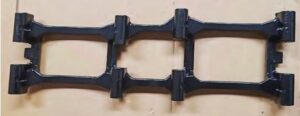
The outer contour of the thin-walled bracket blank shown in Figure 1 measures 535 mm in length and 225 mm in width.
Its maximum thickness reaches 55 mm at the thickest point, while the minimum thickness is only 10 mm at the connecting ribs.
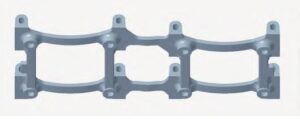
Figure 2 depicts the part model of the thin-walled bracket.
The part is hollow internally, connected only by thin and narrow support ribs, making it prone to deformation under stress and exhibiting poor stability during casting and machining processes.
We establish the machining process flow based on the bracket’s structure and machined areas. The process proceeds as follows:
OP10: Mill and drill eight assembly reference surfaces and holes.
OP20:Drill and mill the tapered deep holes on one side.
OP30:Drill and mill the tapered deep holes on the other side.
OP40:Mill the small flat surface on the back of the reference surface.
Analysis of Machining Challenges
We analyze the machining challenges for thin-walled bracket products as follows:
1) Because the eight assembly reference surfaces are isolated and unconnected, we find it difficult to ensure overall flatness.
2) The eight deep slotted holes measure 11mm x 16mm with a depth of 70mm—nearly seven times the diameter.
This configuration causes significant tool chip evacuation and heat dissipation issues during cutting, resulting in poor machinability.
3) The drawing specifies a profile tolerance of 0.6mm for the tapered deep holes.
During machining, the machining center is prone to spindle runout and tool vibration.
Uneven forces during cutting cause tool deflection, resulting in the top profile dimensions of the tapered deep holes being larger than the bottom profile dimensions.
Furthermore, the arc formed by end milling in the XY plane of the machining center is subject to deviation due to the composite precision of the machining center worktable.
This significantly impacts the contour accuracy of the arc section in the waist-shaped deep hole.
Machining Process for Waisted Deep Holes
In accordance with the technical requirements specified in the drawings, the machining process for waisted deep holes is as follows.
1) Pre-drill a 10mm hole at the center of the waist-shaped deep hole using a 10mm carbide drill bit to reduce the milling allowance for the end mill.
Retract the drill bit every 5mm to fully evacuate chips and cool the drill, ensuring rapid removal of machining allowance while maintaining the verticality and axial straightness of the rough-machined hole.
Continue drilling until the 10 mm hole is fully completed.
2) Employ an extended carbide milling cutter with a diameter of 10mm and a cutting edge length of 80mm.
Utilize the plunge milling function in the XY plane to rapidly machine the oval deep hole dimensions to 10.85mm x 15.85mm, leaving a 0.15mm finishing allowance.
Perform each plunge milling pass with a Z-axis feed of 0.5mm.
Mill the oval deep hole repeatedly until it is fully completed.
This layered progressive plunge milling minimizes the impact of machine accuracy and tool stress factors on the machining process.
3) Employ a 10mm diameter, 80mm cutting edge length carbide end mill with a 75mm Z-axis feed to form the tapered deep hole from top to bottom in a single pass.
Complete the finishing operation in three passes, each removing 0.05mm.
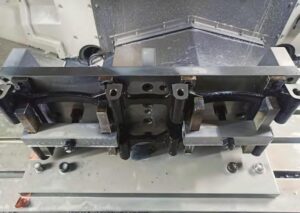
The machining process for the thin-walled bracket’s tapered deep hole is illustrated in Figure 3.
Analysis of Existing Issues and Causes
Inspection Results and Deviation Findings
After we initially machined the bracket product, we inspected it using a coordinate measuring machine.
The results showed that the measured contour tolerance of the tapered deep hole ranged from 0.8 to 1.0 mm, which failed to meet the specifications.
The top surface dimensions of the tapered deep hole slot measured 16.00 to 16.03 mm in length and 11.00 to 11.02 mm in width.
In contrast, the slot bottom dimensions measured 15.75 to 15.78 mm in length and 10.74 to 10.77 mm in width, exceeding the tolerance limits.
Analysis of Machining Errors and Deformation Causes
Comprehensive analysis of inspection reports and on-site manufacturing processes identified the following issues:
The measured flatness of the bracket’s 8 assembly reference surfaces ranged from 0.14 to 0.16mm.
The theoretical distance between the center axis of the tapered deep hole and the locating reference surface specified in the drawing is 35.5 mm.
However, the actual measured distance at the tapered deep holes on the far left and far right positions of the thin-walled bracket showed significant deviation from the theoretical value after machining.
This resulted in poor dimensional consistency across the 8 tapered deep holes.
Preliminary analysis indicates this was likely caused by deformation during workpiece clamping due to excessive planarity error in the bracket.
Process Sequence Influence and Tool Interaction Factors
On-site tracking revealed that the thin-walled bracket first machined the waist-shaped deep holes, followed by the two platforms at the rear ends of the reference surface.
These two platforms sit at the points most prone to deformation between the bracket’s connecting ribs.
During cutting, the connecting ribs deformed under stress, causing overall bracket deformation and resulting in dimensional fluctuations.
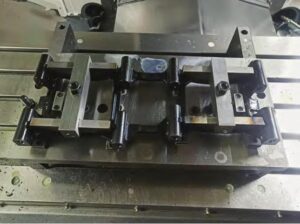
The machining of the small rear planes on the thin-walled bracket is shown in Figure 4.
For waist-shaped deep holes with a depth of 70 mm, several factors contribute to dimensional deviations at the bottom of the groove.
These factors include excessive contact length between the end mill and the workpiece during machining.
They also include natural oscillation at the tool tip and uneven force distribution between the tool tip and the clamping end of the tool holder.
Solution
Optimization of Clamping Force and Reference Surface Finishing
After analyzing and researching the issues encountered during the initial manufacturing of thin-walled bracket products, we implemented the following solutions.
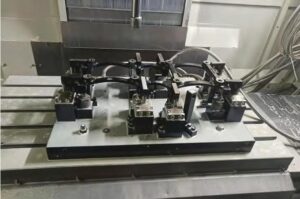
For the OP10 process, we adjusted the working pressure of the hydraulic clamping circuit in the hydraulic station from 4 MPa to 2 MPa.
This reduced the clamping force output by the workpiece clamping cylinder while maintaining the working pressure of the hydraulic support cylinder circuit unchanged.
After completing the countersinking and threaded hole machining, we added an additional reference surface finishing milling step.
This increased the number of finishing milling reference surfaces from two to three.
Parts processed with this optimized procedure achieved a flatness of <0.05 mm upon inspection, demonstrating significant improvement.
The milling and drilling reference positioning surface is shown in Figure 5.
Improved Machining Process Flow and Fixture Strategy
Adjust the machining process flow for the bracket: First machine the two flat surfaces on the back of the reference plane to eliminate dimensional fluctuations caused by stress deformation of the connecting ribs.
Then machine the tapered deep holes on both sides. When clamping the workpiece for the tapered deep hole machining operation, use a digital torque wrench to ensure consistent clamping force each time.
Employ a multi-point interlocking machine tool fixture to automatically balance the clamping force, minimizing deformation caused by uneven stress distribution across different clamping points.
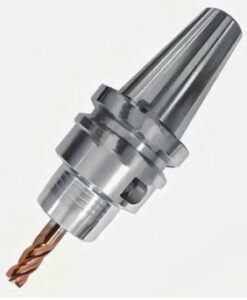
To reduce oscillation caused by excessive protrusion of the extended end mill, replace the standard tool holder with a hydraulic tool holder as shown in Figure 6.
The hydraulic tool holder is a high-precision, high-rigidity cutting tool clamping device.
It employs hydraulic principles to achieve uniform tool clamping, suitable for various high-precision machining operations (such as milling, drilling, and turning).
It enables gap-free clamping between the tool and holder, ensuring high rigidity and runout accuracy (typically ≤0.003mm).
This effectively reduces the vibration inherent in extended end mills, thereby improving the positional accuracy and surface profile precision of tapered deep holes.
CNC Program Optimization for Waist-Shaped Deep Holes
To address the issue of large top dimensions and small bottom dimensions in the waist-shaped deep hole slot, we optimized the CNC machining program for the waist-shaped deep hole.
We modified the post-machining dimensions to 11.1 mm × 16.1 mm.
During the XY-plane slot milling process for the deep waist-shaped hole, we rapidly machined the dimensions to 10.95 mm × 15.95 mm, leaving a 0.15 mm finishing allowance.
This approach machined the top surface shape dimensions of the deep waist-shaped hole close to the upper tolerance limit while bringing the bottom surface shape dimensions near the tolerance midpoint.
Consequently, both the top and bottom dimensions of the deep waist-shaped hole met the drawing tolerance requirements.
Process Optimization and Hydraulic Tool Holder Performance
Machining deep tapered holes in thin-walled bracket products presents significant challenges.
Not only are stringent geometric tolerances required for these tapered deep holes, but improving machining efficiency remains difficult.
Processing four tapered deep holes on a single side takes approximately 35 minutes.
By adjusting the process flow and optimizing parameters—including using a torque wrench to ensure consistent clamping force and adopting hydraulic toolholders—we ultimately produced qualified parts.
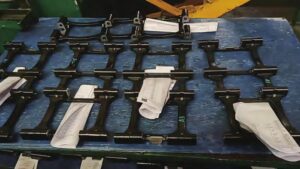
The finished thin-walled bracket is shown in Figure 7. Inspection revealed profile tolerances of 0.40 to 0.47 mm for the eight tapered deep holes.
The slot top dimensions measured 16.10 to 16.13 mm in length and 11.10 to 11.12 mm in width, while the slot bottom dimensions measured 15.94 to 15.98 mm in length and 10.94 to 10.97 mm in width.
These results show that machining effectively reduced the taper.
Continuous multi-piece processing verification demonstrated excellent dimensional stability of the workpieces.
Conclusion
Thin-walled bracket products exhibit poor machinability.
Deteriorating rough casting quality compromises repeat positioning accuracy, while the tendency for deformation under cutting forces undermines dimensional stability.
By practically applying a layered, step-by-step drilling and milling process, we present a feasible solution for machining waist-shaped deep holes.
We combine this process with high-precision clamping devices, including hydraulic fixtures, multi-point self-balancing clamping mechanisms, and hydraulic toolholders.
This approach not only successfully resolves the challenges of waist-shaped deep hole machining but also provides a valuable process reference for similar products.