
Aluminum-magnesium alloys are indispensable lightweight and high-strength materials in modern industry.
They are widely used in the aerospace, automotive, and precision machinery industries.
However, aluminum-magnesium alloys have high thermal conductivity and a low elastic modulus.
They also tend to form built-up edges during the cutting process. As a result, their machining process often faces challenges such as low efficiency and poor precision.
These issues limit the performance of aluminum-magnesium alloy components.
They also constitute technical bottlenecks in high-end equipment manufacturing.
Research on optimizing milling processes for thin-walled aluminum-magnesium alloy casing joints is an in-depth study.
It focuses on material processing technologies.
It also serves as a strategic imperative for enhancing manufacturing competitiveness and driving industrial upgrading.
Structural Characteristics
The wall thickness of the joint flange on thin-walled aluminum-magnesium alloy casings typically ranges from 2 to 5 mm.
This thin-walled structure helps reduce the overall mass of the casing.
However, it also introduces machining challenges such as poor rigidity and susceptibility to vibration-induced deformation during milling.
These issues can compromise dimensional accuracy and surface finish.
The design features a ring configuration of the joint flange around the casing, with multiple high-precision connection holes.
Manufacturers must strictly control positioning tolerances to ensure assembly accuracy.
Additionally, the surface roughness Ra is subject to stringent requirements.
Operators must control it below 1.6 μm to minimize wear, enhance connection reliability, and extend service life.
This imposes high demands on tool selection and parameter settings for the milling process.
Existing Milling Process Issues
The current milling process for thin-walled aluminum-magnesium alloy chamber joints faces three major bottlenecks.
First, traditional radial clamping plates provide limited contact area, concentrating clamping force on the outer periphery of thin walls.
Given the low elastic modulus of aluminum-magnesium alloys, milling easily causes thin-wall bending deformation and tool deflection.
Second, operators mismatch milling parameters with material properties.
At low speeds, machining underutilizes the alloy’s high thermal conductivity.
Large cutting depths cause milling forces to surge abruptly, significantly increasing the risk of built-up edge adhesion and deformation.
Production often requires machine stoppages for tool adjustments or replacements, limiting efficiency.
Third, the machining sequence lacks stress-relief stages.
Moving directly from roughing to finishing causes residual stresses to concentrate and release, leading to warping at thin-walled joints.
This frequently results in flatness and perpendicularity deviations exceeding tolerances.
Optimization Plan for Milling Process
To enhance machining efficiency and precision of aluminum-magnesium alloy thin-walled casings, the process was optimized through refactoring and parameter adjustment.
The goal is to simplify the process chain, increase equipment utilization, and achieve stable dimensional accuracy using advanced machining centers and high-performance tools.
Redesign of Machining Process
The original process employed a split machining model, relying on multiple machines to complete casing joint flange machining.
The lengthy process chain (8 operations) involved alternating use of 3 types of equipment, with idle waiting time exceeding 40%.
Manual tapping frequently caused thread skew or incomplete thread profiles, resulting in a 30% rework rate per part.
Inconsistent clamping references across multiple machines led to cumulative geometric errors, yielding only a 65% pass rate for joint flange flatness.
To address fragmented processing, engineers introduced a mill-turn composite five-axis machining center to consolidate operations.
The new process comprises two core operations.
First, machinists complete rough machining of both front and rear surfaces in a single setup using the swiveling spindle function.
A 25 mm diameter whisker ceramic turning insert removes the bulk material at a spindle speed of 6000 r·min⁻¹ and a feed rate of 0.15 mm per tooth.
It achieves over 90% material removal per operation.
After rough machining, pause for 10 minutes using the machine’s built-in stress relief program.
This helps homogenize internal stresses in the workpiece and reduces the risk of subsequent deformation.
Second, perform precision machining on both sides. Switch to milling mode and use a bullnose cutter (12mm diameter, 3mm radius) to finish the mating edge profile.
Increase the spindle speed to 24,000 r·min⁻¹ and reduce the feed per tooth to 0.08 mm.
Keep the milling depth within 0.5 mm to ensure that the surface roughness Ra does not exceed 1.6 μm.
Subsequently, a ball-nose cutter (6 mm diameter) is used for roughing the thread pilot hole, employing helical milling to ensure hole wall perpendicularity.
During finishing, machinists performed in-machine measurement simultaneously.
A probe detected hole position and flatness in real time, with data directly fed back to the CNC system for coordinate compensation.
The new process reduced operations from 8 to 4, equipment types from 3 to 1, and equipment utilization by 50%.
Premium Milling Tools
For rough machining, choose whisker ceramic turning inserts (WC-Co substrate with SiC whiskers), featuring a hardness of 93 HRA and 40% higher bending strength than standard carbide.
These inserts withstand high milling temperatures exceeding 800°C during roughing operations.
Employing double-sided precision machining with a controlled 8° rake angle, they ensure edge strength while minimizing friction.
In practical applications, a single insert can continuously machine three workpieces, extending service life by 500% compared to traditional carbide inserts.
The finishing stage employs a bullnose cutter for contour machining.
It features polycrystalline diamond inserts specifically designed for aluminum-magnesium alloy processing.
The bullnose design prevents stress concentration at right-angle transitions, while laser cladding enhances wear resistance at the rounded corners.
For surface finishing, machinists use a ball-nose cutter with a TiAIN-coated cutting edge.
Low-speed milling with a small stepover (0.05 mm per tooth) removes tool marks left by the bullnose cutter, ensuring the joint seal face flatness does not exceed 0.02 mm.
Adjusting Milling Parameters
During rough machining, when using a 25mm-diameter whisker ceramic turning insert for double-sided machining, the spindle speed is set to 6000 r·min-1.
This speed selection fully leverages the ceramic insert’s high-temperature resistance.
It matches the insert’s ability to withstand milling heat exceeding 800°C with a high rotational speed.
This combination effectively maximizes the material removal capacity.
With a feed rate of 0.15 mm per tooth, machinists control the single-tooth milling depth below 0.2 mm to prevent tool breakage from overload.
The milling depth is set at 1.5 mm, balancing tool shank rigidity and machining efficiency.
Considering the workpiece wall thickness and a cutting depth ratio of 30%, measured tool shank vibration is kept within 5 μm.
Under this parameter combination, the material removal rate reaches 480 cm³·min⁻¹.
This represents a 40% increase over the 340 cm³·min⁻¹ achieved with the original carbide tooling process.
Thermal imaging monitoring indicates the insert temperature remains stable below 550°C, preventing burn damage or tool adhesion.
Upon entering the finishing stage, switch to a bullnose cutter for contour machining, increasing the spindle speed to 24,000 r·mim-1.
Leveraging the high hardness of Polycrystalline Diamond (PCD) inserts, ultra-high speeds reduce the cutting volume per tooth, thereby enhancing surface quality.
Machinists match a feed rate of 0.08 mm per tooth with a 0.5 mm cutting depth to ensure seal face flatness is controlled within 0.02 mm.
Setting the milling depth to 0.5 mm effectively prevents deformation in thin-walled components.
Actual workpiece allowances measured did not exceed 0.01 mm.
Surface roughness during this stage stabilizes between 1.2 and 1.6 μm, meeting sealing requirements for the engine casing and upstream components.
In-machine probe inspection confirms 98% of hole dimensions achieve first-pass acceptance, reducing rework rates from 30% under the original process to 2%.
Innovative Clamping Technology
The new clamping system employs a three-hole over-constraint layout on one face.
It incorporates high-precision locating holes on the end face of the housing to form a triangular positioning network.
Three cylindrical pins with diameter tolerances of ±0.002mm are distributed at 120mm equidistant intervals, fully constraining the workpiece’s six degrees of freedom.
Finite element analysis confirms that with a positioning hole positional accuracy of ≤0.015 mm, this design effectively controls over-constrained internal stresses.
These stresses remain below 15% of the material’s yield strength.
Combined with graphite-lubricated chrome-plated pins, it reduces the sliding friction coefficient to 0.08.
This eliminates the cantilever beam effect inherent in traditional two-hole positioning.
The system employs reverse-pull bolting technology (see Figure 1), revolutionizing conventional clamping methods.
Custom reverse-pull bolts penetrate from the bottom of the machine housing, converting axial tension into uniform clamping force on rigid ribs via threaded pairs.
At a reverse torque of 15 N·m, contact surface pressure distribution uniformity improves by 40%, while clamping deformation decreases from 0.050 mm to 0.012 mm.
This structure transfers clamping forces to the higher-strength bottom support platform and integrates a dynamic compensation mechanism.
Utilizing a piezoelectric force sensor with a range of 0–500 N and an accuracy of ±1 N, the system employs a proportional-integral-derivative (PID) algorithm to dynamically adjust the reverse pull torque in real time.
This stabilizes the clamping stiffness at 1.2 × 10⁶ N·m.
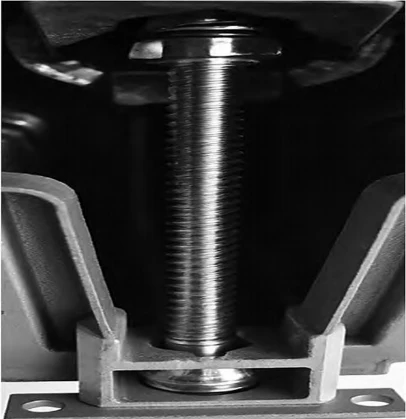
The new design enhances constraint integrity by increasing the number of locating holes, narrowing positional tolerance bands by 50%.
Combined with force flow optimization for the counter-tensioning bolts, this approach boosts clamping system rigidity by 300%.
Dynamic compensation effectively addresses potential stress concentration issues caused by over-constraint.
It ensures a reasonable stress distribution even under statically indeterminate conditions.
Quality Control in In-Machine Measurement and Compensation Technology
During the milling process of thin-walled aluminum-magnesium alloy casing joint edges, the trigger-type probe system is integrated into the five-axis machining center.
It enables real-time closed-loop control of critical dimensions.
At the equipment functionality level, the probe system directly interfaces with the machine tool’s CNC system via infrared signal transmission.
It automatically identifies joint edge hole positions, end faces, and contour features with a measurement accuracy of ±2μm.
The implementation phase comprises three core stages.
(1)Stress Relief for Rough Machining
Following rough milling of the joint edge, a low-temperature stress-relief annealing process (temperature: 180°C, duration: 2 hours, furnace cooling) is applied.
This reduces the work-hardened layer depth from 0.8 mm to 0.3 mm and decreases residual stress levels by over 60%.
Comparison of coordinate measurement data before and after heat treatment verifies the controllable deformation that occurs during subsequent finishing operations.
(2) Probe Calibration
Prior to finishing operations, execute a three-dimensional spatial calibration procedure using a standard sphere (diameter 50 mm, geometric tolerance ≤1 μm).
Use a nine-point calibration method for this process.
The calibration process covers all three spatial coordinate directions (X-axis, Y-axis, and Z-axis) to generate probe radius compensation values and position offset matrices.
Post-calibration probe repeatability is enhanced to 0.005mm.
Dynamic error compensation algorithms eliminate cumulative errors within the machine tool’s motion chain.
(3)Adaptive Milling Compensation
During automatic measurement of the joint edge hole positions, the system collects coordinate data from 20 uniformly distributed points.
It then fits the hole system centerline using the least squares method and generates compensation commands after comparing with the theoretical model.
Through milling parameter adjustments, the axial cutting depth dynamically adjusts from 0.50 mm to 0.35 mm.
The feed rate is modified from 1200 mm·min⁻¹ to 950 mm·min⁻¹.
Additionally, the spindle speed is optimized in real-time based on the material removal rate.
The compensation strategy generates digital control code correction values via the machine tool’s post-processor.
It ensures that the measurement-analysis-compensation cycle does not exceed 5 minutes.
Dynamic Control of Machine Tool Thermal Deformation
To mitigate the impact of thermal errors on machining accuracy during edge-to-edge processing on five-axis machining centers, a three-level thermal deformation control system can be employed.
Thermal drift on the Y and Z axes can reach up to 0.12 mm.
(1)Preheating Program Optimization
Upon startup, execute a customized preheating cycle.
This cycle includes a no-load rapid traverse with 10 minutes of reciprocating motion at 80% maximum speed along the X, Y, and Z axes.
It also includes a light-load milling simulation, where a 5-minute machining of an aluminum-magnesium alloy test piece is performed at 30% of the cutting parameters.
This program stabilizes the machine tool spindle temperature rise at (42±1)°C. It controls the bed temperature gradient within 0.5°C·h⁻¹.
Additionally, it reduces thermal deformation errors for the Y-axis and Z-axis to 0.028 mm and 0.025 mm, respectively.
(2)Real-Time Thermal Error Compensation
The in-machine measurement system automatically triggers the reference plane alignment program every 30 minutes of machining.
It establishes a dynamic coordinate system using the three-point method.
A laser interferometer continuously monitors the position of the machine tool’s moving axes.
Combined with a thermal deformation prediction model developed through finite element analysis, real-time compensation values are generated.
First, spindle thermal elongation compensation: Temperature sensors monitor the spindle nose temperature to correct the Z-axis coordinate system.
Second, bed distortion compensation: Hydraulic pads adjust the worktable level to compensate for Y-axis directional deformation.
Third, rotary axis error compensation: Angular offset correction is applied to rotary axes, with an error compensation range of ±0.05°.
(3)Environmental Temperature Control
The machining area is equipped with a constant-temperature system maintaining temperatures at (20±1)°C.
A thermally symmetrical machine tool structure design is employed.
Critical components, such as columns and crossbeams, are constructed from materials with low thermal expansion coefficients.
Thermal imaging cameras periodically monitor the machine’s thermal distribution to optimize coolant spray positioning, ensuring milling zone temperatures remain stable at (25±2)°C.
Conclusion
Technological innovation serves as the core driving force behind industrial upgrading.
In the high-end equipment manufacturing sector, breakthroughs in technology often catalyze transformative shifts in industry dynamics.
The research on optimizing the milling process for joining thin-walled aluminum-magnesium alloy casings exemplifies this principle in practice.
This approach resolves the tension between machining efficiency and precision.
It also enhances product quality, establishing a benchmark for technological innovation.
It will foster collaborative development across the industrial chain and guide the manufacturing sector toward higher quality and greater efficiency.