
In recent years, driven by the advancement of science and technology, various technologies have undergone constant innovation.
As a result, many industries have set increasingly stringent requirements for metal parts.
This has raised high-precision demands for mold and die processing in the manufacturing industry.
Manufacturers widely use high-speed cutting technology, an advanced processing method, to improve the quality and efficiency of mold processing.
This technology is applied in the automotive industry, aviation industry, mold manufacturing, and other fields.
Based on this, this paper analyzes the characteristics of high-speed cutting technology to clarify its application in mold processing programs.
The goal is to overcome the limitations of traditional mold processing methods and address their shortcomings in metal parts machining.
It also aims to provide technical support to enhance the scientific approach to mold processing, ultimately promoting innovation and development in the manufacturing industry.
Overview of High-Speed Cutting Technology
Definition of High-Speed Cutting Technology
High-speed cutting technology uses CNC machine tools to machine metal.
It operates at cutting speeds and feed rates that are typically 5 to 10 times faster than traditional methods.
This process reduces cutting thickness and produces thinner chips.
By removing metal efficiently at lower temperatures, this technology increases productivity, improves machining accuracy, and reduces production costs.
This technology combines dry and hard cutting with finish machining.
Its applications cover various complex metal parts, including drilling, milling, cutting, rough grinding, and others.
It is imperative in mold and die manufacturing.
It is essential in the manufacture of molds and dies.
This technology efficiently completes processing tasks with high quality and low consumption, solving a range of problems commonly found in traditional cutting methods.
Characteristics of High-Speed Cutting Technology
1. Improving the level of automated production is a key aspect of innovation in processing and manufacturing technology.
By applying high-speed cutting technology, manufacturers can achieve mass production of molds through high-speed machining.
They can also control mold quality through automation, producing high-precision molds efficiently.
High-speed cutting technology incorporates digital and automation features.
These features help increase the level of automation in mold production and transform traditional manufacturing methods.
By relying on high-speed cutting, manufacturers significantly boost processing efficiency, overcome the limitations of manual cutting, and reduce human error.
This technology also enables the effective use of machinery and mold production resources.
It minimizes waste, lowers production costs, and ultimately enhances economic efficiency through automated production.
Automated production to obtain good economic efficiency, improve the overall technical level and quality of mold processing enterprises.
2. Improve product performance.
Machinery mold in the processing production, quality and accuracy is very susceptible to processing technology and technical level and other factors.
Therefore, we should strengthen the control of quality and precision in mold production to avoid situations involving a large number of defective products.
By applying high-speed cutting technology, manufacturers can realize the automatic production of machinery molds.
This technology helps avoid the impact of human error and effectively improves the precision and performance of mold processing.
By increasing the feed rate and material removal rate, high-speed cutting significantly shortens the manufacturing cycle.
At the same time, it reduces cutting force, workpiece stress, and thermal deformation, enabling better machining of thin-walled and less rigid molds.
High-speed cutting technology can significantly shorten the manufacturing cycle of products.
It also reduces cutting force, workpiece stress, and thermal deformation.
This enables high-precision processing of parts with poor rigidity and thin walls, allowing manufacturers to produce machinery molds and dies with excellent performance.
As a result, mold production and processing enterprises can achieve greater economic benefits and improve their market competitiveness.
3. Improve production efficiency.
High-speed cutting technology plays a crucial role in the production of machinery molds.
By utilizing higher spindle speeds and feed rates, manufacturers can process parts more quickly, thereby improving both efficiency and accuracy.
This reduces resource waste and enables ‘one-pass’ mold processing.
As a result, it increases the output of high-speed cutting operations and supports enterprises in scaling up mold production and advancing intensive development.
Help related enterprises to scale up and intensify the development of mold processing production.
Application of High-Speed Cutting Technology in Mold Processing
Developing the Process
According to the technical standards and relevant requirements of metal parts processing, manufacturers should formulate a reasonable process plan.
This plan should guide the application of high-speed cutting technology.
Many structural part molds—such as ribs, beams, and wall plates—use alloy pre-stretched materials as raw materials.
To meet the demands of high-precision, high-strength mold manufacturing, manufacturers typically classify metal parts into two types.
Simple parts undergo a combination of rough and finish machining.
More complex parts require double-sided machining processes.
For simple metal parts, manufacturers can use roughing followed by finishing, or a three-step process of roughing, semi-finishing, and finishing.
For more complicated parts, they may apply positive/negative roughing and finishing or use turnover methods with reverse/positive roughing and finishing.
Selecting the appropriate processing technology involves developing a reasonable, standardized, and scientific plan to determine the best manufacturing methods.
Selection of Clamping and Positioning
When using high-speed cutting technology for mold processing, manufacturers must consider the characteristics of advanced processing methods.
They also need to account for the requirement of high feed speeds.
They need to ensure that the positioning and clamping of the base material are reasonable, standardized, and stable.
For example, locating the base material using two holes on one side helps guarantee the stability and reliability of high-speed cutting during mold processing.
In addition, manufacturers should select positioning and clamping solutions based on the planar positioning and surface holes of the mold machining parts.
To achieve accurate positioning, they can use the process table and process holes located on the base material outside the parts’ contour.
Selecting a Tool
Selecting and using the right tools is key to effectively applying high-speed cutting technology.
In mold processing and manufacturing, manufacturers should carefully consider cutting tool parameters.
They must match these parameters with the characteristics and requirements of mold processing.
By selecting tools optimized for high-speed cutting operations, manufacturers can effectively apply advanced machining techniques with high precision.
This helps protect the quality and efficiency of parts processing.
Therefore, in selecting cutting tools, the HSK series can be used.
Compared with ordinary cutting tools, the HSK series features a back angle ranging from 5° to 8° and a front-to-back angle less than 100°.
To meet the technological requirements of high-precision mold machining, manufacturers must minimize the length of the cutting part.
This increases tool rigidity and reduces the breakage rate of cutting edges.
In the use of high-strength cutting materials, the tool stress test is shown in Figure 1.
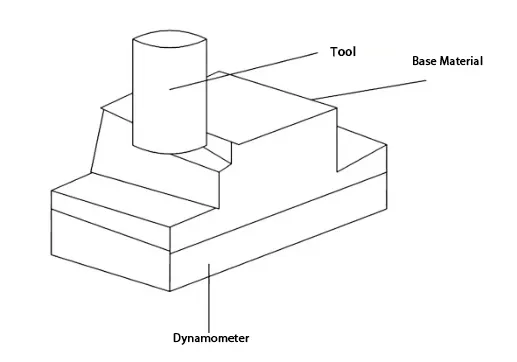
Example of the Use of High-Speed Cutting Technology in Mold Processing
Slide Parts Machining
Since curved parts are commonly used in mold processing, this study uses the machining of slide rib parts as an example.
It tests and analyzes the performance and effects of high-speed cutting technology on the processing of slide parts.
Researchers selected the slide ribs of a mechanical component for testing and analysis.
The designers added the component to the machine’s overall front edge.
They mounted the slide ribs symmetrically on the front beam.
This enhanced support for the front edge and assisted its rotation within the machine’s overall structure.
The base material is 7010/7050-T7651 aluminum alloy pre-drawn sheet, which meets the requirements of high-speed cutting technology, with a thickness of 45-50 mm.
Precision Machining Techniques and Challenges
During part processing, manufacturers transform the rail rib into an integrated inner and outer rib.
They also create a fixing mark to ensure the rib pairs remain securely fixed while machining the rail rib metal parts.
At the same time, manufacturers must consider differences in curvature and position when processing and manufacturing high-precision parts.
They need to match mechanical skin edge strips and ribbed parts precisely to ensure all rib pairs align well.
This alignment helps manage the groove cavity’s width and depth while enhancing rib bending.
Additionally, they ensure the through-holes, distribution holes, installation positions, and curvature are highly consistent.
This guarantees the proper fit of the two slides in each set of rib pairs within the mechanical equipment.
Manufacturers control the quality difference between the two sliding ribs in each rib pair to within 10 grams or less.
Application of High-Speed Cutting and Quality Evaluation
In summary, when machining slide parts, manufacturers must thoroughly consider the complex structures of the parts, including multiple curved surfaces, grooves, and joints.
To machine these complex shapes effectively, they must select suitable cutting tools and optimize their machining procedures.
This study selects the DIGIT318 high-speed machining center and uses an alloy high-speed milling cutter.
It employs an oil mist cooling method to effectively reduce base material deformation caused by drastic temperature changes and ensure the parts’ curvature accuracy.
In addition, when applying high-speed cutting technology to slide parts, manufacturers analyze the mechanical parts’ structure and curvature.
They then select the appropriate clamping method.
They can use a vacuum platform adsorption combined with lever-assisted clamping, controlled through CATIA programming.
This study designed six groups of slide rib processing parameters, shown in Table 1.
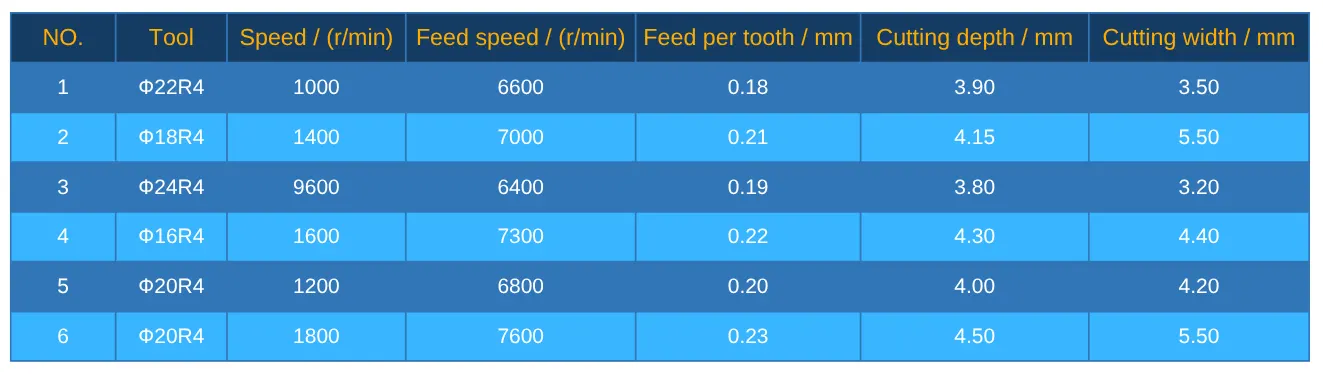
Based on the machining parameters designed in this study, manufacturers applied high-speed cutting technology to process the slide’s ribbed parts.
After inspection, the product conformity rate reached 98%, meeting the standard requirements for mold part processing.
At the same time, this approach improved the precision and quality of the bending parts processed by the 148 Agricultural Machinery and Equipment in November 2024.
Aluminum Wall Plate Processing
Researchers selected typical metal wall plate parts to analyze how high-speed cutting technology performs in processing aluminum alloy wall plates.
In this study, a pre-drawn plate with a base material of 7B04T7451 is selected, measuring 1,520 mm × 1,500 mm × 35 mm and having a thickness of 2.50-6.00 mm.
The aluminum alloy wall plate parts have a relatively complex structure, and manufacturers control the surface dimension errors within 0.01 mm.
Under the requirements of high-precision manufacturing and processing, traditional technology has limitations.
It lacks precision in tool operation and machine tool control, struggles to provide sufficient power, and often reduces the cutting efficiency of the base material and the quality of negative mold processing.
Application of High-Speed Cutting and Equipment Configuration
The study utilizes high-speed cutting technology and employs the three-coordinate high-speed gantry milling machine V2-3500B as its primary equipment.
It combines these characteristics with the properties of the base material. It selects high-precision cutting tools, including the Yabao carbide high-speed milling cutter and the Austrian climbing machine clamping high-speed milling cutter.
The study employs the latest version of the numerical control programming software, CATIA v5, to develop the vacuum adsorption clamping program.
Process Optimization and Quality Improvement Outcomes
Based on the cutting requirements of different mechanical parts, this study assigned specific cutting parameters to parts 1 through 7.
This targeted application of high-speed cutting technology in die and mold processing provides a basis for personalized design, as shown in Table 2.
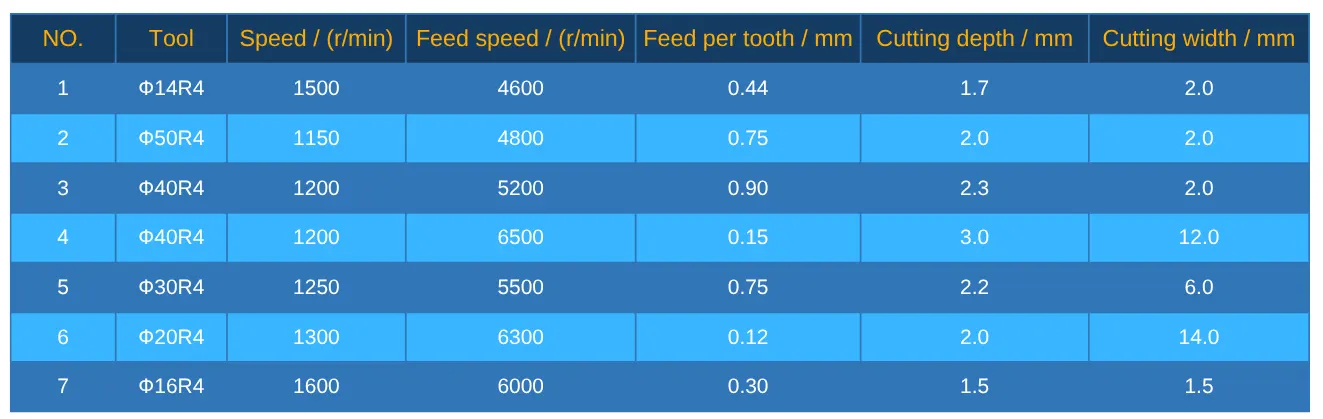
Using the processing parameters designed in Table 2, manufacturers applied high-speed cutting technology to large aluminum alloy wall plate parts.
Product quality inspections achieved a pass rate of 98.50%, exceeding the basic requirements of the mold processing industry.
This approach not only improves the accuracy and quality of mold processing but also reduces raw material costs.
Conclusion
In summary, high-speed cutting technology, as an advanced processing method, significantly outperforms traditional techniques in metal parts manufacturing.
It compensates for the lower precision and quality issues often found in traditional mold processing.
This study specifically analyzes the application of high-speed cutting technology in mold processing by focusing on large aluminum alloy wall plates and slide rib parts.
It fully demonstrates the advantages of high-speed cutting technology and provides a basis for innovative mold processing methods.