Comprehensive Comparison of Aluminum Alloys 6061 and 7075


Titanium alloys are widely used in aerospace, biomedical, and marine engineering fields due to their high-temperature resistance, corrosion resistance, and high specific strength.
Different heat treatments can enhance the properties of titanium alloy materials, achieving a balance between toughness, plasticity, and strength.
Therefore, the material properties and microstructural changes of titanium alloys under heat treatment are a key focus of scholarly research.
Li Jinshan et al. investigated the thermal deformation behavior and mechanisms of high-strength metastable β-titanium alloys, exploring work hardening and flow softening during thermal deformation.
Xiao Shulong et al. focused on the effects of heat treatment on creep evolution and tensile properties of titanium alloys.
Wang Qingjuan et al. examined how different deformation states and solution cooling methods influence the microstructure and mechanical properties of B-type titanium alloys.
Although scholars have achieved a series of results in titanium alloy research, studies on the effects of heat treatment on microstructure evolution and mechanical properties still require further in-depth investigation.
Therefore, it is important to study how different heat treatment processes affect titanium alloys.
These processes include forging, hot rolling, and solution treatment.
Such treatments can significantly alter the microstructural evolution of the material.
They also influence key mechanical properties, including hardness and tensile strength.
Understanding these effects is crucial for the engineering application of titanium alloys.
The titanium alloy used in the experiment was Ti-3Al-8V-4Mo-4Cr-4Zr-2Fe-2Nb, with ingots obtained through vacuum consumable arc melting. The chemical composition test results after melting are shown in Table 1.

Forging of ingots using the RZU200HF press: initial temperature 1100°C, final temperature 860°C, with 1-hour soaking at each temperature.
After five passes of rough forging, the ingots were precision forged into φ30 mm bars using a precision forging press with multiple passes per heating cycle.
We heated the precision-forged bars to 850°C and held them for 30 minutes.
Then, we hot-rolled them through eight passes on a rolling mill to produce φ16 mm bars.
We subjected samples of the titanium alloy bars to a 30-minute solution treatment at 750°C, followed by 30 minutes of air cooling.
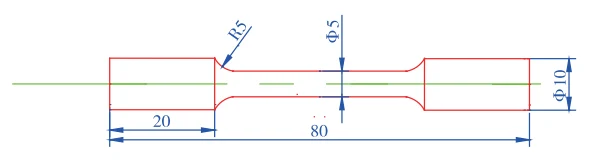
Standard specimens were cut from the heat-treated titanium alloy rod using wire cutting, with dimensions and shape as shown in Figure 1.
We conducted tensile tests according to GB/T 228-2002.
We measured Vickers hardness using an HVS-50 Vickers hardness tester with a 250 g applied load and a 10 s holding time, and calculated the average hardness value from six test points.
Hardness Formula:
-1.jpg "(1)")
In the formula, d is the average indentation diagonal, mm; P is the applied load value, N.
We used an OLYMPUS metallographic microscope for observation, and conducted metallographic microstructural analyses on the titanium alloy specimens.
We examined the specimens after forging, hot rolling, and solution treatment.
The metallographic specimens were mechanically polished by sandpaper grinding and then etched using HF:HNO₃:H₂O = 1:3:6 (volume ratio) reagent.
We observed the phase composition, microstructure morphology, and distribution characteristics of the heat-treated titanium alloy specimens using a JSM-6390 scanning electron microscope (SEM).
Specimens were etched in an HF:HNO₃:H₂O solution (1:3:10, volume ratio).
We performed phase analysis of the heat-treated titanium alloy specimens using a Shimadzu 7000 X-ray diffractometer (XRD) with a scanning angle of 20°–90° and a scanning speed of 5°/min.
Figure 2 shows metallographic optical microscope images of titanium alloy specimens after various heat treatments.
Figure 2(a) shows the metallographic microstructure of the cast titanium alloy.
We observed numerous large-sized casting structures within the titanium alloy crystals, and we found individual areas exhibiting defects such as porosity and disordered irregular lines.
The average grain size is approximately 1500 μm, and the grain boundaries within the titanium alloy are relatively distinct.
Figure 2(b) shows the metallographic microstructure of the titanium alloy after rough forging.
It reveals relatively dense rectangular strip twins distributed within the β crystals, with the β titanium alloy grains appearing finer than before forging.
Compared to Figure 2(a), the average grain size after rough forging is approximately 450 μm.
The grain size exhibits an uneven distribution, increasing from the outer to the inner regions.
The number of defects such as porosity observed within the titanium alloy has significantly decreased or even disappeared, indicating substantial microstructural changes.
Figure 2(c) shows the metallographic microstructure of the titanium alloy after precision forging.
The microstructure exhibits uniform distribution with further refined grains, averaging approximately 100 μm in size.
Figure 2(d) shows the metallographic microstructure of the titanium alloy after hot rolling.
The average grain size is approximately 20 μm, with discontinuous and curved grain boundaries. The grains are extremely fine and fragmented.
Figure 2(e) shows the metallographic microstructure of the titanium alloy after solution treatment. The average grain size is approximately 55 μm.
The microstructure contains very few α-phase grains, primarily consisting of equiaxed β-phase grains.
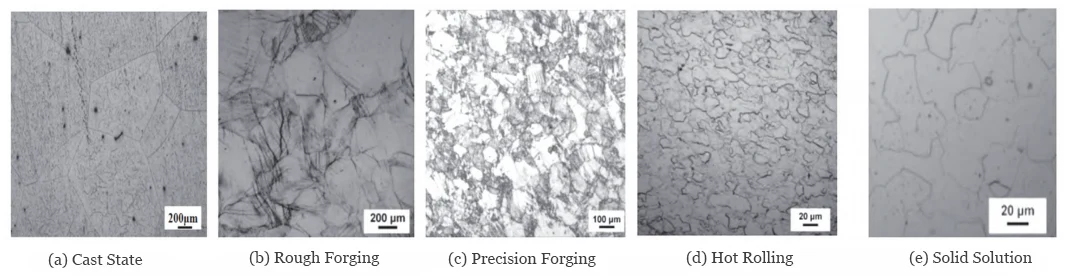
Figure 3 shows the X-ray diffraction (XRD) pattern of the cast titanium alloy specimen.
It can be seen that the titanium alloy exhibits distinct characteristic peaks of the β phase, confirming that the microstructure is predominantly β phase.
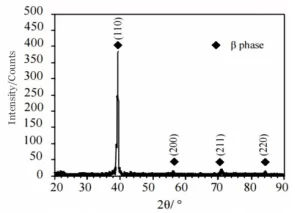
Figure 4 presents the XRD pattern of the forged titanium alloy specimen.
It can be seen that the XRD pattern of the titanium alloy after rough forging (Figure 4(a)) contains the characteristic peak of the α phase (101), indicating the presence of an α phase structure in its microstructure.
However, in the XRD pattern of the titanium alloy after precision forging (Figure 4(b)), the characteristic α-phase (101) peak is almost invisible.
This observation indicates that the rapid cooling rate during precision forging results in minimal α-phase precipitation.
Simultaneously, the characteristic peak intensity in the XRD pattern of the refined-forged titanium alloy exceeds that of the rough-forged sample by nearly threefold.
Moreover, the intensity of the β-phase diffraction peak is exceptionally high.
At the same time, the diffraction peaks of other phases are significantly reduced.
These observations indicate the development of grain texture in the refined-forged titanium alloy.
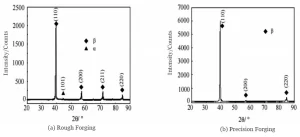
Figure 5 shows the XRD pattern of the titanium alloy specimen after solution treatment.
It can be seen that the microstructure of the titanium alloy remains β-phase after solution treatment, with a strong β diffraction peak, indicating that a single β phase can be obtained after solution treatment.
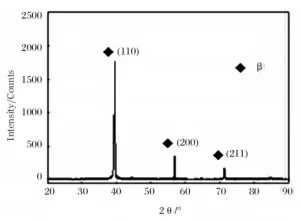
Figure 6 shows the microstructural morphology of the titanium alloy in as-cast, rough forging, finish forging, and solution-treated states as observed by scanning electron microscopy.
The SEM image of the as-cast titanium alloy in Figure 6(a) reveals dendritic crystals formed during casting due to temperature variations, with the alloy existing in a pure β phase.
The SEM image of the titanium alloy after rough forging (Figure 6(b)) reveals that the β grains transformed from the large, coarse morphology in the as-cast state to an equiaxed form after the upsetting and forging process.
Within the grains, plate-like α phase precipitates are visible, arranged in a cross-parallel orientation along different directions and growing along the grain boundaries.
Simultaneously, defects near grain boundaries present in the as-cast state are eliminated, indicating recrystallization of β grains during forging.
Figure 6(c) clearly shows that after precision forging, the microstructure of the titanium alloy transforms into a fine-grained β phase structure with no α phase present within the grains.
Figure 6(d) reveals that after solution treatment, linear α phase precipitates along grain boundaries from the β phase matrix, with a relatively low content of the precipitated α phase.
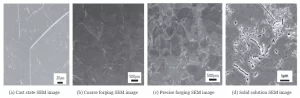
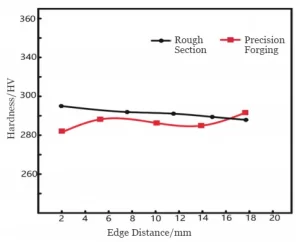
Figure 7 shows the distribution of hardness test values for the cross-section of the titanium alloy specimen after forging.
It can be observed that the hardness values of the titanium alloy decrease from the outer to the inner regions after rough forging.
This is attributed to the greater deformation at the outer edges of the specimen’s cross-section compared to the central region during rough forging, resulting in non-uniform deformation.
As seen in Figures 2(b) and 6(b), the grain size at the outer edges of the titanium alloy after rough forging is smaller than that in the central region. According to the Hall-Petch formula:
-1.jpg "(2)")
(where σs is the crystal yield strength and d is the average grain diameter) indicates that fine grains enhance the alloy’s yield strength, a phenomenon known as grain refinement strengthening.
This microstructural explanation accounts for the decreasing hardness values observed from the outer to inner regions of the titanium alloy in Figure 7 following coarse forging.
Meanwhile, the hardness test curve of the refined-forged titanium alloy specimen in Figure 7 shows that the hardness values at the outer edge and the center are essentially identical.
Overall, the specimen exhibits a generally uniform hardness distribution.
Observation of Figures 2(c) and 6(c) shows that the grain sizes at the outer edge and center of the refined-forged titanium alloy are essentially the same.
This indicates that the material experiences a uniform deformation from the interior to the exterior after refined forging.
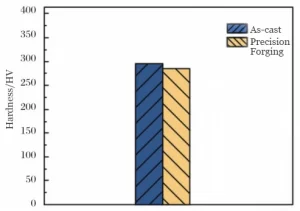
The hardness distribution of titanium alloys in as-cast and precision-forged states is shown in Figure 8.
It can be observed that forging has a relatively minor effect on the hardness of titanium alloys.
As seen in Figure 4(a), a small amount of α phase precipitates after rough forging. The precipitation of the α phase can increase the alloy’s hardness.
However, since the precipitation of the α phase is minimal after precision forging, the alloy exhibits relatively low hardness.
According to the solid solution strengthening formula for materials:
-1.jpg "(3)")
(where σc denotes the critical shear stress; for a saturated solid solution, k is taken as 2/3; for a dilute solid solution, k is taken as 1/2) it can be seen that the strength of titanium alloys can be enhanced through solution treatment.
The tensile properties of the titanium alloy after hot rolling are shown in Table 2.
Tested at room temperature, the material exhibited an elongation range of 18.9% to 20.1% and a tensile strength between 887 and 891 MPa, indicating excellent plasticity after hot rolling.
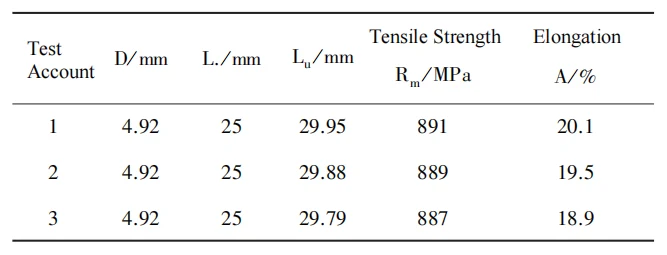
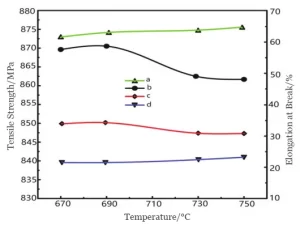
Figure 9 shows the tensile curves of titanium alloys after 30 minutes of air cooling following treatment at different solution treatment temperatures.
In the figure, lines a, b, c, and d represent the measured data for the cross-sectional reduction of area, ultimate tensile strength, yield strength, and elongation of the titanium alloy, respectively.
It can be observed that the tensile strength of the titanium alloy gradually decreases as the solution treatment temperature increases.
Similarly, the yield strength also decreases with rising temperature.
At the same time, the cross-sectional reduction of area and elongation slowly increase as the temperature rises.
At a solution treatment temperature of 750°C, the elongation and reduction of area were approximately 24% and 65%, respectively, indicating good plasticity.
The ultimate tensile strength and yield strength were 861 MPa and 847 MPa, respectively.
The difference between the ultimate tensile strength and yield strength remained relatively constant as the temperature increased.
This behavior demonstrates the stability of the mechanical properties of the titanium alloy after solution treatment.
(1) Cast titanium alloys exhibit a pure β phase. Following hot forging, the microstructure primarily consists of the β phase with trace α phase precipitation.
After hot rolling, no α phase is present within the grain structure.
(2) Heat treatment affects the grain structure of titanium alloys as follows: Cast alloys feature large, unevenly distributed grain diameters.
Following rough and precision forging, grain size reduces from approximately 1500 μm in the as-cast state to about 100 μm.
Further hot rolling refines grains to 20 μm. After solution treatment, the microstructure primarily consists of equiaxed β-phase grains.
(3) The mechanical properties of the titanium alloy are enhanced after heat treatment.
The hardness difference between the as-cast and precision-forged states is minimal, indicating that forging has a negligible effect on the alloy’s hardness.
After rough forging, the hardness of the titanium alloy decreases from the outer to the inner regions.
Following precision forging, the hardness distribution becomes relatively uniform.
The plasticity of the titanium alloy material is good after hot rolling and solution treatment.
At a solution treatment temperature of 750°C, the elongation and reduction of area are approximately 24% and 65%, respectively.