How to efficiently machine shaped parts on CNC mill-turn machines?
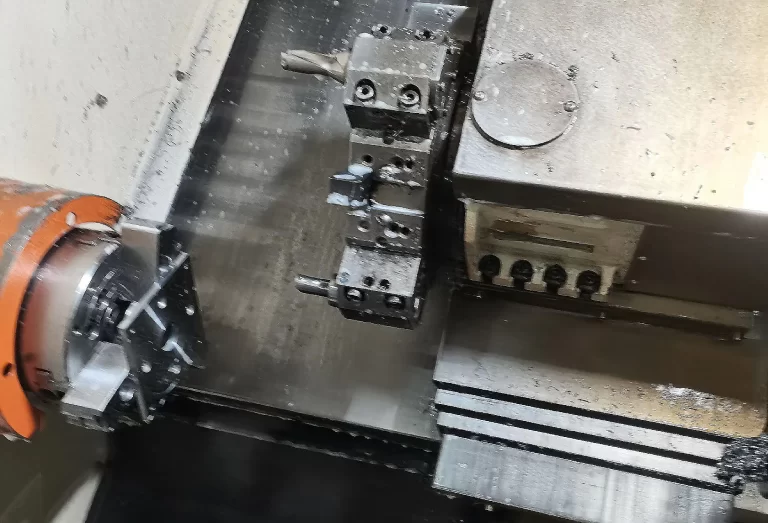


Turning-milling composite machines integrate dual turning and milling capabilities, enabling the completion of all or most machining processes on a single machine.
This not only enhances machining precision but also significantly boosts production efficiency.
In contrast, traditional CNC machines can only focus on single milling or turning tasks, presenting certain limitations.
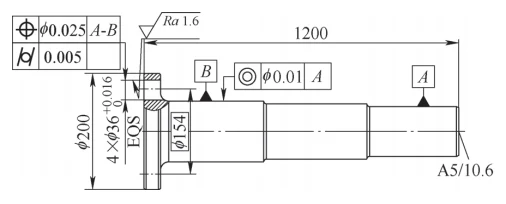
Figure 1 depicts a long shaft-type component with flange surfaces.
Employing a turning-milling composite machine substantially simplifies the machining sequence.
Although the primary function of such machines is turning, with milling serving as an auxiliary capability, they can still achieve high-precision hole positioning.
For instance, in Figure 1, the positional accuracy of four φ36+0.0160mm holes relative to the A-B datum requires φ0.025mm, with a cylindricity tolerance of 0.005 mm.
Achieving such precision on such a large component presents significant challenges.
The conventional process involves completing turning operations, then transferring the part to a CNC boring machine for aligning the A-B datum and drilling/boring the four φ36+0.0160 mm holes.
However, this approach introduces additional clamping and alignment errors.
The use of a turning-milling composite machine effectively avoids clamping and calibration errors, enabling drilling and boring operations directly after turning.
However, due to the multiple axes on such machines and the varying precision of each axis, processing on different axes may cause discrepancies in positional data.
Therefore, researchers must explore ways to enhance the hole positional accuracy of turning-milling composite machines to ensure part quality meets specifications.
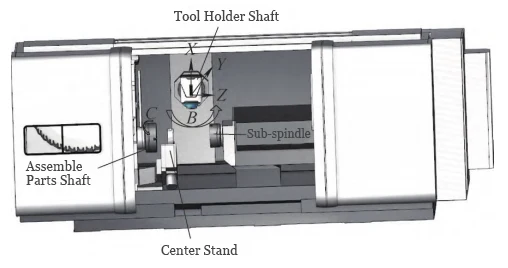
A typical turning-milling composite machine model is shown in Figure 2.
Compared to conventional models, it features an additional sub-spindle equipped with both turning and milling capabilities, along with its own power source.
Its function resembles that of the main spindle used for clamping workpieces, though with relatively lower power.
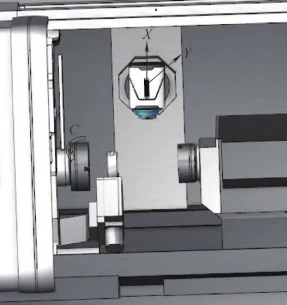
Upward movement of the spindle (tool-holding axis) defines the positive direction of the X-axis, while downward movement defines the negative direction.
Forward movement of the spindle defines the negative direction of the Y-axis, and backward movement defines the positive direction.
Horizontal rightward movement of the spindle defines the positive direction of the Z-axis, and leftward movement defines the negative direction.
Counterclockwise rotation of the spindle defines the positive direction of the B-axis, while clockwise rotation defines the negative direction.
The B-axis tool-holding spindle enables milling at any angle within its rotational range, facilitating the machining of various angled surfaces, pockets, and holes.
It supports multi-axis simultaneous machining and effectively avoids clamping interference during processing through angular rotation.
The chuck axis (workpiece mounting axis) defines counterclockwise rotation as the positive direction of the C-axis, while clockwise rotation is negative.
The C-axis enables circular angular positioning and equal division, facilitating milling, drilling, and boring operations.
Taking the long shaft component with flange faces shown in Figure 1 as an example, this section explores how to enhance the machining accuracy of positioning holes for flange faces on turning-milling composite machines.
Determine the maximum permissible error for each moving axis when the positional accuracy is φ0.025mm, to select an appropriate machining method.
The hole coordinate data is shown in Figure 3. Position tolerance = 2[(X theoretical value – X measured value)² + (Y theoretical value – Y measured value)²]¹/².
Based on the hole coordinates in Figure 3, assuming the deviation values for the X and Y axes are equal in magnitude and direction, the calculation method is as follows: Let the deviation value be A.
Then the measured X value is A, and the measured Y value is (77.0 + A). Thus, Position Accuracy = 2[(0 – A)² + (77.0 – 77.0 – A)²]¹/² = 0.025. This yields A ≈ 0.0088.
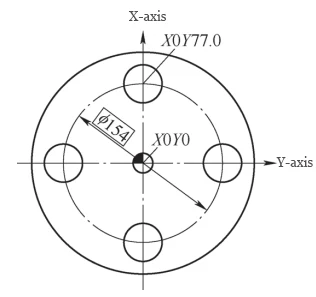
According to the calculation results, the maximum allowable error for each moving axis is approximately 0.0088 mm, meaning the cumulative error of two moving axes must be ≤0.0176 mm.
For large machine tools, this requirement sets a relatively high standard.
Machinists can ensure a positional accuracy of φ0.025 mm only when the machine’s precision meets this level.
Multi-axis machining centers feature numerous processing axes, including linear axes (X, Y, Z) and rotary axes (B, C).
Different axis combinations during machining can lead to variations in positional accuracy data.
The finishing process flow for long shaft-type components with flange faces is as follows.
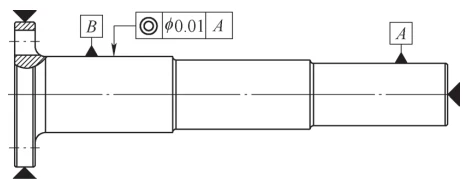
1.First-time clamping, as shown in Figure 4, involves clamping the component’s φ200mm outer diameter on a turning-milling composite machine.
The machinist supports the small-end center hole during turning to complete the outer diameter machining of the long shaft.
Single-pass turning using A and B reference points ensures concentricity ≤0.01mm.
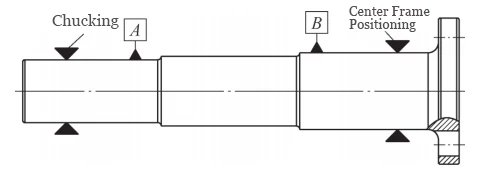
2.Second setup as shown in Figure 5: Clamp the part by its A-reference outer diameter while supporting the B-reference point with a center rest.
Align to ensure axial runout between A and B axes ≤ 0.01 mm. Turn the φ200 mm outer diameter and large end face.
Drill and bore four φ36+0.0160mm locating holes, ensuring positional accuracy ≤ φ0.025 mm.
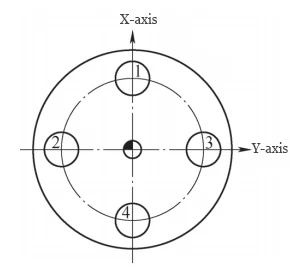
Machining with Two Linear Axis Positioning. The part hole positions are shown in Figure 6, and the machine tool positioning axes are shown in Figure 7.
When machining the four positioning holes shown in Figure 6, the machinist uses the X and Y linear axes shown in Figure 7 as positioning axes.
Establish the center coordinates of the A-B axis as the origin and set the zero point for the angular C axis.
Complete holes 1, 2, and 3 in Figure 6 by moving the X and Y axes, then rotate the angular C axis 180° to machine hole 4.
This machining approach represents the most conventional operation, offering the advantage of minimizing precision errors in the rotary axes.
For small precision machine tools, the traditional view holds that linear axes exhibit higher precision than rotary axes.
However, the introduction of high-end machine tools has overturned this conventional belief, prompting machinists to adopt the machining approach described in Method Two.
Combined machining of linear and rotary axes.
Align the A-B axis center coordinates as the origin, set the angular C-axis zero point, position the X and Y axes to the center of Hole 1 to machine it, then rotate the angular C-axis 90° to machine Hole 2 while keeping the X and Y axes stationary.
Similarly, rotate the C-axis 180° to machine Hole 4 and 270° to machine Hole 3.
This approach leverages the principle that the rotational axis’s precision exceeds the cumulative error accuracy of the two linear axes, thereby enhancing hole machining accuracy.
Regardless of whether machinists choose Method One or Method Two, the A-B axis center origin plays a crucial role.
For turning-milling centers, the turning origin and milling origin are not identical points; a deviation exists between them, directly affecting the positional accuracy of hole machining.
For machining long shaft-type parts, the precision of the center support can also introduce errors in the milling origin.
Therefore, when machining holes that require high precision, machinists must redefine the milling origin before starting the process.
Based on experimental data and inspection results from actual production environments, the machining accuracy of turning-milling composite machines varies significantly depending on the combination of linear and rotary axes used for positioning and integrated machining.
After processing using Method One, coordinate measuring machine (CMM) inspection revealed the positional accuracy of four φ36+0.0160mm locating holes to be φ0.02~φ0.04mm.
After processing using Method 2, coordinate measuring machine inspection of the four φ36+0.0160mm locating holes showed positional accuracy ranging from φ0.005 to φ0.020mm.
When machining holes with high precision requirements, it is necessary to clearly define the accuracy parameters of each axis on the equipment.
This paper analyzes the characteristics of turning-milling composite machines.
The combination of axes with different precision levels can affect hole positioning accuracy.
Selecting an appropriate machining strategy can achieve high hole positioning accuracy.
In actual production, strategies should be flexibly chosen based on specific equipment precision and machining requirements to ensure hole positioning accuracy meets specifications.
Additionally, regularly calibrating and maintaining each machine axis to reduce error accumulation is a critical measure for ensuring machining precision.