How to efficiently machine shaped parts on CNC mill-turn machines?


With the continuous advancement of socioeconomic development, demands for manufacturing efficiency are constantly increasing.
In the machining field, turning processes—a crucial component—must not only optimize part processing time but also ensure manufacturing precision.
Therefore, improving production cycle times and dimensional consistency in turning operations is essential.
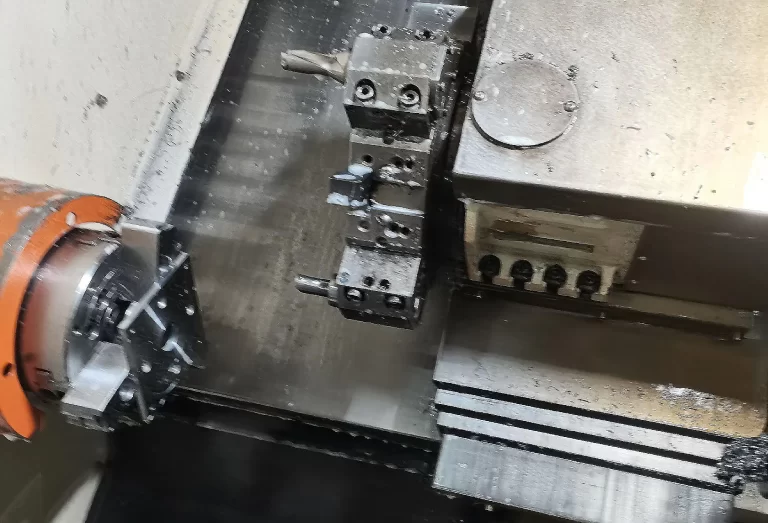
Traditional CNC turning often requires frequent tool changes and multiple tool setting operations.
This not only wastes setup time and causes redundant movements but also leads to cumulative errors during repeated tool setting on the lathe.
Based on current production conditions, this paper proposes a combined machining process path grounded in multi-process coordination principles.
By reconfiguring tool arrangement logic and sequence, this method integrates external cylindrical, internal bore, and end-face machining.
It enables multi-process coordination on existing CNC lathes without requiring specialized fixtures or equipment modifications, offering a practical approach to enhancing production efficiency and machining precision.
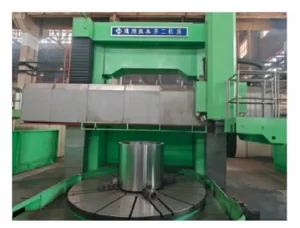
As shown in Figure 1, taking the CK5235×25/32 CNC double-column vertical lathe as an example, its turning process typically employs sequential tool changes to complete the full machining task for a single part.
For shaft or sleeve-type components, this generally involves multiple steps including external cylindrical machining, end face machining, and internal bore machining.
Due to spatial constraints and clamping limitations on most lathe tool holders, only two turning tools can typically be mounted simultaneously.
This inability to cover all process requirements simultaneously frequently leads to the following issues during machining, as summarized in Table 1.
| Existing Problem | Cause |
|---|---|
| High tool change frequency | Usually requires 2–3 tool changes, resulting in a significant increase in auxiliary time |
| Complex tool setting operations | Each tool change requires re-calibration of the tool position, increasing operator workload |
| Accumulated dimensional errors | Multiple tool changes and re-clamping may introduce cumulative errors, affecting part dimensional consistency |
| Uncontrollable machining cycle | Large fluctuations in auxiliary time make it difficult to standardize the batch production rhythm |
Table 1: Problems encountered during the processing
Taking the machining of a set of similar parts as an example, the processing time comprises effective cutting time and setup time.
Effective cutting time may account for only about 85% of the total time, while tool changes and tool setting during setup consume approximately 10% of the auxiliary time.
Therefore, improving production cycle time requires integrating processes to achieve collaborative optimization.
To further enhance cycle efficiency, this paper categorizes and summarizes commonly used tools and machining processes based on a multi-process collaborative machining strategy, thereby optimizing tool positioning and shortening cutting paths.
As shown in Figure 2, this approach achieves single-setup tooling for both internal/external cylindrical machining and end-face machining.
This not only reduces errors introduced by multiple tool setting operations but also significantly saves setup time.
In CNC turning, various machined surfaces often require sequential completion using multiple tools.
Each tool change involves auxiliary actions and interruptions to the machine’s operational cycle.
The multi-process collaborative machining strategy achieves rational allocation of tooling resources and optimized process paths by integrating multiple machined surfaces into a single continuous machining flow for simultaneous completion, thereby optimizing the overall cycle time.
To meet these requirements, this paper employs collaborative process design to integrate three primary process categories for key production components into a unified execution system: rough and finish turning of external cylindrical surfaces, finish machining of end faces, and rough and finish turning of internal cylindrical surfaces.
These processes feature clearly defined sequences and smooth transitions between machining zones, providing a solid foundation for integration.
By standardizing clamping references and coordinate systems, repetitive tool setting operations are eliminated, enabling cycle time reduction.
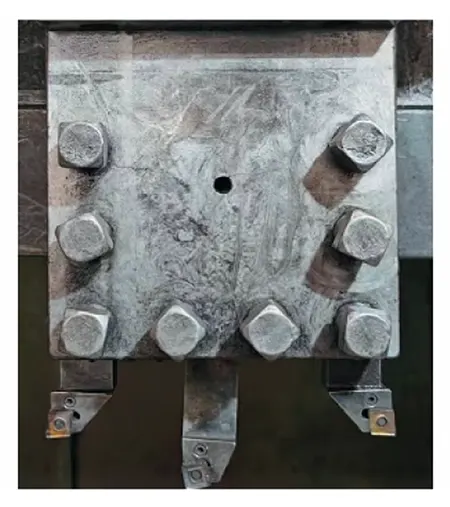
To evaluate the effectiveness of multi-process collaborative machining in actual production, a process trial was conducted using 10 sleeve components with an outer diameter of φ2000mm, inner diameter of φ1800mm, length of 50mm, and material 13MnNiMoR.
The machining parameters are listed in Table 2.
The machining outcomes of traditional tool layouts versus modular tool layouts were compared across roughing/finishing of outer diameters, finishing of end faces, and finishing of inner diameters.
During continuous machining of 10 workpieces per layout, key metrics including average machining time per piece, tool change frequency, and tool setting time were recorded. Statistical results are presented in Table 3.
| Process | Cutting Speed (m/min) | Feed Rate (mm/r) | Cutting Depth (mm) |
|---|---|---|---|
| External Turning | 125 | 0.5 | 5 |
| Facing | 94 | 0.6 | 7 |
| Internal Boring | 90 | 0.4 | 6 |
Table 2: Processing Parameters
| Item | Traditional Structure | Three-Tool Combined Structure |
|---|---|---|
| Machining time per part | 2.5h | 2h |
| Tool change count / part | 2 | 0 |
| Tool change time / part | 5min | 5min |
| Tool alignment count / part | 2 | 1 |
| Tool alignment time / part | 20min | 20min |
| Saved machining time | — | ≈5h |
Table 3 Comparison of Cycle Efficiency and Tool Change
In batch turning production, enhancing single-piece machining efficiency and stability remains a core objective.
The multi-process collaborative machining solution proposed herein achieves the following key technical advantages without relying on structural innovation, but through process logic reorganization and coordinated tool position control, as shown in Table 4.
| Advantage | Reason |
|---|---|
| Significantly improved cycle efficiency | Eliminates cycle interruptions caused by frequent tool changes in traditional machining |
| Significantly improved dimensional consistency | Avoids errors introduced by repeated clamping, controlling the accumulation of dimensional deviations |
| Easier operator handling | Reduces the tool-change process, improving the level of standardized operation |
| Enhanced compatibility | Achieved by adjusting tool positions without modifying the machine tool itself |
Table 4: Technical Advantages
In summary, this study analyzed the turning process of the CK5235×25/32 CNC double-column vertical lathe and summarized its machining characteristics.
Without altering the lathe structure or designing special fixtures, process path optimization was achieved solely through optimized tool positioning.
This resolved issues in the original turning process, including frequent tool changes, multiple tool setting operations, and poor dimensional consistency.
Furthermore, process trial results demonstrate that the improved setup reduced tool changes from 2 per part to 0, shortened processing cycles by over 10%, and effectively validated that collaborative machining enhances production cycle efficiency.
This approach not only simplifies operator tasks but also boosts production efficiency and machining precision, offering broad application prospects and providing a practical optimization solution for similar equipment.