
Today, consumers increasingly pursue the ultimate experience of ultra-thin products and aesthetically pleasing designs.
Most products on the market strive for ultra-thin profiles and premium surface finishes, such as ultra-thin smartphones and ultra-thin laptops.
Within safety constraints, aerospace components also prioritize lightweight design.
This approach reduces overall product mass, extending flight duration for the same fuel consumption.
Conversely, when total weight remains constant, lighter components allow for increased kerosene capacity or passenger load, thereby enhancing operational efficiency.
Processing Challenges
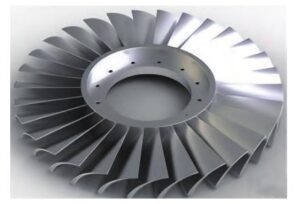
Typical deep-cavity thin-walled components, as shown in Figure 1, present the following processing challenges.
Poor tool rigidity
The deeper the cavity of the machined part, the poorer its rigidity; the longer the tool protrudes from the machine tool clamping, the poorer the tool’s rigidity.
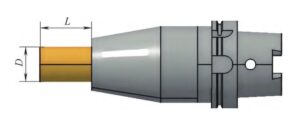
As shown in Figure 2, the tool clamping length generally dictates that the tool overhang length L should not exceed three times the tool diameter D.
For example, if the tool diameter is 10mm, the overhang length should ideally be kept within 30mm.
This principle primarily considers tool rigidity and cutting stability.
Excessive overhang reduces tool rigidity, increasing the likelihood of vibration and deflection, which adversely affects machining accuracy and surface finish.
Technical Requirements
For rotating deep-cavity thin-walled components, such as impeller discs, dynamic balance must be ensured post-machining.
Typically, dynamic balance accuracy for impeller discs is specified at G6.3 or G2.5 grade.
The profile tolerance for blades is generally required to be ±0.07mm, with a thickness tolerance of ±0.15 mm and a surface roughness value Ra = 0.8 μm.
Process Analysis
Blank Preparation
Forging a blank with a diameter of 1000mm made of titanium alloy, which is lightweight and high-strength.
The forging process effectively increases the relative density of the part, enhancing its structural strength.
Rough Machining
Rough-turn the outer and inner diameters on a CNC lathe, leaving a 1.5mm allowance on each side.
Semi-Finishing
Perform semi-finishing turning of the outer diameter and bore on a CNC lathe, leaving a 1mm allowance on one side.
Finish-machine the locating pin holes as process reference points for subsequent machining operations on a five-axis CNC machine.
Employ a two-pin locating method on one face to restrict the part’s spatial movement to six degrees of freedom.
Rough Machining
Five-axis CNC machine tool (DMU MONOBLOCK 80P) rough-machines cavities, leaving a 1.5–2 mm machining allowance on one side.
Heat Treatment
Annealing is performed to relieve internal residual stresses.
Its purpose is to fully release internal stresses generated during rough machining while simultaneously reducing the work-hardening of the component.
Semi-Finishing
On a five-axis CNC machine, a ball-nose end mill is used for semi-finishing the cavity.
A machining allowance of 0.3 to 0.5 mm is reserved on one side of the cavity blades to accommodate subsequent precision milling and polishing operations.
Heat Treatment
Normalizing parts not only enhances their hardness, ensuring sufficient strength during subsequent operation, but also further relieves internal residual stresses through heat treatment.
Finishing
Finish-turn the inner diameter to final dimensions on a CNC lathe.
Machine threaded holes and pin holes on a CNC milling machine, where M6 threaded holes are milled to ensure perpendicularity and pass/fail gauge requirements; pin holes are bored.
Finish-machine the cavity blades on a five-axis CNC machine, leaving a 0.08mm machining allowance on one side.
A slight allowance is left for manual polishing, with a typical tool mark depth of 0.05mm.
Polishing
First, manually rough-polish the cavity blades until no tool marks remain.
Then, manually fine-polish the cavity blades to achieve the required surface quality.
Product Machining Solutions
During rough machining, the overall rigidity of the impeller disk is relatively good.
Combined with a 1mm allowance thickness reserved on one side, rough machining is not particularly difficult.
During semi-finishing and finishing operations, however, the exposed sections between blades exhibit poor rigidity.
Combined with the deep blade profiles, the tool clamping length must be sufficiently long to reach the blade roots, resulting in severe tool rigidity deficiencies.
To address these machining challenges, the following approaches are primarily considered.
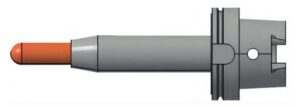
(1)Use an extended tapered HSK tool holder (see Figure 3) to minimize tool overhang and enhance tool rigidity.
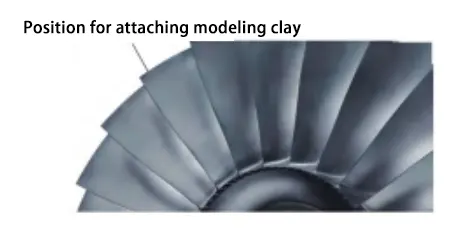
(2)During blade finishing, apply modeling clay (see Figure 4).
The clay absorbs vibrations generated by the ball-nose cutter during blade machining.
(3)Selection of ball-nose cutter.Use a 10mm four-flute ball-nose end mill with transverse flutes, made of cemented carbide.
The cutting edge length is 15mm, with a front angle of approximately 16°.
This tool is relatively sharp, resulting in lower cutting resistance and reduced vibration.
Conclusion
Addressing the machining challenges of deep-cavity thin-walled components, we optimized tool paths and cutting methods through physical approaches.
On one hand, we appropriately increased the tool’s rake angle and number of cutting edges to reduce cutting resistance jointly.
On the other hand, we wrapped the front end of the cutting edge with modeling clay to absorb vibrations, thereby reducing blade vibration.
This approach resolved the machining difficulties and provided valuable experience.