
With advances in contemporary manufacturing technology, industries now extensively use drive shafts to transmit loads.
Drive shaft bushings serve as critical components ensuring transmission efficiency and effectiveness.
The primary function of bushing-type parts is to reduce wear between the shaft and support housing.
They also guarantee proper alignment between shafts and enable the entire transmission system to operate normally.
The machining quality of sleeve components directly impacts their assembly accuracy and operational precision with other parts.
It can even affect the lifespan and performance of the equipment.
Establishing a rational cutting process for sleeve components is fundamental to guaranteeing their surface dimensional accuracy and positional accuracy.
This paper develops a specific machining process route for a transmission shaft sleeve component, considering its structural characteristics and processing requirements.
The aim is to provide a research reference for the process control of sleeve components.
Machining and Structural Features of Sleeve Components
The sleeve components studied here feature relatively complex geometries, with the raw parts cast from 45 steel.
We examined the sleeve component drawing in Figure 1 and identified its primary machined surfaces and their requirements.
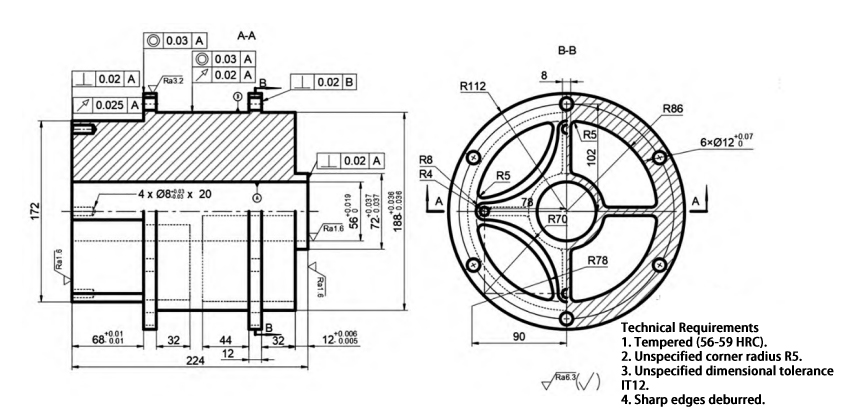
(1)We designate the φ188 outer circular surface as the primary machined surface, requiring a surface roughness of Ra 3.2 μm.
(2)We require the φ56 bore, as the primary machined surface, to have a surface roughness of Ra 1.6 μm.
(3)We treat the left and right end faces of the sleeve as the primary machined surfaces, requiring surface roughness of Ra 1.6 μm and Ra 3.2 μm, respectively.
Establishment of the Basic Process Route
Based on the characteristics of the sleeve part in this study, we selected the outer circular surface of the part as the roughing datum.
The hole was chosen as the finishing datum.
We established ten primary machining operations when arranging the machining sequence.
We determined these according to the principles of machining the datum first, then other features; roughing before finishing; and surfaces before holes.
Key parameters such as primary machining allowances and process dimensions are shown in Tables 1 to 4.
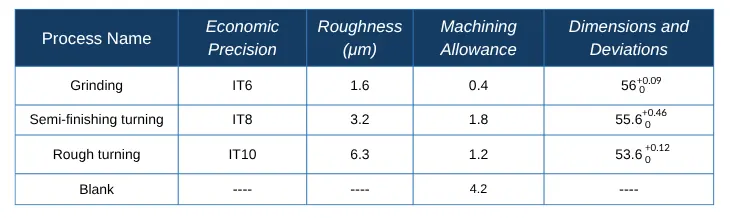
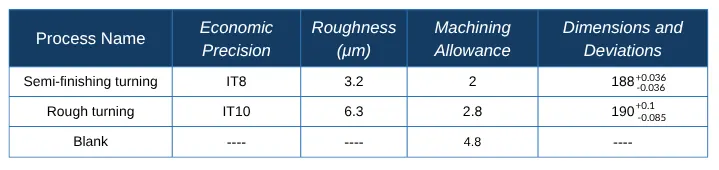
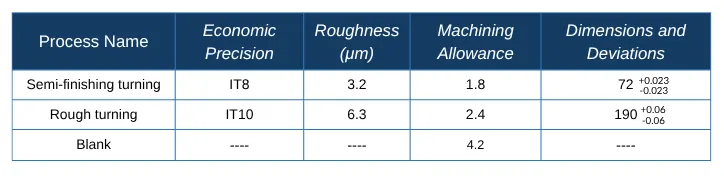
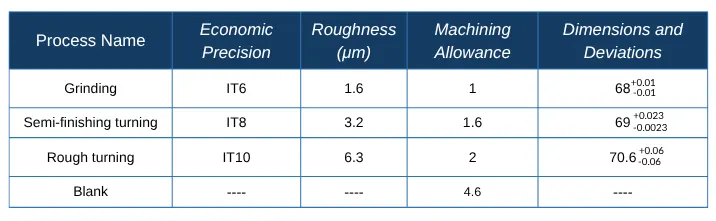
Process 1: Rough turning φ188mm outer cylindrical surface;
Process 2: Rough turning φ56mm bore;
Process 3: Semi-finish turning φ56mm bore;
Process 4: Rough turning height 68mm left end face:;
Process 5: Rough turning φ72mm right end face;
Process 6: Semi-finish turning φ188mm outer diameter ;surface, φ72mm outer diameter surface;
Process 7: Semi-finish turning height 68mm left end face;
Process 8: Semi-finish turning φ72mm right end face;
Process 9: Finish turning height 68mm left end face;
Process 10: Grinding φ56mm bore.
Selection of Cutting Tools, Machines, and Key Parameters
Machining φ188mm Outer Circular Surface
Select an external roughing lathe tool with a 90° cutting edge angle.
We mechanically clamp the tool insert.
We use YT5 as the tool material, giving the tool a flat face and a chamfered edge geometry.
Based on the geometric features of the sleeve part, the main rake angle is set to 91°.
We use a CA6140 horizontal lathe, and we set the following cutting parameters for the roughing operation.
(1) Depth of cut.
Rough turning allowance is 2.8mm, completed in a singlepass with depth of cut ap=1.4mm.
(2) Feed rate.
Rough turning feed rate f=0.7~1mm/r, selecting feed rate f=1mm/r.
(3) Cutting speed.
Because the workpiece material is 45 steel and the tool material is YT5 cemented carbide, we set the cutting speed to range from 60 to 75 m/min.
We select a cutting speed of v = 60 m/min.
According to equation (1), n = 99.11 r/min.
Based on the selected machine model, a rotational speed of approximately 99.11 r/min is chosen, corresponding to n = 100 r/min.
The actual cutting speed v = 60.57 m/min can then be calculated.
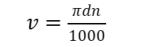
In the formula, we define v as the cutting speed, d as the diameter of the workpiece surface to be machined, and n as the workpiece rotational speed.
We achieve a depth of cut of ap = 1 mm in a single pass for semi-finishing turning of the φ188 mm outer cylindrical surface.
The feed rate f = 0.5mm/r, spindle speed n = 160r/min, and cutting speed V = 95.50m/min.
Machining 56mm Internal Bore
We select a round-shank internal boring tool for rough turning and semi-finish turning operations.
It has a 90° rake angle and a 91° main rake angle to facilitate chip evacuation during internal bore turning.
The tool material is YT5.
We used the CA6140 horizontal lathe for machining.
We determined the cutting parameters for rough and semi-finish turning as follows:
For rough turning:
1. Depth of cut (ap) = 1 mm (single pass)
2. Feed rate (f) = 1 mm/r
3. Spindle speed (n) = 450 r/min
4. Cutting speed (v) = 73.23 m/min
For the precision grinding process, the selected grinding wheel abrasive type is A46KV6P350x40x127, and the grinding machine is an MD1420 universal external cylindrical grinder.
The cutting parameters for this process are set as follows:
Grinding wheel rotational linear velocity vc = 30 m/s Grinding depth feed rate ft = 0.05 mm Longitudinal feed rate flong = 0.02 mm/r Workpiece rotational speed n = 1780 r/min.
Machining the Left End Face at 68 mm and the Right End Face at φ72 mm
For tool and machine selection, we choose the same tools and lathe that we used for rough turning the 188 mm outer diameter surface.
The determined cutting parameters are as follows.
For semi-finish turning the 68mm left end face: – Depth of cut ap = 1.6mm (single pass) – Feed rate f = 0.5mm/r – Spindle speed n = 160r/min – Cutting speed V = 86.45m/min
During the semi-finish turning of the φ72 mm right end face, we complete a single pass with a depth of cut of ap = 1.5 mm.
The feed rate f = 0.5mm/r, spindle speed n = 400 r/min, and cutting speed v = 90.48m/min.
For the left end face machining operation with a finishing height of 68 mm, we achieve a depth of cut of ap = 1 mm in a single pass.
The feed rate f = 0.2 mm/r, spindle speed n = 200 r/min, and cutting speed V = 108.07 m/min.
Conclusion
This paper analyzes the manufacturing process of a sleeve-type component.
By integrating dimensional and positional accuracy requirements for each surface, it establishes machining strategies for all surfaces and selects appropriate locating references.
We formulate a machining sequence for the sleeve based on the chosen locating references and determine the machining allowances for its surfaces.
We select suitable cutting tools and machine tools based on material properties and machining allowances.
This selection helps define the cutting parameters for each machining operation. This research aims to provide a reference for process control in the machining of sleeve-type components.