
In the new landscape of global manufacturing transitioning toward high-quality development, demands for precision and performance in mechanical products continue to rise.
Traditional machining methods struggle to meet the requirements for ultra-high precision and superior surface quality in components for aerospace, optics, and medical fields [1]
Ultra-precision machining technology achieves nanometer-level processing accuracy through precise control of cutting parameters, optimized tool design, and improved machine tool structures, providing robust support for the advancement of high-end manufacturing.
Therefore, in-depth research on the application of ultra-precision machining technology in CNC mechanical manufacturing holds significant theoretical value and practical significance.
Overview and Key Technologies of Ultra-Precision Machining
Ultra-precision machining is an advanced manufacturing technology capable of achieving nanometer-level precision, with machining accuracy below 0.1 μm and surface roughness controllable at the 1 nm scale.
Its fundamental principle involves precisely controlling various parameters during the cutting process to enable controlled material removal from the workpiece.
Equipment-wise, ultra-precision machining primarily employs ultra-precision lathes, milling machines, and grinding machines.
Ultra-precision lathes achieve spindle rotational accuracy at the 10 nm level, linear axis positioning accuracy at 50 nm, and feature multi-axis interpolation capabilities.
Tool materials typically utilize synthetic diamond with exceptional hardness and wear resistance, with the tool tip radius controllable below 0.2 mm.
Process characteristics involve optimizing cutting parameters (such as spindle speed, feed rate, and cutting depth) to maintain a stable cutting state, preventing vibration and thermal deformation.
Simultaneously, low cutting speeds and minimal cutting depths (generally < 1 μm) are employed alongside high-precision cooling and lubrication systems to ensure process stability and reliability.
This provides critical technological support for high-end manufacturing sectors, including aerospace, optics, and medical equipment.
High-Precision Motion Control Technology
This system employs a five-axis simultaneous control architecture comprising three closed-loop systems: position control, speed control, and force control.
Position control utilizes Renishaw optical encoders with 5 nm resolution and a feedback cycle under 1 ms.
Speed control incorporates torque motors and high-precision encoders, maintaining speed fluctuations within 0.1%.
The force control loop employs piezoelectric ceramic sensors for real-time cutting force detection, achieving control accuracy better than 0.5 N.
The system implements real-time compensation algorithms via field-programmable gate arrays (FPGAs), including geometric error compensation, thermal deformation compensation, and vibration compensation, ensuring stable and precise machining processes.
By incorporating machine learning algorithms, the system adaptively adjusts control parameters, builds a process database, and intelligently optimizes machining parameters. It also features a fault diagnosis module to enhance system reliability.
Practical testing demonstrates that this control system improves contour accuracy by 35%, surface roughness by 40%, and machining efficiency by 25% when processing high-precision surfaces, significantly elevating the overall performance of ultra-precision machining.
Tool Materials and Preparation Techniques
Ultra-precision machining primarily employs single-crystal diamond tools, which achieve a hardness of 80 GPa.
The tool front angle is controlled between -5° and -2°, the rear angle ranges from 7° to 10°, and the tip radius typically measures 0.5 to 1.0 mm, with surface roughness < 5 nm.
For machining difficult-to-cut materials like titanium alloys and high-temperature alloys, polycrystalline cubic boron nitride (PCBN) tools with nanocoatings are employed, where coating thickness is controlled between 200 and 500 nm.
Tool preparation utilizes precision grinding and ion beam polishing processes, ensuring that the tool curvature satisfies the cutting equation.

where: R is the tool radius curvature; f is the feed rate; h is the cutting depth.
A tool wear prediction model is simultaneously established to enable online monitoring and optimized replacement of tools.
To extend tool life, a novel nanocomposite coating technology has been developed and combined with ultrasonic vibration-assisted cutting processes, significantly enhancing tool wear resistance and machining efficiency.
Research indicates this composite process extends tool life by over 40%, reduces cutting forces by 25%, and improves surface finish quality by 20%.
Environmental Control and Compensation Technology
Ultra-precision machining is highly sensitive to environmental conditions, where minute temperature fluctuations, vibration interference, and air contamination can significantly impact machining accuracy.
A comprehensive environmental control system comprises three core modules: temperature control, vibration isolation, and cleanliness management.
The temperature control system employs a combination of precision air conditioning and localized constant-temperature devices to maintain the machining area at (20±0.1)°C.
It simultaneously monitors machine tool thermal deformation and performs real-time compensation.
The vibration isolation system employs an active air-bearing vibration isolation platform. It is also combined with passive rubber vibration-damping pads.
Together, they effectively isolate ground vibrations and equipment-induced vibrations. This setup controls vibration amplitude within one μm..
For cleanliness control, it features a high-efficiency filtration system and laminar flow air supply devices to ensure workpiece surfaces remain free of particulate contamination.
Additionally, a real-time error compensation system based on laser interferometry has been developed.
By continuously monitoring geometric, thermal, and dynamic errors, it establishes predictive error models to enable dynamic compensation during machining, enhancing overall machining accuracy by over 30%.
Case Study: Ultra-Precision Machining of Aeroengine Blades
Process Requirements and Challenge Analysis
Aero-engine compressor blades represent a quintessential challenging-to-machine component.
Their surfaces feature complex double-curved geometries, with blade thickness tapering from 20 mm at the root to 0.8 mm at the tip.
The material selected is TC4 titanium alloy, demanding blade surface contour accuracy better than 0.01 mm and surface roughness Ra ≤ 0.4 μm.
The machining challenges primarily manifest in the following aspects:
First, the material exhibits poor machinability.
Titanium alloys have a low thermal conductivity (7.2 W/m·K), causing cutting temperatures to exceed 800°C and promoting work hardening easily.
Second, the blades have low rigidity, particularly at the tips, making them highly susceptible to deformation and vibration.
Third, high surface profile accuracy demands complex five-axis simultaneous control and precise tool compensation strategies.
Additionally, blade surface integrity demands are stringent, with zero tolerance for microcracks, inclusions, or scratches.
Simultaneously, since blades operate under high-temperature and high-pressure conditions, strict requirements exist for residual stress distribution in the machined surface layer.
Ensuring a uniform distribution of compressive residual stresses presents significant challenges for process design.
Machining Solution Design and Optimization
(1) Machining Solution Design Process.
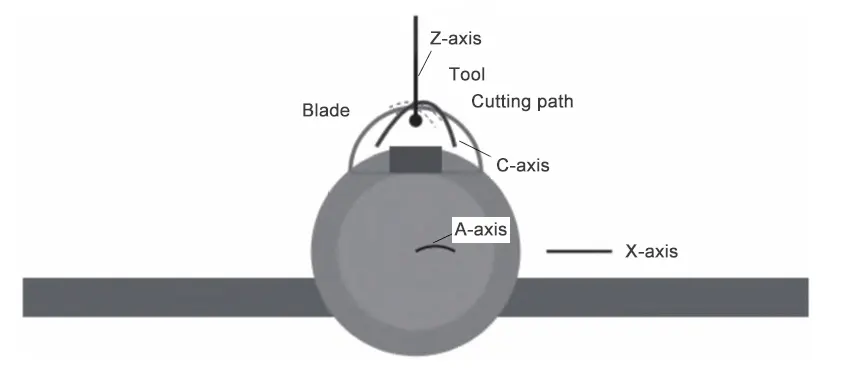
Begin with blade geometric modeling analysis, followed by process feasibility assessment. The Makino V33i five-axis vertical machining center is selected as the primary equipment.
Featuring a dual-tilting head structure, its A and C axes enable ±120° flexible rotation, with a maximum spindle speed of 24,000 r/min.
Its positioning accuracy exceeds ±3 μm, and repeatability reaches ±1 μm.
The integrated HEIDENHAIN iTNC530 CNC system supports five-axis simultaneous programming and offers advanced tool radius and length compensation capabilities.
The tooling system employs a modular configuration: φ10 mm solid carbide end mills for roughing, φ6 mm and φ4 mm coated ball-nose end mills for finishing and superfinishing, respectively.
Tools utilize TiAlN coating, with HSK-A63 standard tool holders ensuring high rigidity and repeatability. Figure 1 illustrates five-axis machining of an aero engine blade.
(2) Process Parameter Optimization Strategy.
Test results indicate that spindle speed most significantly affects surface roughness, feed rate primarily influences machining efficiency, while cutting depth directly impacts machining accuracy.
A variable parameter machining strategy was developed to address the tendency of titanium alloys to work harden.
In the root region with higher rigidity, cutting parameters were appropriately increased to enhance efficiency.
In the thin-walled tip region, high-speed, shallow-depth machining was employed to reduce cutting forces and heat generation.
Concurrently, a cutting force prediction model was established to adjust feed rates based on instantaneous cutting thickness dynamically, ensuring cutting forces remained within a stable, reasonable range.
This effectively prevented machining deformation and vibration issues [2].
Experimental Validation and Results Analysis
The reliability of the process plan was validated through experimental machining of five TC4 titanium alloy blades. Experimental results are as follows:
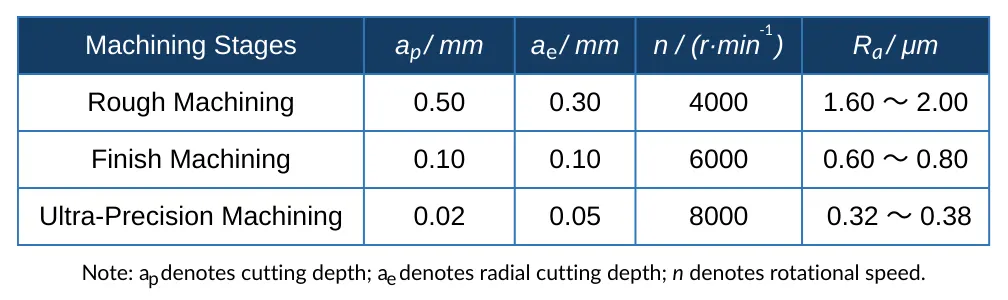
(1) Machining efficiency: Roughing time was 45 min, finishing time 35 min, and superfinishing time 25 min, with total machining time controlled within 105 min.
(2) Dimensional accuracy: Measured using a Zeiss PRISMO coordinate measuring machine, the blade profile contour fell within 0.008–0.012 mm, meeting design specifications.
(3) Surface quality: Measured using a Taylor Hobson CCI white light interferometer, the Ra values ranged from 0.32 to 0.38 μm, exceeding the design requirement of 0.4 μm.
(4) Metallographic analysis revealed no significant work hardening on the workpiece surface, with microhardness increases controlled within 8%. No surface defects, such as microcracks, were detected.
Subsequent life testing demonstrated that the improved manufacturing process enhanced the blade fatigue life by over 15%.
Furthermore, X-ray diffraction measurements of surface residual stresses revealed stable compressive stresses around -350 MPa with uniform distribution, providing reliable assurance for the blade’s service performance.
Fatigue test results confirmed that the optimized machining process extended the blade’s high-cycle fatigue life by over 20% compared to conventional methods.
The comparison of blade machining parameters and results is shown in Table 1.
Application Expansion of Ultra-Precision Machining Technology
Optical Component Manufacturing
Ultra-precision machining technology plays a critical role in optical component manufacturing, particularly in the processing of high-end optical elements such as aspheric lenses and free-form mirrors.
Taking aspheric lens machining as an example, surface profile accuracy requires peak-to-valley values better than λ/4 (light wavelength λ=632.8 nm) and Ra < 2 nm.
Single-point diamond turning technology uses air-bearing spindles, which achieve radial runout precision better than 50 nm.
Processing parameters: n=2,000 r/min, ap=0.1 μm, feed rate 2 μm/r.
Processing environment requirements: Temperature controlled at 20°C±0.1°C, relative humidity 45%±5%.
By incorporating slow-cutting servo technology, ultra-precision machining of complex free-form surfaces is achievable, with contour accuracy reaching 0.1 μm and Ra < 1 nm [3].
Post-machining optical elements measured by a white-light interferometer exhibit transmission wavefront distortion better than λ/10 and imaging quality MTF > 0.95, meeting high-end optical system requirements.
Furthermore, when machining large-sized optical elements, fast-cutting servo technology significantly enhances processing efficiency, with a maximum response frequency reaching 2 kHz.
The development of cutting-edge equipment such as laser weapons and astronomical telescopes has driven growing demand for ultra-large-aperture optical elements.
This presents new challenges for ultra-precision machining technology, necessitating the development of novel composite processing techniques and intelligent compensation strategies.
Integrated Circuit Manufacturing
Ultra-precision machining technology is primarily applied in integrated circuit manufacturing for processing core components like photolithography masks and wafer carriers.
Mask substrates require flatness better than 0.5 μm/100 mm and Ra < 0.2 nm. Processing employs a dual-axis air-bearing ultra-precision surface grinder using a #3000 resin-bonded diamond grinding wheel [4].
Parameters: n=1,500 r/min, ap=0.001 mm, table feed rate 300 mm/min.
Processing environment requirements: Class 100 cleanroom, temperature 20°C±0.05°C, humidity 40%±2%.
An online laser measurement system monitors flatness in real time, and a closed-loop control system dynamically compensates for deviations.
For wafer carrier processing, single-point diamond cutting technology delivers flatness better than 0.3 μm/300 mm and Ra < 1 nm. A nickel-phosphorus alloy coating (2 μm thick) enhances wear resistance [5], extending service life by 50%.
As integrated circuits advance toward 3 nm processes, demands for machining precision intensify, driving ultra-precision machining toward atomic-level accuracy.
This trend also catalyzes novel processing methods like plasma-assisted machining.
Conclusion
As a frontier technology in modern manufacturing, ultra-precision machining demonstrates immense application value and development potential in CNC manufacturing.
Analysis of the ultra-precision machining case study for aircraft engine blades validates the technology’s significant advantages in enhancing machining precision and improving surface quality.
Although challenges remain in equipment stability and environmental control, continuous breakthroughs in new materials and processes will inevitably propel ultra-precision machining technology to advance mechanical manufacturing to higher levels.
In the future, this technology will deeply integrate with emerging technologies such as artificial intelligence and big data, injecting new vitality into the intelligent and high-quality development of manufacturing.