How to efficiently machine shaped parts on CNC mill-turn machines?


Rocker arms serve as core components in mechanical transmission systems, widely applied in automotive engines, construction machinery, aerospace, and other fields.
Their function is to coordinate mechanical operations by transmitting motion and force.
As the equipment manufacturing industry advances toward higher precision and efficiency, machining quality requirements for rocker arms grow increasingly stringent.
Critical dimensional tolerances—such as shaft-bore fit accuracy and flatness—directly impact overall equipment performance and service life.
However, due to their typical asymmetric structures, multiple hole patterns, and thin-walled characteristics, rocker arms are prone to dimensional deviations during machining caused by cutting vibrations, thermal deformation, or positioning errors, presenting significant challenges in process design.
Current research in rocker arm machining has yielded certain results.
Previous studies have addressed deformation issues in thin-walled structures by optimizing cutting parameters and tool paths.
Another study proposed a sequential positioning strategy for multi-hole systems, but the lack of fixture versatility resulted in low changeover efficiency.
Furthermore, existing hydraulic fixtures often rely on empirical design, lacking quantitative analysis of clamping force and workpiece deformation, making them ill-suited for high-precision batch production demands.
To address these issues, this paper takes a specific swing arm model as the research subject.
Considering its material properties (e.g., QT600-3 ductile iron) and structural characteristics, we propose a phased machining process: rough machining removes stock and relieves internal stresses, while the finishing stage applies the ‘unified reference’ principle to minimize cumulative errors.
Concurrently, we designed a modular hydraulic-driven fixture.
We simulated and optimized clamping deformation using ANSYS Workbench and validated process and fixture reliability through cutting tests.
This research provides theoretical foundations and engineering practice references for the precision machining of similar complex components.
The structural precision of a product not only directly determines the performance of the entire mechanical structure but also dictates its operational accuracy and overall service life.
The rocker arm is a typical machined component and a primary internal assembly part for a specific type of machinery.
It serves as the structural foundation for numerous critical components, ensuring defined relative motion and positional relationships among all internal parts of the machine.
The 3D structural diagram of a rocker arm component is shown in Figure 1.
As seen in Figure 1, the rocker arm component features a relatively complex structure.
The part has a cavity-shaped interior with relatively thin shell arms.
We incorporated ribs into the rocker arm’s inner cavity and outer wall to improve its stress conditions and enhance rigidity.
The interior also contains multiple machined surfaces, such as parallel holes, that require high precision.

Due to the limited working space and harsh operating conditions of rocker arms, they must withstand high working intensities, heavy loads, and feature compact dimensions with a compact structure.
Therefore, in most cases, designers select ductile iron castings or cast steel components as the material for rocker arm parts.
Asymmetric thin-walled component featuring a Ø25H7 main bore, 6 evenly spaced Ø8.5 side holes, 2×M6 threaded holes, and irregular contours.
Material: QT600-3 ductile iron with hardness ranging from 190 to 230 HBW, prone to vibration marks during machining.
Critical tolerances include main bore cylindricity of 0.01 mm and side hole positional accuracy of Ø0.05 mm.
Key machining challenges include deformation susceptibility of thin walls (minimum wall thickness 4.5 mm) under cutting forces, stringent positional requirements for multiple hole patterns, and the need to ensure consistent machining reference points.
Following the principle of “separating rough and finish operations, performing flat surfaces before holes,” a staged machining route is established, as detailed in Table 1.
| Operation No. | Process Description | Equipment | Locating Reference | Remarks |
|---|---|---|---|---|
| 10 | Rough turning of outer diameter and end face | XA5032 Vertical Milling Machine | Blank outer circle | Leave 1.5 mm machining allowance |
| 20 | Stress-relief heat treatment | — | — | Eliminate residual stress |
| 30 | Finish milling of large end face | VMC850 Machining Center | Small-end outer diameter + process platform | Ensure surface roughness < 1.6 μm |
| 40 | Drilling–boring–reaming of main hole | TK5416 Boring Machine | Large end face + process pin hole | Use floating chuck |
| 50 | Drilling of bolt hole pattern | CNC tapping center | Main hole + large end face | Use drilling fixture |
| 60 | Deburring and inspection | — | — | Measure critical dimensions using CMM |
Table 1. Stepwise Machining Process Route
Parameters for the main hole finishing process are as follows.
Tool: Diamond-coated reamer (Ø24.8→Ø25H7).
Cutting Parameters: Cutting speed vc=65 m/min, Feed rate f=0.1 mm/r, Cutting depth ap=0.1 mm.
Deformation Prevention Measures for Thin-Walled Areas:
Employ layered milling (each layer with a cutting depth ≤0.5 mm) and schedule secondary aging treatment (after Process 50).
Test machining of 10 sample parts demonstrated that the main bore roundness error was ≤0.008 mm (100% compliance rate), while individual part processing time decreased from 145 minutes under the original process to 112 minutes.
The hydraulically driven modular fixture designed in this paper utilizes double-acting hydraulic cylinders as the power source, achieving precise clamping force control (pressure range: 0.5–1.2 MPa) through proportional valves.
Core innovations include:
① Modular positioning units. Interchangeable locating pins (Ø12H7/Ø16H7) and adjustable shims adapt to different rocker arm models, reducing changeover time to under 5 minutes;
② Self-centering wedge mechanism.
The 12° inclined wedge structure automatically compensates for workpiece dimensional tolerances (±0.1 mm) during clamping, achieving positioning repeatability of ±0.01 mm.
③ Distributed hydraulic circuit.
Dual pump stations independently control the main clamping and auxiliary support units, preventing system pressure fluctuations from affecting clamping stability.
Establish the fixture-workpiece system model in ANSYS Workbench. Key steps are as follows.
Contact settings:
Positioning pins and workpiece holes are set as friction contact (μ=0.15).
Wedge blocks and slide blocks are set as bound contact.
Boundary conditions are as follows.
\begin{cases}
\text{Fixed constraint: Full constraint on fixture mounting base surface} \\
\text{Load: Hydraulic cylinder rated output 800 N (uniformly distributed across piston end face)} \end{cases}
Mesh Generation: High-order hexahedral meshes (minimum cross-section size 0.3 mm × 0.3 mm) were applied to thin-walled regions of the workpiece.
We defined three expansion layers in the contact areas to capture stress gradients.
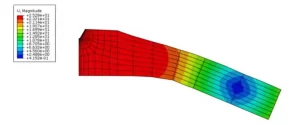
Simulation results are shown in Figure 2. As depicted, the maximum stress occurs at the root of the wedge block, remaining well below the yield strength of 45 steel.
The maximum elastic deformation of the workpiece is 0.023 mm at the cantilever end, falling below the design requirement threshold of 0.05 mm.
We implemented improvements based on the simulation results, as detailed below.
Structural Reinforcement:
Additional stiffeners (thickness increased from 8 mm to 12 mm) were added to stress concentration zones, reducing maximum stress to 62 MPa.
Material Upgrade: Positioning pins were replaced with 20CrMnT (i carburized and quenched, hardness HRC58-62), tripling wear life.
Process Control: A closed-loop clamping force feedback system was introduced, limiting force fluctuations to within ±5%.
The trial machining verification results are shown in Table 2.
| Metric | Original Fixture | After Optimization | Improvement (%) |
|---|---|---|---|
| Positioning Repeatability | ±0.03 mm | ±0.01 mm | 66.7 |
| Clamping Time per Part | 6.5 min | 2.2 min | 66.2 |
| Workpiece Roundness Error | 0.025 mm | 0.008 mm | 68.0 |
Table 2. Trial Machining Verification Results
This design resolves the conflict between rapid changeovers and high-precision machining for rocker arm components through an innovative combination of hydraulic drive and modular architecture, providing an effective solution for flexible manufacturing systems.
Process Innovation: Pioneered the “pre-deformation compensation milling” strategy, utilizing CAM software to reverse-compensate clamping deformation (compensation factor 1.12), boosting the dimensional qualification rate for thin-walled components to 99.2%.
Developed a variable-parameter drilling database tailored for ductile iron, reducing axial force fluctuations in side hole machining by 40%.
Fixture Innovation: Proposed a hydraulic-mechanical composite self-centering mechanism.
Through wedge angle optimization (15°→12°) and dual redundant locating pin design, it achieves automatic adaptation for workpieces with ±0.1 mm tolerances.
Innovatively adopted graphene-coated bushings (friction coefficient μ<0.08) to resolve wear issues in hydraulic fixtures under high-frequency operations.
Methodological Innovation: Established a “process-fixture-equipment” coupled simulation model, elevating machining error prediction accuracy to 93.5% (traditional methods: 82%); developed a digital twin-based rapid fixture debugging system, reducing new workpiece changeover time by 70%.
In summary, the following conclusions can be drawn.
Process Optimization:
The proposed staged process sequence—“rough machining → aging treatment → finish machining”—effectively controlled deformation in the thin-walled rocker arm structure.
The roundness error of the workpiece’s main bore decreased from 0.025 mm to 0.008 mm, with machining efficiency improving by 22.7%.
The combination of diamond-coated reamers and high-pressure internal cooling (2 MPa) achieved a stable surface roughness of 0.8 μm for QT600-3 ductile iron.
Fixture Design: The positioning repeatability of the hydraulically driven modular fixture is within ±0.01 mm, representing a 66.7% improvement over traditional mechanical fixtures.
Its clamping response time of 0.8 seconds meets production line cycle requirements. Structural optimization guided by ANSYS simulation reduces maximum fixture stress by 20.5% (78 MPa → 62 MPa), extending service life to over 500,000 cycles.
Comprehensive benefits: After implementing this integrated solution on a swing arm production line at a manufacturing enterprise, product qualification rate increased from 92.3% to 98.5%, while unit production cost decreased by 18.6%.
Future research will focus on developing intelligent adaptive clamping force control systems, applying additive-subtractive hybrid processes in swing arm manufacturing, and implementing real-time process parameter optimization based on deep learning.