How to efficiently machine shaped parts on CNC mill-turn machines?
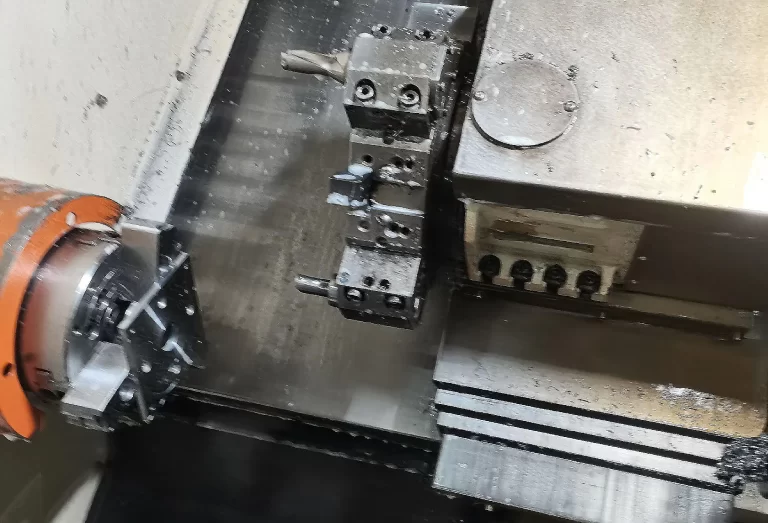


When performing CNC programming, the programmer must determine the cutting parameters for each machining operation and incorporate them into the program as instructions.
Cutting parameters include cutting speed, depth of cut, and feed rate.
Different machining methods require the selection of different cutting parameters.
During rough machining, the primary focus is on enhancing productivity, while also considering economic viability and processing costs.
For semi-finishing and finishing operations, cutting efficiency, economic considerations, and processing costs should be balanced while ensuring machining quality.
Specific values should be determined based on machine tool manuals, cutting parameter handbooks, and practical experience.
From the perspective of tool durability, the sequence for selecting cutting parameters is: first determine the depth of cut, then the feed rate, and finally the cutting speed.
The depth of cut is determined by the rigidity of the machine tool, workpiece, and cutting tool.
Within the limits of allowable rigidity, the depth of cut should be set as close as possible to the workpiece’s machining allowance.
This reduces the number of passes and improves production efficiency. Principles for determining depth of cut:
1) When the required surface roughness value is Ra 12.5 μm to 25 μm, if the machining allowance for CNC processing is less than 5 mm to 6 mm, rough machining can achieve the requirement in a single pass.
However, when the allowance is larger, the process system rigidity is poor, or the machine tool power is insufficient, multiple passes may be required.
2) For surface roughness requirements of Ra 3.2 μm to 12.5 μm, a two-step process of rough machining followed by semi-finishing is recommended.
Select the same back cutting depth as above for rough machining.
After rough machining, leave a 0.5 mm to 1.0 mm allowance to be removed during semi-finishing.
3) For surface roughness requirements of Ra 0.8 μm to 3.2 μm, a three-step process of rough machining, semi-finishing, and finishing is recommended.
The depth of cut for semi-finishing should be 1.5 mm to 2.0 mm.
For finishing, the depth of cut should be 0.3 mm to 0.5 mm.
Feed rates are primarily determined based on the machining accuracy and surface roughness requirements of the part, as well as the materials of the tool and workpiece.
The maximum feed rate is constrained by the machine tool’s rigidity and the performance of the feed system.
Principles for Determining Feed Rates:
1) When the quality requirements of the workpiece can be assured, higher feed rates may be selected to improve production efficiency.
Generally, feed rates are chosen within the range of 100–200 m/min.
2) For cutting operations, deep hole machining, or processing with high-speed steel tools, lower feed rates are recommended, typically within the range of 20–50 m/min.
3) When high machining accuracy and surface roughness are required, feed rates should be selected lower, generally within the range of 20–50 m/min.
4) During tool idle travel, especially for long-distance “return-to-zero” operations, the maximum feed rate set by the machine’s CNC system may be selected.
Spindle speed should be selected based on the permissible cutting speed and the diameter of the workpiece (or tool).
The calculation formula is:
n = 1000v / πD
v—-Cutting speed, unit: m/min, determined by tool durability;
n—-Spindle speed, unit: r/min;
D—-Workpiece diameter or tool diameter, in mm.
The calculated spindle speed n must ultimately be selected from the machine tool manual, choosing the available or closest matching speed.
In summary, specific cutting parameters should be determined using an analogy method based on machine tool performance, relevant manuals, and practical experience.
Simultaneously, the spindle speed, cutting depth, and feed rate must be mutually compatible to achieve optimal cutting conditions.
Reference Formula:
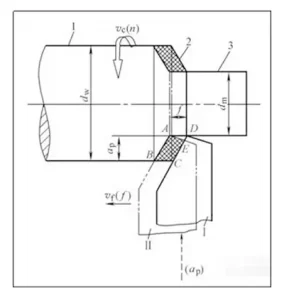
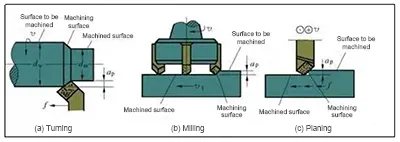
The vertical distance between the machined surface and the unmachined surface of the workpiece is called the back clearance.
The back clearance is the depth of cut measured from the cutting edge reference point perpendicular to the working plane.
It represents the depth to which the tool penetrates the workpiece during each feed, it is also known as the cutting depth.
Based on this definition, when turning an external cylindrical surface longitudinally, the back clearance can be calculated using the following formula:
a p = ( d w — d m ) /2
Where:
a p — Back rake (mm);
d w — Diameter of the workpiece surface to be machined (mm);
d m — Diameter of the workpiece surface already machined (mm).
The relative displacement between the tool and workpiece in the feed direction per revolution of the workpiece or tool.
Based on the feed direction, it is classified into longitudinal feed and transverse feed.
Longitudinal feed refers to the feed along the direction of the lathe bed guideways, while transverse feed refers to the feed perpendicular to the direction of the lathe bed guideways.
Note: Feed rate vf denotes the instantaneous speed of the cutting edge at a selected point relative to the workpiece during feed motion.
vf = fn
Where:
vf — Feed rate (mm/s);
n — Spindle speed (r/s);
f — Feed rate (mm/s).
The instantaneous velocity of a selected point on the cutting edge relative to the workpiece’s main motion. The calculation formula is as follows:
vc = (π dw n) / 1000
Where:
vc — Cutting speed (m/min);
dw — Diameter of the workpiece surface to be machined (mm);
n — Workpiece rotational speed (r/min).
Calculations should be based on the maximum cutting speed.
For turning operations, use the diameter of the surface to be machined for calculation, as this location experiences the highest speed and fastest tool wear.
Cutting Parameters
1. Depth of cut ap (mm)
ap = (dw – dm) / 2 (mm)
2. Feed rate f (mm/r)
3. Cutting speed vc (m/min)
vc = πdn/1000 (m/min)
n = 1000vc/πd (r/min)
By systematically determining cutting depth, feed rate, and spindle speed, CNC programmers can optimize machining efficiency and part quality.
Depth of cut should align with machine rigidity and workpiece allowances, feed rates should consider surface finish, and tool material, and spindle speed should be selected based on cutting speed limits and workpiece diameter.
Ensuring compatibility among these parameters allows stable and efficient cutting operations, minimizes tool wear, and meets surface roughness and dimensional accuracy requirements.
This structured approach provides a reliable framework for effective CNC programming and machining process optimization.