How to efficiently machine shaped parts on CNC mill-turn machines?


Modern metal cutting and workpiece manufacturing technologies are continuously upgrading. Industrial production has raised higher requirements for machining precision, efficiency, and complexity.
This trend drives the rapid development of five-axis machining technology.
Complex geometric workpieces are becoming increasingly prevalent in precision forging, casting and additive manufacturing industries.
Traditional machining tools can hardly balance high-precision finishing, efficient material removal and low-cycle production requirements.
Represented by conventional ball-nose end mills, traditional 3D surface machining tools have obvious limitations in machining efficiency when dealing with complex curved workpieces.
Benefiting from the progress of five-axis machining centers and modern CAM systems, barrel-shaped end mills with innovative arc cutting edge geometries have regained industry attention.
This article mainly analyzes the unique advantages of barrel-shaped cutting tools cooperating with five-axis machining.
It introduces the classification, performance characteristics, and practical application values of various barrel-shaped tool products.
It also further discusses the rationality and application prospects of the innovative single-insert barrel tool design.
This study provides a reference for the efficient and low-cost machining of complex surfaces in modern metalworking.
Five-axis machining is becoming increasingly popular in the field of modern metal cutting.
Five-axis machining offers significant advantages, such as the ability to machine complex-shaped parts in a single setup without changing the workpiece’s orientation, while ensuring high machining accuracy and reducing cycle times.
Advanced workpiece manufacturing technologies have raised the bar for precision forging, casting, and mainstream additive manufacturing (AM).
This has also led to more complex workpiece geometries.
To reduce machining allowances and remove material by cutting, manufacturers need to obtain results that match the workpiece’s final shape.
High-performance cutting tools are required for finishing and semi-finishing operations on complex geometric surfaces.
Ball-nose end mills are considered the traditional tools for machining 3D surfaces.
Ball-nose end mills are the most commonly used tools for semi-finishing and finishing surfaces in milling operations.
Developments in the field of five-axis machining centers, along with significant advancements in modern CAM systems, have led to the emergence of tools with different cutting edge geometries on the market—namely, curved or barrel-shaped end mills.
Although these tools are well-known to machinists, they are often overlooked.
The combination of five-axis machining with CNC software and computer modeling of complex tool configurations has brought barrel-shaped end mills back into the public eye.
The cutting edges of these end mills are arc-shaped, representing a segment of a circle with a radius greater than the tool’s nominal radius.
For comparison purposes, in ball-nose end mills, the tool radius is equal to the radius of the cutting edge.
Compared to ball-nose end mills, using arc-shaped end mills with “multi-pass milling technology” to machine surfaces can significantly increase the feed rate, thereby reducing cutting time.
When machining complex surfaces, three-axis CNC machines cannot guarantee the correct cutting position for barrel-shaped tools.
Five-axis machines, however, allow for the full utilization of barrel-shaped end mills.
Depending on the orientation of the cutting edge relative to the tool’s axis, barrel-shaped end mills come in various configurations, such as pure barrel, conical barrel, lens-shaped, and elliptical or parabolic.
The tool’s edge geometry determines its application. For example, lens-shaped tools are suitable for both 5-axis and 3-axis machines, whereas end mills with a conical barrel profile are only suitable for 5-axis machines.
The barrel-shaped design, when applied to multi-flute solid end mills, provides higher tool precision and maximizes the number of cutting edges.
The ISCAR NEOBARREL tool series includes multiple sub-series.
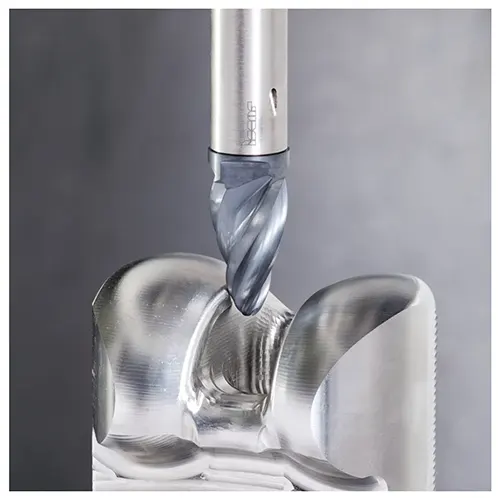
Figure 1 shows solid carbide end mills (SCEM) with diameters ranging from 8 to 12 mm.
The 10-mm conical-barrel solid carbide end mill features a curved outer cutting edge with a radius of 85 mm.
Compared to a 10-mm ball-nose end mill, this end mill achieves four times the feed rate while maintaining the same surface roughness.
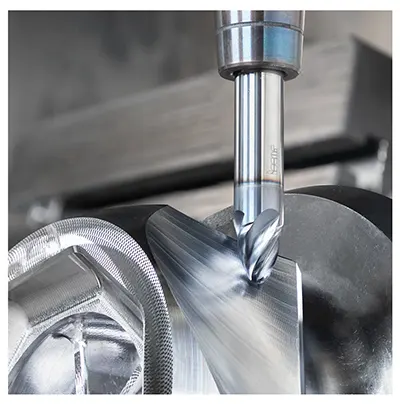
ISCAR’s MULTI-MASTER series is a line of indexable carbide-tipped tools.
The series’ new tapered inserts feature the same cutting edge geometries and diameter ranges as the SCEM series, offering a wide range of options for using the MULTI-MASTER series on five-axis machines.
The indexable insert design of the MULTI-MASTER series ensures efficient use of carbide and delivers significant cost savings.
A diverse selection of tool bodies, extension bars, and reducers enables the creation of customized, modular tool assemblies for complex machining projects.
ISCAR recently launched a new series of barrel-shaped end mills featuring a single-insert design.
It is well known that single-insert tools offer lower precision than tools with indexable carbide inserts or solid-carbide end mills.
However, if we analyze single-insert tools and make some compromises on precision, they can compete effectively with indexable-insert tools or solid carbide tools.
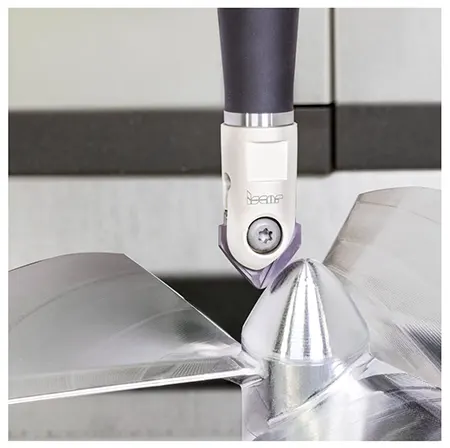
To address doubts about the validity of the single-flute barrel-shaped tool design, we should consider several factors.
Single-insert tools enhance cost-effectiveness by expanding the diameter range of barrel-shaped milling cutters.
These tools have nominal diameters ranging from 16 to 25 mm.
Compared to the feed rates suitable for carbide end mills and indexable-head cutters, the durable insert structure and high-rigidity insert clamping allow for increased feed per tooth.
This ensures appropriate feed rates, enabling efficient machining.
When machining stability is poor, reducing the number of teeth helps control vibration.
The BALLPLUS series of tools allows conventional tools to be converted into barrel-type end mills by using barrel-edge inserts.
ISCAR’s BALLPLUS tools include a wide selection of tool bodies, shanks, and extension bars, greatly simplifying tool customization.
Today, the single-insert barrel-type tool design has become a more logical and rational choice.
In modern manufacturing, the prospects for barrel-shaped end mills are vast.
The metalworking industry has already realized numerous applications for barrel-shaped designs.
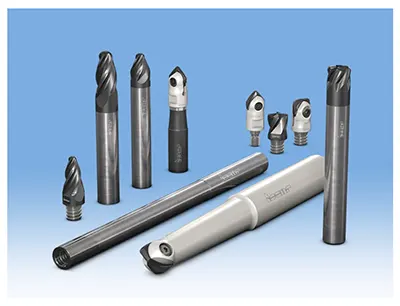
These tools include solid-carbide barrel-shaped end mills, solid-carbide indexable-head barrel-shaped end mills, and single-insert barrel-shaped end mills.
These products jointly form a complete series of barrel-shaped contouring end mills. They are well prepared to address future machining challenges.
In summary, the combination of five-axis machining technology and barrel-shaped end mills effectively solves the efficiency and precision bottlenecks of traditional ball-nose end mills in complex surface machining.
Various types of barrel-shaped tools, including solid carbide end mills, indexable carbide-tipped tools and innovative single-insert tools, have formed a complete and differentiated product system.
These tools deliver significantly higher feed rates and machining efficiency while guaranteeing qualified surface roughness.
Meanwhile, their modular design and efficient material utilization enable cost optimization and flexible customized machining.
The single-insert barrel tool makes partial compromises in machining precision.
However, it delivers outstanding advantages in cost performance, diameter coverage and vibration control.
Therefore, it serves as a practical and rational option for industrial machining.
Modern manufacturing industry keeps advancing. Barrel-shaped end mills with diverse specifications and excellent performance will embrace wider application scenarios.
They will also greatly promote the high-efficiency, high-precision and low-cost development of complex metal surface machining.