How to efficiently machine shaped parts on CNC mill-turn machines?


Lightweighting is a key characteristic of products in aerospace and defense applications.
As a heat-treatable, high-strength aluminum alloy with excellent toughness and hardness in the Al-Zn-Mg-Cu series, 7075 aluminum alloy is widely used for thin-walled components.
Machining these thin-walled aluminum alloy parts requires high precision.
The process removes material at significant rates.
Controlling deformation during machining presents a major challenge.
The primary causes of machining deformation stem from uneven stress distribution induced by cutting forces and heat.
The workpiece’s low elastic modulus and high plasticity further increase the likelihood of deformation.
Thermal coupling effects also cause residual stresses to redistribute during machining. In addition, elastic deformation occurs under clamping forces.
During flexible machining unit manufacturing, rational and reliable fixturing methods can effectively mitigate deformation in thin-walled parts, thereby enhancing machining accuracy and efficiency.
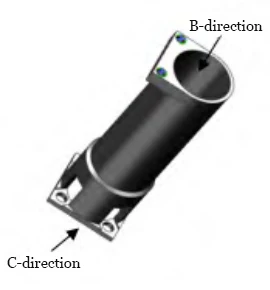
Figure 1 shows a simplified model of a thin-walled connecting sleeve component for a missile launch device.
Based on the part’s machining process sequence, three operations are required: machining the outer diameter and inner bore, machining the B-side end face, and machining the C-side end face.
The outer diameter machining is performed on a CNC lathe:
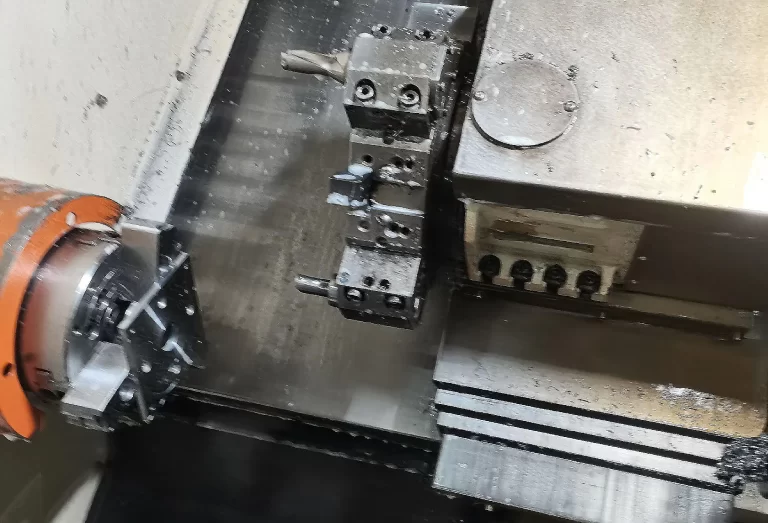
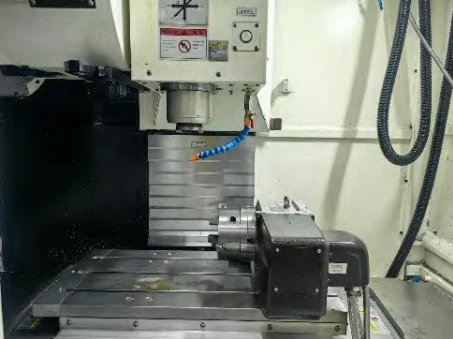
The end face machining is performed on a vertical machining center VM740S (as shown in Figure 2), requiring the preservation of the intersecting features between the B-direction half-square and half-circle.
The square section has a thickness of 5 mm, while the C-direction machining must ensure a thickness of 2 mm.
The thin-walled requirements for the 21 mm × 21 mm square end face are specified.
The bore diameter is Ф17 +0.030mm, and the outer diameter is Φ19 ± 0.02 mm.
The overall workpiece length is 65±0.1mm, with perpendicularity between the end face and inner hole guaranteed.
Due to the interaction between clamping stresses and cutting forces during machining, maintaining dimensional accuracy in the thin-walled structure becomes difficult.
Under these combined forces, deformation is likely to occur.
As a result, the part may exhibit large geometric tolerances.
Therefore, a dedicated intelligent fixture was designed for milling to meet the machining process requirements.
For sleeve-type components, clamping can be achieved through either external cylindrical or internal bore positioning methods.
During actual machining, the milling force is calculated using formula (1).
-300x65.jpg "(1)")
In the formula, cp represents the coefficient of influence of the workpiece on cutting force;
B denotes the milling width; K indicates the coefficient of influence of tool rake angle on cutting force;
K1 signifies the coefficient of influence of cutting speed.
We selected a 4-tooth cylindrical milling cutter with a diameter of 10 mm.
Operating conditions were: tool speed 5000 r/min, feed rate 0.2 mm/r, depth of cut 0.3 mm, and milling width 8 mm.
Referring to the manual, the cp value was determined to be 68, K was set to 1, and K1 was set to 0.64.
Substituting these values into equation (1) yielded a calculated Fc value of 211 N.
We calculate the theoretical clamping force using formula (2).

In the formula, k1 represents the general safety factor, k2 denotes the machining condition factor, k3 indicates the tool blunting factor, and k4 signifies the interrupted cutting factor.
Consulting the metal cutting calculation manual, k1 is set to 1.5, k2 to 1, k3 to 1.1, and k4 to 1.2. Substituting these values into Equation (2) yields a theoretical clamping force of approximately 417 N.
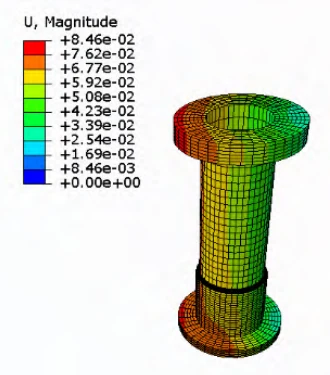
Using external diameter and bottom surface positioning with vise clamping (as shown in Figure 3), the workpiece is held in place during machining.
However, the clamping force applied in this method causes deformation of the workpiece.
The bore also shows a tendency to deform under the same force.
The maximum deformation reaches 0.08 mm.
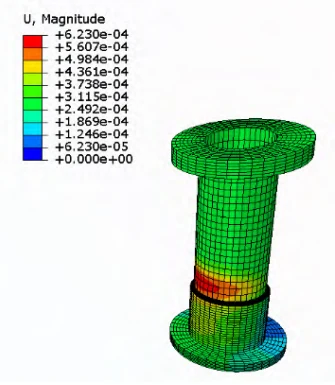
Using internal hole positioning with an expanding mandrel clamping method (as shown in Figure 4), the clamping force is uniformly applied to the internal hole.
This reduces the force per unit area and interacts with the cutting forces and residual stresses generated during machining, significantly minimizing part deformation caused by the clamping force.
The maximum deformation is 0.00059 mm, representing 0.75% of the deformation under external positioning.
Therefore, when milling the upper and lower surfaces, the positioning and clamping scheme significantly impacts part deformation and geometric tolerances.
Employing an expansion mandrel positioning method effectively controls the deformation effects of cutting forces on machined surfaces.
Considering factors such as flexible machining unit processing, the clamping method must support efficient automation.
The convenience of industrial robot workpiece handling is also an important requirement.
Based on these considerations, the chosen clamping solution is pneumatic expansion mandrel positioning and clamping.
Engineers need dedicated fixtures to ensure stable processing of thin-walled connecting sleeve components.
Finite element analysis results further support the need for specialized fixture designs.
Engineers should develop two sets of fixtures for the milling operations.
One fixture completes the B-axis machining process.
The other fixture completes the end-face machining process.
For machining along the C-axis, the positioning surfaces feature semi-circular and square elements, necessitating precise workpiece clamping.
Engineers design corresponding auxiliary supports accordingly.
Figure 5 illustrates a flexible smart fixture incorporating an expansion mandrel for enhanced auxiliary positioning, enabling repeatable clamping cycles.
The fixture comprises a clamping body, support surfaces, an expansion mandrel assembly, elastic locating pins, and auxiliary locating elements.
The clamping body bolts to the machine tool table, featuring a diameter of 100 mm and height of 11 mm.
Constructed from high-strength cast iron and subjected to aging treatment, it ensures base stability and dimensional stability.
The base incorporates locating reference surfaces and locating mandrels, while elastic locating pins and auxiliary locating elements achieve complete workpiece positioning within the fixture.
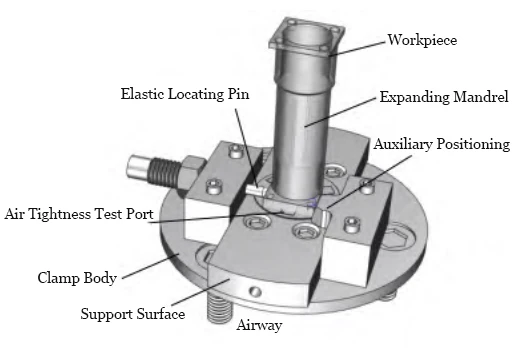
The connecting sleeve positioning elements employ a combination of reference surface positioning and auxiliary positioning.
The clamping body features a workpiece support surface (three-point support boss) mating with the workpiece bottom surface.
A pneumatic tapered expansion mandrel mates with the workpiece bore for positioning.
The mandrel material is 40Cr, while the expansion sleeve material is 65Mn (surface carburized) with a taper ratio of 1:10. with an expansion allowance of 0.03mm.
To enhance radial deformation uniformity of the expansion sleeve, six circumferential slots are uniformly machined to improve positioning accuracy.
Auxiliary positioning elements—elastic locating pins and auxiliary locating features—are installed at key locations on the part’s base surface to achieve Z-axis rotational positioning.
The contact surfaces of auxiliary locators employ high-manganese steel wear-resistant material, designed as inclined planes with a 0.01mm clearance to the workpiece.
The elastic locating pin maintains a 0.02mm clearance. Full consideration of part geometry ensures foundational reference positioning for critical dimensions.
Supplementary locating at key features further guarantees machining accuracy, verifiable through airtightness test holes.
The designed clamping and positioning scheme achieves complete workpiece positioning through end-face, mandrel, and auxiliary positioning.
Positioning errors primarily stem from fixture geometric errors, clamping deformation errors, and thermal deformation errors.
Thermal deformation errors are disregarded during end-face milling operations.
Clamping deformation error exerts the primary influence, composed of radial expansion error and eccentricity error.
Calculated via Formula (3), it is determined to be 0.01 mm, meeting positioning requirements.
-300x29.jpg "(3)")
In the formula, ΔD represents the radial deformation; ΔDeccentric denotes the eccentricity error;
Fradial signifies the expansion force; e indicates the initial eccentricity between the expansion sleeve and the workpiece.
If the temperature rise is significant, positioning errors caused by thermal deformation must be considered.
These can be verified through calculation using Equation (4), where asleeve and aworkpiece refer to the linear expansion coefficients of the expansion sleeve and the workpiece, respectively.

The clamping method employs pneumatic internal expansion clamping, wherein the expansion mandrel secures thin-walled parts through the tension force generated by its own expansion.
The core assembly primarily consists of tie rods, expansion mechanisms, and expansion sleeves (as shown in Figure 6).
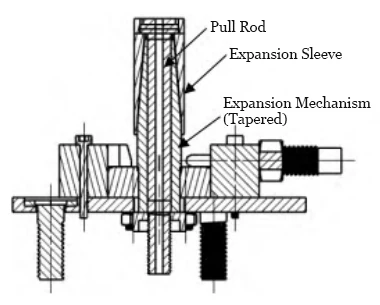
During clamping, compressed air enters the upper chamber of the cylinder, driving the piston tie rod downward.
This transfers axial tension to the expansion mechanism, causing the expansion sleeve to slide along the tapered surface.
This forces the jaws to expand radially outward, applying uniform radial force to the workpiece’s inner wall for secure holding.
The clamping force must not exceed the material’s yield strength, and the radial expansion of the workpiece should remain below the allowable deformation range (1/3 to 1/5 of the workpiece tolerance).
The calculation and verification process is as follows:

In the formula, F represents the mandrel expansion force; P denotes the air source pressure (typically 0.4–0.8 MPa);
Apiston is the effective piston area, where A = πD²/4; D is the piston diameter (D = 40 mm); a is the half-cone angle of the tapered mandrel (typically 5°–15°, designed at 10°);
n is the mechanical efficiency (accounting for friction losses, approximately 0.8–0.9).
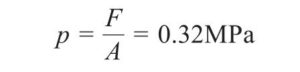
In the formula, p represents the contact pressure between the expansion sleeve and the workpiece;
A denotes the effective contact area between the expansion sleeve and the thin-walled workpiece, where A = πDL.
D is the inner diameter of the workpiece (D = 17 mm), and L is the contact length (L = 27 mm).
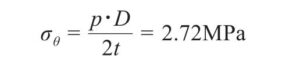
In the formula, σθ represents the circumferential stress; D denotes the inner diameter of the workpiece (D = 17 mm); t indicates the wall thickness of the thin-walled component (t = 1 mm).

In the formula, n represents the safety factor (typically greater than or equal to 1.5 to 3); σs denotes the yield strength of the thin-walled component material.

In the formula, ΔD represents the radial deformation of the workpiece; E工 denotes the elastic modulus of the workpiece material; v工 indicates the Poisson’s ratio of the workpiece.
The computational reasoning demonstrates that the expansion mandrel assembly design is sound.
Further optimization can be achieved by adjusting the piston diameter, cone sleeve angle, or selecting aluminum alloy or carbon fiber composite materials for advanced design iterations.
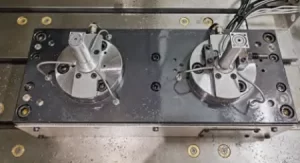
Part machining trials were conducted in a flexible machining cell using the clamping scheme validated through design verification (as shown in Figure 7).
The CNC machining center employs a FANUC Oi-MF PLUS CNC system equipped with a high-speed spindle unit.
The spindle exhibits low temperature rise and minimal thermal deformation during testing, achieving positioning accuracy of ±0.005 mm and repeatability of ±0.003 mm.
Automated workpiece clamping employed a FANUC M-20iD25 fixed-joint robot with a repeatability of ±0.02 mm, meeting the machining requirements for thin-walled connecting sleeve parts.
Test machining utilized 7075 aluminum alloy material, milling the thinnest section to 1mm.
The primary focus was evaluating the impact of traditional clamping versus the proposed clamping solution on machining accuracy for thin-walled parts.
During testing, cutting parameters were varied to compare workpiece surface accuracy, thin-wall deformation, machining efficiency, and other parameters, enabling optimization and assessment of the designed clamping solution.
The test-machined parts were inspected using a coordinate measuring machine, with results shown in Table 1.
Influenced by factors such as cutting force variations, the thin-walled sections experience noticeable deformation.
Cutting temperature changes also affect the final dimensional accuracy.
Differences in clamping force across various machining schemes further contribute to deformation levels.
Under the optimized scheme, the deformation at the thin-walled sections was 0.01 mm.
This represents a 37.5% reduction compared to the traditional scheme.
The end-face perpendicularity error was 0.015 mm, a 62.5% reduction, meeting the high-precision requirements for military components.
Surface roughness decreased to 1.235 μm, a 37.1% reduction. Average process time per operation increased by 50%, significantly boosting production efficiency.

This study addresses the challenge of clamping deformation control in machining thin-walled aluminum alloy sleeve components.
It combines theoretical analysis, structural innovation, and machining validation.
The goal is to develop a systematic solution based on pneumatic expansion flexible clamping technology.
Research findings confirm:
①Coupled control of clamping force and expansion volume effectively balances the interaction between cutting forces and fixture constraints during machining.
This approach reduces deformation at thin-walled sections by 37.5%.
It also controls end-face perpendicularity to 0.015 mm.
As a result, Grade 7 precision is achieved.
② Stress compensation from flexible contact reduces machining vibration amplitude, lowering surface roughness by 37.1%.
③ The integrated application of pneumatic expansion mandrels with industrial robot units enhances efficiency, reducing process time by 50%.
This technology resolves the traditional clamping dilemma of “rigid holding versus flexible deformation” for thin-walled components.
It provides a balanced solution that ensures both stability and adaptability during machining.
As a result, it offers significant engineering value for the intelligent manufacturing of aerospace thin-walled parts.
Future work will integrate the “precision design + thermal control + intelligent compensation” technology with flexible fixture design.
This integration aims to further enhance the clamping system’s adaptive capability.
The goal is to improve performance under complex operating conditions.