Automated Fixture Design and Process Improvement for Aerospace Cylinder Parts


In machining, engineers use machine tool fixtures to secure workpieces in precise positions for processing or inspection.
These fixtures effectively ensure machining accuracy, enhance work efficiency and quality, and broaden the application scope of machine tools.
Currently, manufacturers primarily categorize commonly used fixtures into two types: universal fixtures and specialized fixtures.
Universal fixtures mainly include three-jaw chucks, four-jaw chucks, and flat-jaw vices, primarily used for machining simple parts.
Specialized fixtures, on the other hand, are custom-made for parts with specific shapes and structures, exhibiting high specificity and higher costs.
In machining, we often encounter irregularly shaped parts, whose machining has always been a highly challenging problem.
Due to their irregular shapes, clamping issues during machining become critical factors affecting both machining accuracy and production efficiency.
Traditional universal and specialized fixtures face numerous limitations when processing irregularly shaped parts.
Therefore, there is an urgent need to innovate a machine tool fixture to meet the machining demands of such parts.
This thesis aims to design an adaptive fixture for irregularly shaped parts, addressing the challenges in their machining, expanding the applicability of CNC milling machines, and enhancing their production efficiency.
Before analyzing traditional machining methods in detail, it is essential to understand why irregularly shaped parts are inherently difficult to process.
Unlike standard geometries such as cylinders, blocks, or plates, irregular parts often feature freeform surfaces, asymmetric contours, varying thicknesses, or discontinuous clamping areas.
Traditional Machining Methods
Conventional machining typically employs universal fixtures or custom-made specialized fixtures to process irregular parts.
Universal fixtures: Three-jaw chucks and four-jaw chucks are primarily suited for circular or near-circular workpieces, while the clamping surfaces of vise jaws are generally flat.
For irregular parts featuring curved surfaces or complex geometries, achieving precise positioning and reliable clamping becomes challenging.
Custom Fixtures: Designed and manufactured specifically for the shape and dimensions of particular irregular parts, these fixtures involve lengthy design and production cycles, high costs, and limited versatility, being suitable only for dedicated applications.
The use of universal or specialized fixtures for machining irregularly shaped parts presents challenges such as inaccurate positioning, unreliable clamping, poor adaptability, and low efficiency.
The limited contact area between the jaws of three-jaw and four-jaw chucks and irregularly shaped workpieces results in unstable positioning, making precise alignment difficult to achieve.
Similarly, the flat clamping surfaces of vise jaws struggle to provide reliable positioning for curved or complexly shaped components.
Designing custom fixtures presents significant challenges, requiring substantial time and effort for both design and validation.
For irregularly shaped parts, universal fixtures struggle to distribute clamping force evenly.
Loosening or deformation during machining can compromise quality and safety.
Custom fixtures may also exhibit uneven clamping force due to poorly designed clamping mechanisms or manufacturing inaccuracies.
Universal fixtures primarily suit common shapes and dimensions, offering limited adaptability for irregular parts.
Custom fixtures require design and manufacturing tailored to each irregular part’s specific requirements, resulting in high costs.
Moreover, custom fixtures are only usable for specific irregular parts, lacking versatility.
Should the irregular part design change, the custom fixture becomes unusable, leading to waste.
Whether using universal or specialized fixtures, mounting irregularly shaped parts requires frequent adjustments to fixture positioning and clamping force.
This not only increases operator workload but also leads to unstable machining accuracy, higher scrap rates, and reduced production efficiency.
An adaptive fixture enables precise positioning and reliable clamping of various irregularly shaped components, facilitating subsequent assembly and machining.
It requires sufficient strength, rigidity, reliability, and excellent manufacturability.
This paper innovatively designs an adaptive fixture for irregularly shaped parts, as shown in Figure 1, aligning with modern machine tool fixture trends toward standardization, precision, efficiency, and flexibility.
Engineers replace the original flat jaws of a standard flat-jaw vise with new three-stage adaptive jaws.
Each jaw level slides along dovetail grooves, and technicians secure it with screws to prevent derailment.
Each jaw level adaptively adjusts its position according to the irregular workpiece, allowing technicians to meet the machining and clamping requirements for various types of irregular components
This design breaks through the barrier of traditional specialized fixtures for irregular parts, offering high versatility, low cost, and convenient operation.

Due to their irregular forms, irregularly shaped parts typically feature curved surfaces or complex geometries.
Using universal fixtures results in limited contact areas, making precise positioning difficult.
However, engineers design and manufacture custom fixtures for a single irregular part, which extends production cycles, increases costs, and generates significant waste.
Therefore, this paper fully considers the structural characteristics of irregular parts when designing fixtures.
The goal is to achieve a simple fixture structure, convenient operation, reliable positioning, and good manufacturability, while simultaneously meeting the clamping needs for machining multiple irregular parts, thereby solving the challenges of irregular part processing.
The fixture designed in this paper is an adaptive fixture for irregular parts on CNC milling machines, with its structure shown in Figure 2.
It is directly mounted on the standard vise of a CNC milling machine as the base. A new jaw 5 replaces the original standard flat jaw, featuring a dovetail groove for installing the jaw guide rail 11.
A primary jaw 1 is mounted on the jaw guide rail. A secondary jaw 2 is installed on the dovetail groove at the front end of primary jaw 1.
A tertiary jaw 3 is mounted on the dovetail groove at the front end of secondary jaw 2. The jaw guide rail 12 is secured to the new jaw 5 with screws.
Positioning screws limit movement between the first-stage jaw 1 and the jaw guide rail 12, the second-stage jaw 2 and the first-stage jaw 1, and the third-stage jaw 3 and the second-stage jaw 2, preventing derailment of any jaw stage.
The principle works as follows: when technicians insert a shaped workpiece and rotate the screw with a sleeve wrench, each vise jaw continuously pushes inward.
The jaws progressively close any remaining gaps until they fully clamp the workpiece.
During clamping, each jaw distributes pressure evenly across the entire jaw structure until the object fits perfectly against the third-stage jaw.
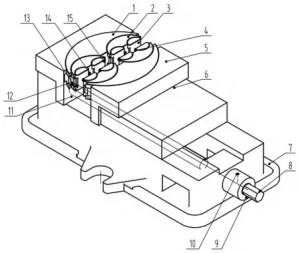
This design employs a standard parallel-jaw vise as the base component.
As a universal machine tool accessory, it serves as the primary clamping fixture for planers, milling machines, drilling machines, grinding machines, and slotting machines.
It consists of components such as the body base, movable jaws, nuts, and screws, as shown in Figure 3.
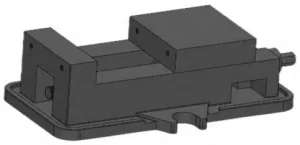
Engineers built upon the standard vise and designed an innovative three-stage jaw adaptive structure to replace the conventional flat jaws.
First, mount the jaws onto the standard vise body. The threaded hole specifications on the jaws match those of the original flat jaws, enabling direct interchangeability and compatibility with multiple models of flat-jaw vices.
Install dovetail guides onto the jaws and secure them in position with screws.
The three jaws operate on a similar sliding principle: The primary jaw slides along the guide rail via its rear dovetail groove, secured by screws to prevent derailment.
The secondary jaw slides along the front dovetail guide rail of the primary jaw via its rear dovetail groove, also secured by screws to prevent derailment.
The third-stage jaw similarly slides by engaging its rear dovetail groove with the dovetail guide rail at the front end of the second-stage jaw, with screws limiting its movement to prevent derailment.
This structure enables automatic alignment of each jaw stage according to the shape and dimensions of the irregular workpiece being clamped, ultimately achieving secure clamping for various irregular components, as shown in Figure 4.

To ensure fixture clamping and positioning, screws are primarily employed in this design.
Sleeve 8 is secured to screw rod 9 using M5x14 screw 7; jaw 11 is secured to jaw body 10 using M10x35 screw 5; guide rail 13 is secured to jaw 11 using M8x16 screw 12;
The sliding of primary jaw 14 along guide rail 13 is limited by M8x30 screw 15. The sliding of secondary jaw 1 along primary jaw 14 is limited by M6x25 screw 2.
An M6x16 screw 4 limits the sliding of the third-stage jaw 3 on the second-stage jaw 1.
This screw both secures all structures and allows the jaws to automatically align based on the irregularly shaped workpiece being clamped.
This ultimately enables adaptive clamping for workpieces of various shapes, as shown in Figure 5.

Based on the preliminary adaptive fixture design, engineers verified each jaw level through virtual simulation animation and CAE analysis. They then machined the fixture using 7075AL material.
Because each jaw level has dovetail structures, engineers employed customized cutting tools, designed specific machining processes, and verified the program through simulation.
Finally, engineers machined and assembled all components to produce the final fixture, as shown in Figure 6.
To validate the fixture’s feasibility and effectiveness, we applied it to the actual machining of multiple irregularly shaped components.
Through practical machining verification, we identified the following advantages of the fixture:

Adaptive fixtures effectively compensate for irregularities in the shape of complex workpieces.
They automatically adjust clamping force and positioning based on the workpiece’s geometry and dimensions, ensuring stability and precision throughout the machining process.
Through real-time monitoring and adjustment, they effectively reduce machining errors caused by inaccurate positioning and unreliable clamping.
When machining complex curved surfaces, adaptive fixtures automatically adjust clamping point locations and clamping force intensity according to surface variations, ensuring consistently precise part positioning throughout the process and thereby enhancing machining accuracy.
Adaptive fixtures rapidly accommodate irregularly shaped parts of varying dimensions.
Operators eliminate frequent fixture changes, enabling swift clamping and positioning of irregular components.
This reduces machine downtime and minimizes fixture changeover and adjustment time, resulting in smoother, more efficient machining processes.
During batch production of irregular parts, adaptive fixtures automatically recognize different shapes and swiftly adjust to optimal clamping conditions, significantly boosting production efficiency.
Adaptive fixtures offer high versatility, accommodating components of varying shapes and sizes.
This versatility reduces the need for multiple fixture types and quantities, eliminating the high costs associated with custom-made fixtures for each unique part.
Consequently, it lowers the expenses related to fixture design, manufacturing, and inventory management.
Additionally, adaptive fixtures enhance machining accuracy and stability, reducing scrap rates and thereby lowering overall production costs.
Adaptive fixtures are relatively simple to operate, functioning similarly to standard vise clamps.
Operators can master them with minimal training. Typically, simply place the irregularly shaped part onto the fixture and turn the screw.
The fixture automatically adjusts to the optimal clamping position, effortlessly accommodating various shapes and sizes of irregular parts.
No complex adjustments or operations are required, ensuring convenient handling.
This paper addresses the challenges of clamping irregularly shaped parts during machining.
It analyzes the limitations of traditional machining methods and proposes an innovative adaptive fixture design solution.
Through rational design of clamping mechanisms, positioning methods, and fixture structures, coupled with the introduction of adaptive functionality, this solution achieves a fixture with high precision, stability, and adaptability.
The final fixture was fabricated from 7075 aluminum alloy via CNC machining and validated through practical machining tests.
These tests confirmed the fixture’s feasibility and effectiveness in clamping various irregularly shaped components.
By achieving adaptive clamping functionality, the fixture demonstrates significant advantages in enhancing machining accuracy, boosting production efficiency, reducing costs, improving operational convenience, and offering strong versatility.
This solution provides a highly practical approach for the machining of irregularly shaped components.