How to efficiently machine shaped parts on CNC mill-turn machines?
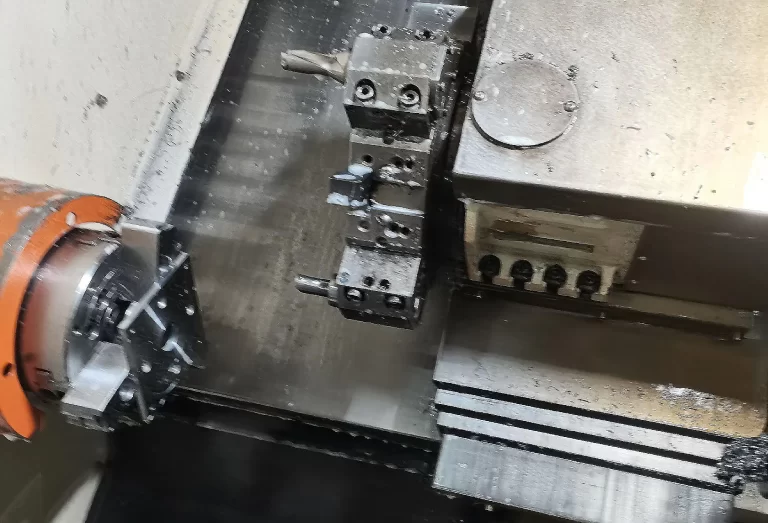


This paper proposes an efficient planning process based on a CNC boring and milling machine for machining narrow circumferential slots on complex parts.
A fixed spindle, tool reference surface positioning, and CNC macro program control enable high-precision machining of narrow slots.
The study analyzes the impact of the process flow, tool and fixture design, and machining parameters on efficiency and quality.
It also demonstrates the process’s scalability and cost-effectiveness.
This method improves machining efficiency while ensuring machining stability and dimensional consistency.
It is suitable for narrow slot machining on complex parts across multiple industries.
Gas turbine exhaust manifolds and certain chemical processing equipment components often require the machining of high-precision narrow grooves along their circumference.
Traditional end mills or saw blades are inefficient, prone to breakage, and unable to guarantee consistent machining quality.
To address these issues, this paper proposes a narrow-slot planing process based on a CNC boring and milling machine.
By fixing the spindle, positioning the tool, and utilizing macro program control, this method ensures precise and consistent slot width and depth, thereby improving machining efficiency.
This process is suitable for complex parts and space-constrained environments.
It balances machining quality, stability, and cost-effectiveness. It also provides a reliable technical solution for high-precision part machining.
The core of planing operations on CNC boring and milling machines lies in tool geometry and positioning principles, workpiece clamping, and spindle fixation techniques.
By aligning the tool reference surface with the slot position, the boring tool is ensured to cut precisely along the length of the narrow slot.
Simultaneously, aligning the feed direction with the slot thickness direction maintains the symmetry of the tool’s rake and clearance angles, thereby minimizing machining errors.
Spindle fixation is achieved through a positioning plate and bolt assembly.
This ensures that the spindle does not rotate during machining.
It also guarantees the circumferential distribution accuracy of the slot positions.
Combined with CNC program cycle commands, this enables depth control and feed rate adjustment, thereby improving the efficiency and stability of narrow slot machining.
The machining process for narrow groove planing on a CNC boring and milling machine consists of five steps:
Workpiece clamping, tool clamping and alignment, spindle fixation, CNC program creation, and machining execution.
During workpiece clamping, the machined surface must be perpendicular to the spindle to ensure cutting accuracy and machining stability.
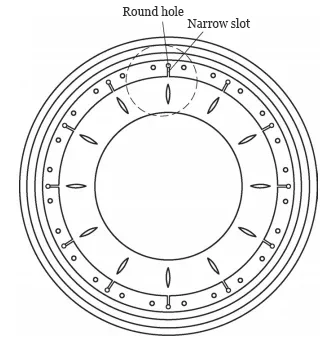
The longitudinal direction of the narrow groove (see Figure 1) must align with the spindle to ensure cutting accuracy and machining efficiency.
Tool clamping and alignment are achieved through reference-surface positioning.
This ensures that the boring tool’s machining direction aligns with the length of the narrow groove.
It also ensures that the feed direction aligns with the groove’s thickness.
A dial indicator corrects the groove position and ensures precise tool installation.
A positioning plate and bolts secure the spindle by clamping the spindle shoulder.
This prevents spindle rotation during machining. It also ensures consistent circumferential distribution of the narrow grooves.
When programming the CNC, the operator defines the primary cutting axis and feed axis and controls machining depth using “until” or “when” loop commands in the macro program.
After starting the program, the system automatically performs planing.
The design principle of the entire process is to ensure machining accuracy, improve efficiency, and adapt to the spatial constraints of complex parts, making the operation simple and reliable.
In CNC programming, the primary cutting axis is set to the CNC axis corresponding to the length of the narrow slot, while the feed axis corresponds to the depth of the slot.
This enables synchronized control of longitudinal cutting and longitudinal feed, ensuring machining accuracy.
Macro programs use “until” or “when” loop instructions, with the machining depth serving as the loop termination condition.
This ensures that the system machines each narrow slot to the predetermined depth.
It also maintains a stable and consistent machining process. This makes it suitable for batch machining of multiple narrow slots.
The machine tool’s feed multiplier controls the cutting speed, and the program optimizes the feed rate (fz) based on tool diameter and slot width.
The system typically sets fz between 0.01 and 0.02 mm/z. The operator selects the spindle speed based on the material.
For stainless steel, for example, it is typically 700 rpm, which ensures both stable cutting and surface roughness that meets process requirements.
A reasonable combination of speed and feed rates achieves a balance between machining efficiency and tool life and reduces machining errors and tool wear.
The program uses cumulative variables to track machining progress.
This allows for dynamic adjustment of the cutting step size based on actual machining width and depth. It helps maximize machining efficiency.
This program design offers high adaptability and flexibility, making it suitable for the continuous machining of multiple narrow slots.
It is easy to operate and highly repeatable, avoiding issues such as tool breakage and slow machining speeds associated with traditional end mill machining.
Consequently, it significantly improves production efficiency and process stability while ensuring machining quality.
The tool features a design with a cutting insert at the bottom of the boring bar (see Figure 2).
A tool slot is machined into the end face of the tool holder.
One side provides a reference surface for positioning, and bolts secure the tool from the opposite side.
A dial indicator calibrates the tool to ensure precise positioning and symmetrical arrangement of the cutting insert’s rake angles.
This effectively guarantees the machining accuracy of slot width and depth while minimizing tool deflection or machining errors.
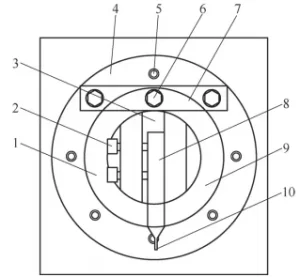
The fixture design incorporates an optimized positioning plate structure that securely locks the spindle in place.
Bolts secure the plate to the ram’s threaded holes at both ends, and the central threaded hole presses against the spindle shoulder to prevent rotation or displacement during machining.
The fixture accommodates spindles of various diameters, ensuring a stable relative position between the tool and the spindle.
This enhances machining accuracy and reliability for circumferentially distributed narrow grooves, providing stable support for the machining of complex parts.
Tool selection includes single-edge grooving cutters, solid-welded grooving cutters, and machine-mounted grooving cutters.
The groove width, depth, and material hardness determine the optimal tool selection to balance machining efficiency and tool life.
The design meets machining requirements for narrow grooves ranging from 2 to 4 mm and can be flexibly applied to other complex parts.
It balances tool adaptability with machining process stability, thereby enhancing the overall flexibility and applicability of the machining process.
The slot width ranges from 2 to 4 mm, with a depth of approximately 10 mm.
The slot width determines the tool diameter to ensure planing efficiency and surface quality.
The feed rate and spindle speed directly affect the distribution of cutting forces and tool wear.
Appropriate parameter settings reduce the risk of tool breakage and improve machining stability and reliability.
Matching the feed rate with the cutting speed is a key factor in ensuring machining stability.
Compared to traditional end mill machining, the planing method on CNC boring and milling machines can significantly improve cutting efficiency.
It also ensures consistent groove width and depth dimensions. This helps extend tool life and stabilizes machining quality.
Theoretical analysis shows that appropriate selection of tool diameter, cutting speed, and feed rate significantly improves production efficiency, reduces production costs, and maintains machining quality.
This method is particularly suitable for high-precision machining of narrow circumferentially distributed grooves.
It is of great significance for enhancing part machining consistency, economic benefits, and process reliability.
This planing process is highly efficient. By combining a fixed spindle with precise tool positioning and utilizing macro cycle commands in CNC programs, it achieves precise control over depth and feed rates.
Machining speeds are 2 to 5 times faster than those of traditional end mills.
This significantly shortens cycle times and saves machining time and labor costs.
It also improves production efficiency and part processing capacity.
Machining quality is stable and reliable. Tool reference surface calibration and the spindle positioning plate ensure precise and consistent narrow slot dimensions.
The symmetrical design of the tool tip’s secondary rake angle reduces machining errors and the risk of tool breakage.
The process is simple to operate and facilitates repeatable machining, ensuring product consistency and stability in batch production, thereby providing a reliable machining solution for complex parts.
The process is suitable for complex parts and space-constrained applications.
It offers excellent adaptability in tool selection and fixture design, enabling the machining of multiple narrow slots and achieving circumferential distribution.
This method extends to narrow slot machining in other industrial sectors.
It balances machining efficiency, quality, and cost-effectiveness.
It also provides reliable technical support for the production of high-precision parts.
Circular radial narrow grooves are widely used in heat shield assemblies for high-precision components such as gas turbine exhaust manifolds.
Manufacturers typically arrange these grooves uniformly around the circumference.
Traditional end mills or saw blades suffer from low machining efficiency and a high risk of tool breakage, making it difficult to ensure consistent machining quality and dimensional accuracy.
The planing method on a CNC boring and milling machine enables continuous machining of narrow slots along their length.
A fixed spindle and precise tool positioning strictly control both slot width and depth.
This process enables high-precision narrow slot machining on complex part surfaces.
It is suitable for scenarios requiring the simultaneous machining of multiple slots.
This improves production efficiency and process stability.
This machining process is suitable for narrow grooves with widths of 2–4 mm and depths of approximately 10 mm.
It demonstrates excellent adaptability to high-strength, heat-resistant materials such as stainless steel.
The spindle is secured via a positioning plate and bolts to prevent part rotation, while tool reference surface alignment and tightening bolts ensure high-precision clamping.
The CNC program allows for flexible configuration of the primary cutting axis, feed axis, and cycle commands.
Cutting speed and feed rate are adjusted based on groove depth, width, and material hardness to ensure machining stability and repeatability.
Additionally, the tool and fixture designs are highly versatile, accommodating a wide range of grooving tools.
This makes the process suitable for parts with limited space or complex geometries.
It can be extended to industrial sectors such as aerospace, power generation, and chemical engineering.
It also meets diverse machining requirements and provides process flexibility.
Compared to traditional end mill machining, this process can increase efficiency by 2 to 5 times when machining narrow grooves 2–4 mm wide and 10 mm deep, significantly reducing machining time.
Precise spindle fixation and tool positioning reduce the risk of tool breakage, lower maintenance and replacement costs, and ensure machining quality and dimensional consistency.
Additionally, the process is easy to operate, programs are reusable, and it supports continuous machining of multiple narrow slots, reducing manual intervention and process complexity.
Overall, its economic benefits and production reliability are significantly superior to those of traditional machining methods.
The circumferential radial narrow-groove planing process for CNC boring and milling machines proposed in this paper achieves high-precision machining of narrow grooves 2–4 mm wide and 10 mm deep.
By rationally designing the process flow, tool and fixture structures, and machining parameters, this method ensures machining accuracy, tool life, and surface quality.
This process is 2 to 5 times more efficient than traditional end milling and is suitable for complex parts and space-constrained applications.
Multiple narrow slots can be machined simultaneously, reducing the risk of tool breakage and lowering processing costs.
The research results indicate that this method offers high process stability, scalability, and cost-effectiveness.