
Manufacturers widely use CNC machining technology in high-end sectors such as aerospace, automotive production, and precision instrumentation.
The CNC machining parameters examined in this study control the relative motion between cutting tools and workpieces through programmed commands, thereby influencing part surface quality.
However, improper parameter settings are common during actual machining.
This not only leads to surface roughness exceeding tolerances and defects like scratches or tears but may also cause residual tensile stress concentration on surfaces.
This shortens component fatigue life, reduces corrosion resistance, and increases production costs.
Therefore, conducting an in-depth investigation into the correlation between CNC machine tool processing parameters and surface quality is crucial.
Exploring targeted optimization strategies also holds significant practical importance.
These efforts help resolve actual machining quality issues.
They further enhance the manufacturing level of high-end equipment components.
Analysis of Cutting Parameters on Surface Quality
Impact of Cutting Speed
1. Effect on Surface Roughness
Cutting speed is one of the key parameters determining surface roughness in CNC machining.
At low cutting speeds, the friction coefficient between the workpiece material and the tool’s rake face increases, facilitating the formation of built-up edges.
However, when the cutting speed rises to a certain range, the temperature in the cutting zone increases, enhancing the material’s plastic deformation capability.
The built-up edges gradually disappear, reducing friction between the tool and workpiece.
This diminishes the microscopic unevenness of the machined surface, thereby improving surface roughness.
However, excessively high cutting speeds accelerate tool wear, diminish cutting edge sharpness, and increase susceptibility to chipping during machining.
This can lead to a rebound in surface roughness values.
2. Effects on Surface Residual Stresses
Cutting speed indirectly influences the residual stress state on part surfaces by altering cutting heat and the degree of plastic deformation.
At low cutting speeds, less cutting heat is generated, but the tool exerts strong compressive forces on the workpiece.
This causes severe plastic deformation in the surface layer metal, readily forming residual compressive stresses.
As cutting speed increases, heat generation rises significantly, causing the surface temperature to surge rapidly.
During cooling, the underlying material constrains the contraction of the surface metal.
This constraint gradually generates residual tensile stress.
When residual tensile stress exceeds the material’s yield strength, microcracks may form on the part surface, shortening its fatigue life and reducing its corrosion resistance.
Influence of Feed Rate
1. Determining Role in Surface Microstructure
Feed rate directly determines the microstructural characteristics of surfaces machined by CNC machines.
With fixed tool geometry parameters, a higher feed rate increases the residual cutting area height per tool revolution on the workpiece surface.
This results in more pronounced spiral-shaped scratches, exacerbated micro-unevenness, and consequently higher surface roughness values.
While reducing the feed rate can lower surface roughness, it increases machining time and reduces production efficiency.
Therefore, a balance must be sought between surface quality and machining efficiency.
2. Inducing Surface Machining Defects
Excessive feed rates readily induce various surface machining defects.
On one hand, when feed rates are too high, cutting forces increase significantly, potentially causing tool deflection.
This results in concave or tapered errors on the machined surface, compromising its geometric accuracy.
On the other hand, for materials with high plasticity, machining with large feed rates can cause defects such as tearing and burrs on the workpiece surface.
These defects not only affect the part’s appearance quality but may also lead to abnormal fit clearances during subsequent assembly processes, potentially causing component jamming failures.
Impact of Cutting Depth
1. Indirect Influence on Surface Finish and Roughness
While cutting depth does not directly determine surface roughness values, it indirectly affects machining accuracy and surface quality by altering cutting force magnitude.
As cutting depth increases, cutting forces rise proportionally, potentially causing the tool’s actual cutting path to deviate from the programmed trajectory and thereby compromising geometric accuracy.
Simultaneously, large cutting depths intensify the load on the tool edge, accelerating edge wear.
When tool chipping or wear occurs, irregular wavy patterns appear on the machined surface, leading to increased surface roughness values.
2. Effects on Surface Layer Metal Structure
Cutting depth influences the metallographic structure of the surface layer by altering the deformation depth of the workpiece’s surface metal.
During machining with a shallow cutting depth, the cutting action primarily occurs in the thin surface layer of the workpiece, resulting in minimal metal deformation.
Conversely, machining with a deep cutting depth penetrates deeper into the workpiece, subjecting the surface layer to severe plastic deformation and thermal cycling, which may induce phase transformations.
Furthermore, for heat-treated components, excessive cutting depth may damage the surface strengthening layer.
This damage can compromise the performance advantages gained from heat treatment.
It can also adversely affect the component’s service life.
Optimization Plan for CNC Machine Tool Processing Parameters
Optimization of Cutting Speed
1. Determining Speed Ranges Based on Material Properties
For different workpiece materials, pre-experiments are conducted to plot “cutting speed-surface roughness” relationship curves, identifying optimal speed ranges.
Technicians also consider tool material properties when adjusting speeds.
For example, they can increase speeds by 3–5 times when using carbide tools compared to high-speed steel tools.
This approach ensures both efficient machining and high surface quality.
2. Dynamic Speed Compensation Mechanism
The CNC system incorporates dynamic speed compensation functionality, adjusting cutting speed in real-time based on load conditions during machining.
When spindle current exceeds the rated value by 10%, the system automatically reduces speed by 5%–10% to prevent tool overloading and chipping.
Technicians employ a segmented speed-reduction strategy when machining thin-walled parts or slender shafts.
They lower the speed by 20%–30% during the entry and exit phases.
This minimizes surface waviness caused by workpiece vibration, ensuring consistent machining accuracy and surface quality.
Optimization of Feed Rate
1. Feed Rate Matching Based on Surface Precision Requirements
Determine the feed rate range according to the surface quality grade of the part.
For precision mating surfaces requiring Ra ≤ 1.6 μm, control the feed rate between 0.08–0.15 mm/r.
Technicians increase the feed rate for non-mating surfaces with Ra ≤ 6.3 μm.
They set it to 0.2–0.3 mm/r to balance machining efficiency and quality.
Simultaneously, adjust feed rates in conjunction with tool rake angle modifications.
When the rake angle decreases from 90° to 45°, appropriately reduce the feed rate by 10%–15% to prevent increased residual cutting height.
2. Collaborative Optimization of Feed Rate and Cutting Depth
Adopt a collaborative strategy of “low feed rate + appropriate cutting depth” to avoid quality issues caused by optimizing a single parameter.
When the cutting depth is set between 0.5 and 1 mm, controlling the feed rate between 0.1 and 0.2 mm/r reduces dimensional errors caused by tool deflection.
When machining high-strength materials, operators employ a “layered feed” approach.
Each layer’s feed rate does not exceed 0.1 mm/r.They also use a cooling system during machining.
This combination reduces the incidence of surface tearing, burrs, and other defects.
It results in a more uniform surface microstructure.
Optimization of Cutting Depth
1. Layered Depth Setting Based on Machining Stages
Differentiated cutting depths are set according to specific requirements.
During rough machining, which focuses on removing stock, cutting depth can be set at 2–5 mm to prioritize machining efficiency.
In semi-finishing, cutting depth is controlled at 0.5–1 mm to correct surface errors from rough machining.
For finishing, cutting depth is set at 0.1–0.3 mm to minimize the impact of cutting forces on surface quality.
2. Depth Compensation for Tool Wear Conditions
Establish a tool wear monitoring and depth compensation mechanism.
Operators collect real-time tool position data through the CNC system.
When tool wear exceeds 0.02 mm, the system automatically increases the cutting depth during the finishing stage by 0.01–0.02 mm.
This adjustment offsets the impact of tool wear on surface quality.
Simultaneously, tools undergo regular regrinding to ensure the cutting depth during finishing matches tool sharpness, preventing defects like surface burn marks and scratches caused by tool dulling.
Case Study
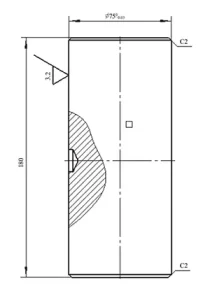
The following analysis examines the machining of C456D-256-144JP connecting rod pins (Figure 1) at a pumping unit manufacturer.
As a critical component of pumping units, these pins are made of 45 steel with stringent outer diameter dimensional tolerances and a surface roughness requirement of Ra ≤ 1.6 μm.
During batch CNC precision turning, operators encountered issues such as oversized outer diameter dimensions and surface roughness exceeding specifications.
These problems severely impacted product assembly performance and service life.
On-site investigation and experimental analysis revealed the core cause.
The issues resulted from unreasonable matching of cutting parameters and failure to compensate for tool deflection.
This combination led to uncontrolled machining accuracy and poor surface quality.
Troubleshooting Surface Quality Issues on Connecting Rod Pins
1. Basic Machining Information for Connecting Rod Pins
These connecting rod pins are machined on a CK6150 CNC lathe using carbide external turning tools.
Initial machining parameters are set as follows: cutting speed 100 m/min, feed rate 0.2 mm/r, cutting depth (finishing stage) 0.5 mm.
The machining process employs a “one clamp, one center” setup.
After rough turning, a 5 mm outer diameter allowance is retained, followed by two-pass finish turning to achieve the final dimensions (first pass cutting depth: 0.3 mm; second pass: 0.2 mm).
During batch production, the first part passed inspection. However, dimensional deviations began occurring after the 10th part, accompanied by surface scratches and minor step defects.
2. Field Testing and Analysis of Connecting Rod Pins
Three displacement sensors were positioned at the CNC lathe spindle, tool holder, and workpiece clamping points.
Connected to a data acquisition instrument and computer, they monitored tool displacement and workpiece vibration data in real time during machining.
Test results revealed: – At a feed rate of 0.2 mm/r, tool “deflection” reached 0.015–0.02 mm, gradually increasing with the number of machined parts;
At a cutting speed of 100 m/min, the cutting zone temperature reached 320°C.
This high temperature caused slight softening of the workpiece surface metal.
It also left traces of surface plastic deformation after tool compression.
During the finishing stage, the cutting depth distribution was unreasonable.
This caused significant fluctuations in the tool cutting force.
The fluctuations induced workpiece vibration.As a result, the surface roughness exceeded specifications.
Improvement Plan and Verification for Connecting Rod Pin Machining Parameters
To address surface quality issues of connecting rod pins, two improvement plans were formulated and verified sequentially using single-factor orthogonal experiments.
Solution 1: Optimize fundamental cutting parameters.
Reduce the feed rate to 0.12 mm/r.
Increase the cutting speed to 120 m/min to prevent built-up edge formation.
Divide the finishing turning stage into three passes.
Set the cutting depths to 0.3, 0.15, and 0.05 mm, respectively.
This approach reduces the single-pass cutting force and tool relief.
Solution 2: Parameter Compensation Optimization.
Building upon Solution 1, an “allowance-to-part count” correlation model was established to address tool allowance issues.
After machining every 10 parts, the cutting depth of the final finishing pass was increased by 0.005 mm.
This “increase” represents cumulative compensation, with the baseline cutting depth for the final pass set at 0.05 mm (corresponding to parts 1–10).
After machining 10 parts, slight tool wear occurs. To compensate for the resulting “insufficient cutting depth,” the final pass depth is adjusted to 0.055 mm (0.05 + 0.005) for machining parts 11–20.
After machining another 10 parts, tool wear intensified further, prompting continued cumulative compensation in the same manner.
By dynamically compensating for tool wear, consistent actual cutting depth is maintained across each batch of parts, preventing dimensional shortfalls or surface roughness exceeding tolerances due to tool dullness.
CNC System Enhancement: Dynamic Feed Compensation
Concurrently, a “dynamic feed compensation” function was added to the CNC system.
Validation testing was conducted on a batch of 100 parts.
The results showed that Solution 2 yielded superior improvements.
The dimensional out-of-tolerance rate decreased from 35% to 2%.
The surface roughness pass rate increased from 60% to 98%.Machining stability also improved significantly.
The project ultimately adopted Solution 2, while fixing the final finishing pass depth at 0.05 mm.
Here, “fixing” does not mean permanently setting an index value, but rather establishing a fixed reference value.
The “ideal cutting depth in unworn condition” is set as the reference, with all compensations calculated relative to this value: Compensation = 0.05 mm + Wear Compensation Value.
This approach avoids directly fixing the final cutting depth. When tool wear becomes excessive, the machine stops for tool replacement.
At this point, the final pass depth must be reset to the baseline value of 0.05 mm, initiating a new cycle of “baseline fixation + dynamic compensation” to ensure consistent surface quality.
Additional Improvement Measures
To further ensure connecting rod pin machining quality, the company implemented the following complementary improvement plans:
1) Tool Management Optimization:
Replaced carbide tools with coated carbide tools (TiAlN coating) to enhance wear resistance, extending tool life from 50 to 120 parts per set and reducing parameter adjustment issues caused by tool wear.
2) Fixture Process Enhancement:
Adding copper shims (0.2 mm thick) at the workpiece clamping points minimized deformation caused by clamping stress.
Additionally, switching from “one clamp and one center” to “dual centers + follow-up tool holder” clamping reduced vibration amplitude during machining.
3) Enhanced Inspection System:
An online probe was installed beside the CNC lathe to automatically inspect outer diameter dimensions and surface roughness every 5 pieces.
Real-time data feedback enabled dynamic adjustment of cutting parameter compensation values.
Following these comprehensive improvements, the connecting rod pin achieved stable, compliant manufacturing quality.
During batch production, dimensional tolerance compliance exceeded 99%, with surface roughness uniformly controlled below Ra 1.6 μm.
Long-term monitoring revealed no recurrence of surface quality defects caused by cutting parameter issues.
This validated the effectiveness of the proposed cutting parameter optimization approach and improvement plan, providing a reference for subsequent machining of similar shaft components.
Conclusion
This paper thoroughly investigates the correlation between cutting parameters and surface quality in CNC machining.
It comprehensively analyzes the effects of key parameters, such as cutting speed, feed rate, and cutting depth.
The study examines their impact on surface quality indicators, including surface roughness, residual stress, and micro-topography.
Based on the above analysis, this paper proposes a series of targeted cutting parameter optimization schemes.
The effectiveness of the proposed optimization approach and improvement measures is validated through a practical case study involving the machining of C456D-256-144JP connecting rod pins for a pumping unit manufacturer.
The dimensional tolerance pass rate for this connecting rod pin was maintained above 99%, with surface roughness consistently controlled below Ra 1.6 μm.
Machining stability was significantly enhanced, providing a reliable reference for processing similar shaft components.