
Workholding fixtures serve as auxiliary devices in mechanical processing.
Their design philosophy ensures processing accuracy and operational convenience during mass production.
This, in turn, enhances processing efficiency.
The author’s organization requires the production of 1,000 various types of gears each month.
The current processing methods fail to meet production demands.
Therefore, it is necessary to optimize the workholding fixtures to improve processing efficiency.
Challenges with the Original Fixture
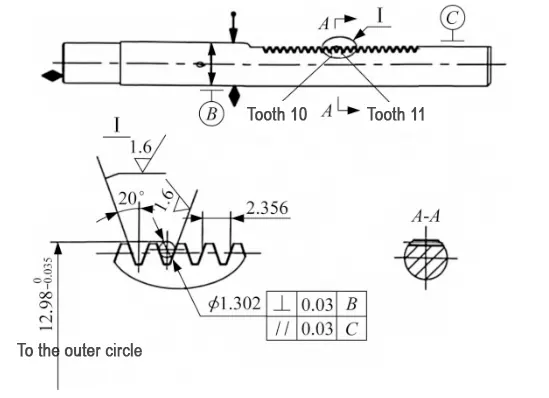
The rack part is shown in Figure 1.
The operator must achieve high precision and batch production efficiency for the rack during the online cutting process.
The dimensional requirement is 12.98 0 –0.035 mm.
The parallelism must be 0.03 mm, and the perpendicularity must also be 0.03 mm.
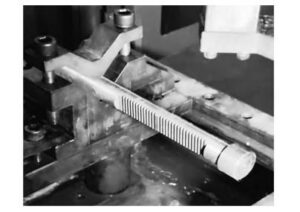
The original fixture uses V-shaped clamping for positioning.
It processes each part individually and requires two processing steps: rough and finish. The entire process takes 65 minutes to complete.
The original fixture is shown in Figure 2.
Because the original processing method causes a long workpiece overhang, poor processing stability, and low processing efficiency, engineers need to redesign the fixture.
Positioning Method
Design Principles of Workholding Fixtures
The design of workholding fixtures must ensure that parts maintain consistent precision throughout multiple clamping processes.
It must also improve production efficiency to enable quick and convenient clamping operations.
This effectively meets the demands of high-efficiency, high-quality production.
The positioning method of workholding fixtures depends on the shape and precision requirements of the processed product.
Positioning Methods and Elements
1.Outer Cylindrical Surface Positioning
The outer cylindrical surface allows operators to position the produced racks, which have a cylindrical structure.
Outer cylindrical surface positioning refers to using the outer cylindrical surface of the workpiece as the positioning reference.
2.Positioning Elements and V-Block Advantages
Positioning elements determine the workpiece’s position in the workholding fixture.
Commonly used positioning elements include V-blocks, locating sleeves, half-cylindrical sleeves, and conical sleeves.
Among these, V-blocks offer good centering accuracy.
Even if there are errors in the outer diameter, the fixtures can still ensure that the positioning reference axis of the same batch of workpieces remains on the symmetrical surface of the V-block.
Additionally, they have advantages such as easy installation and standardized structural dimensions.
These features make them widely used in various production processes.
3.Types of V-Blocks and Their Applications
V-blocks commonly use three specifications of inclined surface angles: 60°, 90°, and 120°.
The 90° angle V-block has minimal positioning error, and the workpiece is less likely to slip on the V-block, offering good versatility.
The 60° angle V-block provides better positioning stability, with the workpiece remaining more stable on the V-block.
It is suitable for processing small-diameter parts and can prevent errors caused by vibration during processing.
The 120° angle V-block has poorer positioning accuracy, making the workpiece prone to slipping on the V-block.
It is suitable for larger-diameter parts and is generally used as auxiliary support to enhance stability.
A short V-block can restrict two degrees of freedom, while a long V-block or a combination of two short V-blocks can restrict four degrees of freedom.
Fixture Implementation and Standard Compliance
Based on the above analysis and in accordance with the JB/T8018.1—1999 standard “Machine Tool Clamping Fixtures and Components—V-Blocks,” the workholding fixture uses a positioning method that adopts two short V-blocks with a 90° angle.
This method is suitable for cylindrical parts of different sizes and features good versatility and high stability.
Workholding Fixture Structure
Based on the above analysis, determine the positioning method for the fixture.
The design and manufacture of fixtures should aim to improve production efficiency.
They should take into account the geometric structural characteristics of the parts and the process conditions.
Contour dimensions, external shape, and related precision define the geometric structural characteristics.
Process conditions include reference points, positioning principles, production batch size, and machine tool performance.
The rack is a cylindrical body with a length of 135 mm and a diameter of 16 mm.
Engineers divide the 130 mm continuous V-shaped groove into two independent sections of 30 mm and 10 mm to reduce the contact area between the workpiece and the V-block.
This reduces the contact area from 1,456 mm² to 448 mm², approximately a 70% reduction, thereby improving clamping accuracy.
The wire cutting machine tool uses an AR40 slow-speed wire cutting machine.
Based on previous processing experience, the cutting thickness during the cutting process is approximately 50 mm.
Operators can control the dimensional accuracy within 0.005 mm.
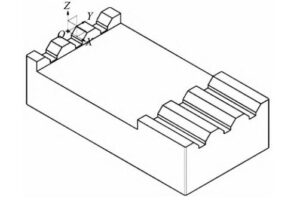
Considering the workpiece diameter dimensions, engineers designed a rack processing fixture capable of simultaneously processing three workpieces, as shown in Figure 3.
Material Selection
Selecting Grade 45 steel as the universal clamping body offers advantages such as low cost, high strength, hardness, and wear resistance.
During wire cutting, the cutting force is minimal, so operators can neglect its influence on the surface of the clamping body.
Repeated clamping on the fixture causes wear, which in turn affects positioning accuracy.
To address this, engineers can apply tempering treatment to enhance wear resistance and hardness, achieving a Rockwell hardness (HRC) between 25 and 35.
Processing Technology
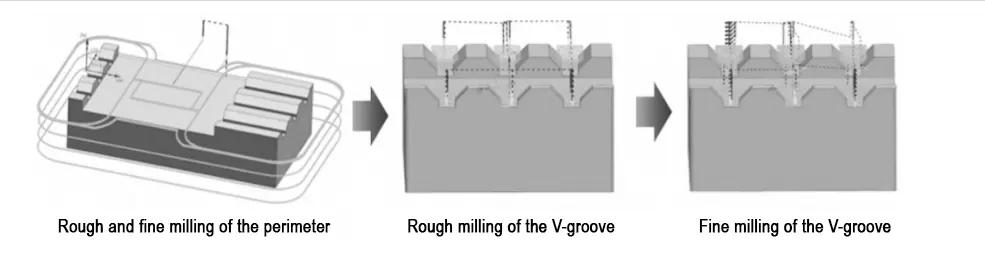
During the machining process, the operator uses machining commands from the UG programming software to perform rough machining on the periphery of the fixture.
The operator then performs finish machining on the V-shaped locating groove.
The machining process flow is shown in Figure 4.
For the machining parameters of the V-shaped slot, rough machining uses a vertical milling cutter with a diameter of 10 mm and a radius of 1 mm.
The spindle speed is 5,000 r/min, the feed rate is 2,000 mm/min, and the depth of cut is 0.1 mm.
For finishing, a 10 mm diameter end mill with a 1 mm radius is used, with a spindle speed of 8,000 rpm, a feed rate of 1,000 mm/min, and a depth of cut of 0.05 mm.
Accuracy
The quality of workpiece fixtures directly affects the quality of the workpiece.
Operators must control the dimensional accuracy and geometric accuracy of the workpiece fixtures within one-third of the process tolerance.
Operators must maintain them within 0.01 mm.
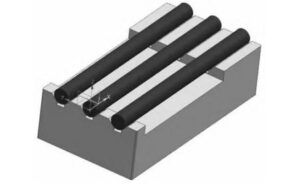
Place three inspection mandrels of the same diameter on the fixture.
Position the dial indicator on the upper surface at one end of the mandrel and move it along the X-axis to the other end, ensuring the height difference is within 0.005 mm.
Then press the indicator head against one end of the side surface.
Move it along the X-axis to the other end, ensuring that the inclination error of the generatrix is within 0.005 mm.
Repeat this process for all three V-grooves.
Place the dial indicator on the middle of the mandrel.
Move it along the Y direction to inspect the heights of the three mandrels, and control the height difference within 0.005 mm.
Based on the actual inspection results, develop separate machining programs to correct the V-groove precision for each error value until the precision requirements are met.
The fixture precision inspection is shown in Figure 5.
Processing Test
The designed gear rack machining fixture is shown in Figure 6.
It can clamp three workpieces at once, with the workpieces secured using clamping plates.
Due to the increased number of parts, the contact area for wire cutting is large.
During trial cutting, it was found that dimensional accuracy was inconsistent.
After analysis, engineers modified the machining process to a three-step process: rough machining, semi-finishing, and finishing.
Rough machining leaves a 0.05 mm allowance, and semi-finishing leaves a 0.005 mm allowance.
Batch processing trials reduced the single-piece processing time to 40 minutes.
The clamping time was 20 seconds, resulting in an overall processing efficiency improvement of 38.5%.
The dimensional and geometric accuracy of the gear rack processing both met the process requirements.