Automated Fixture Design and Process Improvement for Aerospace Cylinder Parts
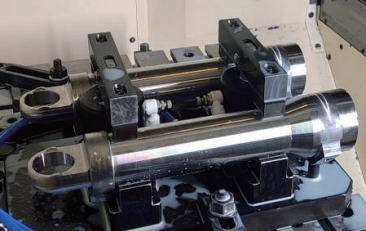


As the coal industry transitions toward high-quality development, hydraulic supports play a critical role.
Hydraulic supports act as the key equipment supporting coal mine comprehensive mechanized mining workfaces.
With this transition, manufacturing standards for hydraulic supports continue to rise.
At the same time, requirements for dimensional accuracy in the threaded joint holes of hydraulic cylinder piston rods are becoming increasingly stringent.
If the coaxiality between the sealing section and the threaded section of the threaded joint hole is insufficient, problems can occur.
It often leads to sealing compression and fluid leakage issues.
These issues directly affect the overall performance of the support.
Therefore, it is urgent to address the drilling precision issues of threaded joint holes.
Conventional drilling processes typically involve securing the workpiece and using a rotating drill bit to perform the drilling.
However, the stepped hole structure inside the piston rod threaded joint hole requires operators to drill with high precision at different positions.
If a conventional drilling machine is used, limitations arise. A single tool cannot meet the internal hole processing requirements.
As a result, operators cannot complete drilling in a single clamping and positioning operation. The current processing method involves clamping the workpiece securely.
Operators then continuously change tools according to the internal hole dimensions. This process is necessary to meet the drawing specifications.
Considering the inaccuracy of visual inspection, each tool change results in positioning deviations of the hole center.
Due to multiple positioning operations, the threaded section and sealing section of the threaded joint hole cannot guarantee coaxiality.
As a result, operators may not be able to assemble the threaded joint onto the side-push jack.
This leads to a high scrap rate and causes unforeseeable labor and property losses. Consequently, the current method is unsuitable for mass production.
Workpiece positioning involves restricting all or part of the workpiece’s degrees of freedom according to machining requirements.
Based on the specific characteristics of the part, engineers designed a simple yet effective machining fixture.
Engineers designed it for the threaded joint hole of the hydraulic cylinder piston rod. The fixture ensures machining accuracy.
Figure 1 illustrates the design. It primarily consists of V-blocks, clamping plates, positioning plates, fixed screws, nuts, and machining sleeves.
The main advantage of this machining fixture lies in the positioning sleeve mother holes designed on the positioning plate.
Designers typically set the center distance between the two threaded joint holes of the hydraulic support side-push jack at 35 mm.
Therefore, engineers directly machine the center distance of the positioning sleeve mother holes on the positioning plate to 35+0.50 mm.
The precise fit between the machining sleeve and the female hole ensures consistent center distance dimensions for the threaded joint holes during batch processing.
After replacing the tool, the operator uses the machining sleeve to assist with secondary positioning.
The sleeve’s guiding function ensures rapid and precise positioning. It accurately aligns the tool to the machining hole center after each tool change.
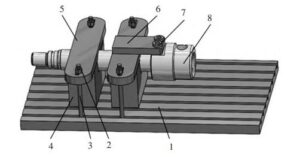
To minimize deformation caused by clamping, engineers machine the bottom edge of the V-block on a milling machine.
This allows operators to place the piston rod horizontally in the V-shaped groove.
A dual clamping plate structure is used for positioning. It prevents component movement during drilling operations.
Working principle: The bottom of the V-block has grooves. These grooves correspond to the width of the grooves on the drilling machine platform.
This design facilitates the clamping of the entire positioning fixture onto the platform. Before machining, operators can place the V-block on the workbench of the swing-arm drilling machine.
This is done using the fit between the V-block fixing groove and the workbench.
One V-block is placed on each side. They are then adjusted to the appropriate distance. Operators place the jack piston rod to be processed in the V-shaped groove.
Next, they secure and fix it firmly on the side opposite the piston rod head. This is done using a clamping plate, fixing screws, and nuts.
Next, adjust the other side of the V-shaped block to the appropriate distance, then adjust the positioning plate.
The centers of the two positioning sleeve holes on the positioning plate should be coaxial. Operators must align them with the marked center of the threaded joint hole on the jack piston rod to be machined.
After adjustment, securely fix the positioning plate, fixing screws, and nuts;
Finally, select the appropriate processing sleeve based on the chosen drill bit, tap, reamer, or countersink, and place it in the locating sleeve bore of the locating plate.
Normal processing can then proceed. Different tool diameters correspond to different processing sleeves. This ensures proper clearance between the tool and the processing sleeve.
As a result, the operator guarantees the concentricity of the threaded joint hole being processed.
The outer dimensions of the machining sleeve are shown in Figure 2.
When designing the machining sleeve, engineers increase the dimension **H** within the sleeve as much as possible.
This is based on the thickness of the locating plate. Increasing H ensures a sufficient guiding contact surface.
It enhances the guiding function of the machining sleeve. This also ensures precise alignment with the hole center during each replacement of the machining sleeve.
To improve the relative accuracy of the hole, engineers carefully select the material for the machining sleeve.
It is made of 45 steel. Engineers apply heat treatment to achieve a hardness of 40–45 HRC.
This ensures the stability of hole dimensions during batch processing of parts.
The height dimension H of the section mating with the locating plate is 17 mm, slightly smaller than the thickness dimension of the locating plate.
They must clamp and position the machining sleeve in a single operation, machining both the inner hole and outer diameter on the same machine.
Operators must control the dimensional deviation of the outer diameter d2, which mates with the locating plate’s machined master hole, within 0–0.05 mm.
They must control the dimensional deviation of the hole d1, which mates with the drill bit diameter, within 0–0.1 mm.
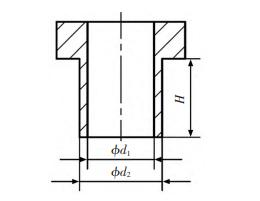
Engineers design processing sleeves of corresponding sizes for drill bits, taps, reamers, and countersinks of different specifications.
Operators can use these sleeves for threaded joint hole processing with different diameter requirements.
Figure 3 shows the dimensions of the piston rod threaded joint hole.
The threaded section 2-M16×1.5 and the sealing section 2-φ18H9 of the threaded joint hole require extremely high coaxiality.
Threaded joint step hole machining process:
① After securing and adjusting the piston rod on the positioning fixture platform, the operator uses a radial drill press to machine the threaded joint hole.
First, install a φ14 mm drill bit. Place the corresponding φ14 mm machining sleeve at the machining sleeve’s female hole location.
Then, operate the radial arm to align the drill bit’s center with the machining sleeve’s center.
The drill bit passes through the machining sleeve, thereby achieving rapid and precise positioning of the drill bit.
Afterward, operators can perform normal φ14 mm drilling.
Once they complete it, they remove the drill bit.
② Replace the drill bit with a φ17.5 mm drill bit and the machining sleeve with a φ17.5 mm machining sleeve.
Operate the swing arm in the same manner to align the drill bit center with the machining sleeve center.
The drill bit passes through the machining sleeve, completing the rapid and precise positioning of the drill bit, and proceed with φ17.5 mm drilling operations;
③Subsequent operations follow the same steps as above.
These include tapping M16 threads with a tap. Reaming the φ18 mm sealing surface with a reamer.
Chamfering with a chamfering tool. Operators continue the process until they machine the hole to the finished product.

The use of this rapid positioning fixture effectively ensures the coaxiality of the threaded section and sealing section of the threaded joint hole.
It guarantees that the threaded joint holes of the piston rod meet the technical requirements specified in the drawings.
Additionally, the processing sleeve extends the service life of the drill bit. This directly improves production efficiency.
It also ensures the dimensional stability of threaded joint holes during mass production processes.
It allows them to quickly and accurately position the tools at the center of the processing hole.
This effectively reduces errors caused by each tool change and repositioning. It also ensures processing accuracy.
Operators achieve a 100% qualification rate for threaded joint hole processing.
This lowers maintenance costs. It also reduces the labor intensity of workers.
The new positioning fixture has significant application and promotion value, providing a reference for the processing of holes in other shaft-type parts.