How to efficiently machine shaped parts on CNC mill-turn machines?


In high-end manufacturing sectors such as aerospace and medical devices, the machining precision of complex curved components—including aircraft engine blades and artificial joint prostheses—directly impacts equipment performance and operational safety.
Such components typically feature free-form surfaces (curvature variation rate >0.1%/mm), micron-level tolerances (±5μm), and stringent surface quality requirements (Ra≤0.8μm).
Traditional three-axis machining struggles to meet these forming demands due to toolpath limitations and high interference risks.
Five-axis CNC machining achieves complex geometric forming through multi-axis coordination, yet its process complexity introduces two core challenges: error accumulation and efficiency bottlenecks.
Digital twin technology offers a novel solution by establishing real-time mapping between physical entities and virtual models.
This paper proposes a full-process optimization method for five-axis machining based on digital twins.
Through high-fidelity modeling, real-time error compensation, and virtual debugging, it overcomes the bottleneck in achieving coordinated optimization of precision and efficiency in complex surface machining.
Digital twin technology employs a three-tier collaborative architecture—“physical entity-virtual model-data interaction”—to achieve comprehensive, end-to-end dynamic mapping of complex curved surface five-axis machining processes.
This provides closed-loop support for optimizing machining precision and efficiency.
The physical entity layer centers on five-axis CNC machines, integrating cutting tools, fixtures, and multi-source sensing systems.
These systems include vibration sensors (1kHz sampling frequency), infrared temperature sensors (-50~300℃ measurement range), and piezoelectric cutting force sensors (0~5000N range).
They enable real-time acquisition of critical process data such as spindle speed (adjustable 0~18000r/min), feed rate (0.05–0.2 mm/r), and peak cutting force.
This establishes a digital mirror foundation for the physical machining process.
The virtual model layer constructs high-fidelity virtual models from physical layer data, including 3D geometric features, material properties, and process logic, enabling visual simulation of the machining process.
The data interaction layer leverages the OPC UA industrial communication protocol to establish real-time transmission channels between virtual and physical data.
This ensures synchronization between physical equipment status and virtual models with a latency of less than 10ms, providing real-time data support for dynamic process monitoring, error prediction, and parameter optimization.
The error system in five-axis machining of complex surfaces exhibits multi-source and coupled characteristics.
We can categorize its core error sources into three types:
First, machine tool errors are the primary source of error accumulation, encompassing positioning errors of the axis system and associated errors of rotary axes.
Second, tool errors directly impact surface forming quality, covering geometric errors and wear errors.
Finally, process errors stem from mismatches between cutting parameters and machining conditions.
For instance, when feed rates exceed 150 m/min, the machine vibration amplitude increases by over 30%, leading to chatter marks on the workpiece surface.
In severe cases, deformation can exceed 50 μm.
In complex surface machining, contour errors account for over 60% of total errors.
Their formation closely relates to multi-axis motion synchronization and the smoothness of the tool path.
Real-time dynamic compensation is essential to suppress error propagation chains and achieve micrometer-level precision control.
Long Short-Term Memory (LSTM) networks capture dynamic features of time-series data.
Inputting vibration signals (1kHz sampling rate), temperature data (0.1 °C resolution), and process parameters, they output profile error predictions (MAE ≤ 2 μm).
Model training used 500 historical data sets, with network parameters adjusted via the Adam optimizer (learning rate 0.001), achieving a 40% improvement in prediction accuracy over traditional methods.
High-fidelity digital twin models form the foundation for precise process simulation, requiring the integration of geometric, physical, and process modeling technologies.
Engineers acquire point cloud data of complex curved parts using 3D scanning technology.
Siemens NX software reconstructs surfaces to generate CAD models that are consistent with the physical workpieces.
To enhance accuracy, engineers use reverse engineering to correct model deviations, ensuring 99.9% geometric similarity between virtual models and physical objects.
At the same time, they import the structural model of the five-axis CNC machine tool, including the bed, spindle, rotary axes, and other components.
Engineers precisely configure the motion parameters and travel ranges for each axis.
Engineers establish a physical model of the cutting process using finite element analysis (FEA).
The Johnson-Cook constitutive equation describes the plastic deformation behavior of materials (e.g., titanium alloys, superalloys).
Combined with cutting force models (e.g., the Oxley model), it calculates the magnitude and distribution of cutting forces under different cutting parameters, simulating the force-heat coupling process between the tool and workpiece.
Additionally, a tool wear model was introduced to predict tool wear based on cutting time and material hardness, providing a basis for tool replacement decisions.
Integrate toolpath planning with cutting parameter optimization logic.
For complex surfaces with varying curvature, employ the constant residual height method to generate initial toolpaths, ensuring uniform machining allowance.
Through virtual simulation based on digital twin models, collision detection algorithms (e.g., bounding box algorithms) identify interference risks between tools, fixtures, and workpieces, automatically adjusting tool orientation to avoid collisions.
For cutting parameter optimization, establish a parameter optimization model targeting machining efficiency while constraining surface roughness and machining errors.
Initial parameter ranges reference process manuals (e.g., cutting speed 80–150 m/min, feed rate 0.05–0.2 mm/r).
Virtual simulation based on digital twin models enables visualization and predictability of machining processes.
Simulates multi-axis coordination of five-axis machine tools in a virtual environment.
Real-time display of relative tool-to-workpiece positions via toolpath tracking, dynamically demonstrating material removal processes.
For critical regions of complex surfaces (e.g., curvature discontinuities), employs fine time steps (0.01s) to capture instantaneous cutting force variations.
Acceleration sensors (1kHz sampling rate) and temperature sensors mounted on the machine tool spindle and worktable collect vibration acceleration and ambient temperature data.
After filtering, engineers transmit this data to the digital twin model, enabling real-time mapping of machining conditions.
When vibration amplitude exceeds thresholds (e.g., 0.1g), the virtual model triggers early warnings, indicating potential tool wear or parameter issues.
Engineers construct a deep learning-based error prediction and compensation model to achieve precise control of machining errors.
An LSTM neural network is employed as the prediction model.
Input features include sensor data (vibration acceleration, temperature), process parameters (cutting speed, feed rate, cutting depth), and machine tool axis position information.
The output represents surface contour error. Model training utilizes historical machining data (500 valid samples), with network parameters adjusted via the Adam optimizer.
The mean absolute error (MAE) of predicted errors is controlled within 2μm.
Based on the error prediction results, the digital twin model generates compensation values and transmits them to the CNC system of the five-axis machine tool.
For machine tool axis errors, an error mapping matrix distributes compensation values to each axis to correct motion trajectories.
Engineers correct tool wear errors by adjusting the tool length compensation values.
Engineers realize the compensation process through real-time data interaction, keeping response delays within 10 milliseconds.
Virtual debugging technology simulates the entire machining process in a digital environment to identify unreasonable process parameters and tool paths in advance, thereby reducing the number of actual trial cuts.
Based on virtual simulation results, analyze tool-workpiece contact zones.
Apply variable feed rate strategies to surface segments with abrupt curvature changes, enhancing efficiency while maintaining machining quality.
Optimize cutting parameters using genetic algorithms, targeting maximum machining efficiency with a constraint of prediction error ≤6μm.
This experiment focuses on titanium alloy blades (TC4 material) critical to aircraft engines.
The blade surface is a free-form surface with a maximum curvature radius of 50 mm.
During aircraft engine operation, engineers require the blades to meet extremely high precision and surface quality standards.
This experiment demands machining accuracy of ±5 μm and surface roughness Ra < 0.8 μm.
The experimental platform comprises several key components.
A five-axis machining center (model DMU50) was selected.
Equipped with an HSK-A63 spindle capable of reaching a maximum speed of 18,000 rpm, it accommodates diverse complex machining requirements.
Its X/Y/Z axis travel of 500 mm × 450 mm × 500 mm provides ample spatial range for blade machining.
Acceleration sensors (Model PCB 352C65) are installed to precisely capture spindle vibration signals.
These signals reflect vibration conditions during machining, aiding in stability analysis. Concurrently, infrared temperature sensors (resolution 0.1°C) monitor cutting zone temperatures.
Temperature significantly impacts titanium alloy blade machining quality; real-time temperature monitoring enables timely adjustment of machining parameters.
A virtual simulation system developed using Unity 3D interacts with the physical machine tool via the OPC UA protocol.
As a communication standard in industrial automation, OPC UA provides a secure and reliable architecture for data exchange between devices and software from different platforms and vendors.
It enables real-time and historical data acquisition, as well as seamless integration and interoperability between devices.
The virtual model updates at a frequency of 100Hz, accurately reflecting the real-time status of the physical machine tool.
A coordinate measuring machine (Zeiss CONTURA G2 model) was employed to inspect surface errors on machined blades.
With a measurement accuracy of up to 0.5μm, it precisely measures deviations between actual and theoretical blade dimensions, providing data support for evaluating machining quality.
To compare the effectiveness of the proposed digital twin optimization method with conventional machining, the experiment was divided into two groups.
The control group employed traditional machining methods, i.e., processing based on empirical process parameters; the experimental group utilized the proposed digital twin optimization method.
Five blades were machined in each group. By comparing the machining errors and efficiency metrics of the processed blades between the two groups, the advantages of the digital twin optimization method were validated.
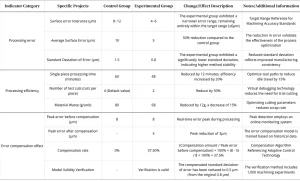
The experimental group demonstrated significantly superior machining accuracy, efficiency, and error compensation performance compared to the control group.
Detailed data are presented in Table 1. Overall, this validation confirms the effectiveness and stability of the digital Li-based machining method in precision control and efficiency enhancement.
The proposed five-axis CNC machining simulation and optimization method for complex curved parts based on digital twins effectively addresses the core challenges of precision control and low efficiency in machining complex surfaces.
This is achieved by constructing high-fidelity digital twin models for dynamic mapping of the machining process, integrating deep learning algorithms for real-time error prediction and compensation, and utilizing virtual debugging technology to optimize tool paths and cutting parameters.
Experiments demonstrate that machining errors can be consistently maintained within 6μm, with efficiency improvements exceeding 20%, thereby supporting intelligent manufacturing for high-precision complex curved parts.
Future research will deepen in three directions: exploring lightweight modeling and parallel computing, integrating multiphysics coupling simulation, and extending applications to batch production and flexible manufacturing scenarios to enhance efficiency and adaptive capabilities.