
New-type productive forces serve as the core driving force behind economic development and are also key to achieving high-quality growth.
As these new productive forces continue to evolve, traditional industries are undergoing gradual transformation and upgrading, while emerging industries are accelerating their rise.
In this process, higher vocational colleges play a crucial role. They not only supply enterprises with a large number of highly skilled technical professionals but also provide robust technical support.
To better serve the development of new-quality productive forces, vocational colleges have begun acquiring specialized equipment.
This equipment not only enhances teaching quality and research capabilities but also enables enterprises to receive superior technical services.
Notably, large-scale machinery and CNC gantry machining centers have become standard equipment in vocational colleges.
The introduction of such machinery allows students to gain hands-on experience with large-scale equipment applications while still in school.
This significantly strengthens the institutions’ capacity to cultivate technical talent.
Challenges
However, several challenges persist. First, manufacturers generally achieve low precision in machined products, and they cannot consistently maintain dimensional accuracy during processing.
Second, achieving faster operation requires not only increasing the spindle speed but also ensuring smooth movement of the X, Y, and Z axes throughout the machining process.
Yet, high operating speeds introduce additional complications.
For instance, high-speed operation generates substantial heat, often distributed unevenly.
This severely impacts thermal stability, becoming a primary factor limiting machine stability.
Therefore, during machining, attention must be paid not only to operational effectiveness but also to how environmental changes affect precision.
It is essential to manage heat-generating components to prevent excessive temperatures from adversely affecting precision.
Only by implementing these measures can manufacturers ensure the machine tool’s accuracy and stability, thereby accelerating the development of new productive forces.
In modern large CNC gantry milling machines, the layout of the main drive system represents a critical technical consideration.
These units are typically mounted on the ram, which itself functions as a large-scale spindle transmission assembly.
During workpiece cutting operations, the spindle generates substantial heat.
Both this heat generation and the preload settings applied during spindle assembly significantly influence machine tool performance.
Excessive preload increases thermal conductivity, leading to greater thermal deformation.
This deformation is further influenced by factors such as the ram’s cross-sectional design and guideway arrangement.
Effects of Heat on Machine Tool Components
Heat Generation Factors in the Main Drive
During machining, the spindle generates significant heat.
Additionally, the preload applied by assembly technicians during spindle and bearing installation plays a role.
Excessive preload increases thermal conductivity under machining loads, leading to substantial thermal deformation.
Thermal deformation of the ram directly impacts machining accuracy and performance.
Therefore, investigating how the main drive transmission configuration affects ram thermal deformation is crucial.
Analysis of Main Drive Transmission Configurations
Machine tool main drives primarily employ two transmission methods: front-end transmission and end-face transmission.
Frontal drive mounts the main motor and gearbox on the ram’s front face, featuring a shorter transmission chain that provides superior transmission rigidity.
This semi-enclosed configuration allows unrestricted ram dimensions, enhancing structural performance.
However, this layout concentrates heat from the main drive on the ram’s front face, causing uneven force distribution between front and rear surfaces and increasing susceptibility to thermal deformation.
The other transmission method uses end-face transmission, in which engineers mount the main motor and gearbox on the upper part of the ram.
Engineers transmit power to the spindle through a long drive shaft.
The advantage of this layout is that the longer drive shaft, though offering relatively lower rigidity, prevents significant temperature differences between the front and rear sides of the ram.
This design thereby reduces deformation risks.
However, the drawback of end-face transmission is that it imposes limitations on ram dimensions.
Impact of the Ram
1. Importance of the Ram in Machine Tool Processing
In modern machine tool processing, the ram serves as a critical transmission component whose performance and precision directly influence the overall machining efficiency and quality of the machine tool.
However, during processing, the ram is susceptible to thermal deformation caused by heat generated from the spindle and preload forces.
This thermal deformation not only affects the ram’s inherent performance but also adversely impacts the machining accuracy and stability of the entire machine tool.
Thermal deformation of the ram is primarily caused by heat generated by the spindle and preload forces.
During high-speed rotation, the spindle generates substantial heat and transmits it through the ram to the entire machine tool.
Simultaneously, preload forces induce internal stresses within the ram. When these stresses interact with thermal effects, the ram becomes susceptible to thermal deformation.
2. Influence of Transmission Layout on Thermal Deformation
For the front-face heat transfer method, heat accumulates on the front surface of the ram, causing uneven stress distribution between the front and rear surfaces.
This imbalance induces thermal deformation. Such deformation alters the ram’s shape and dimensions, thereby compromising the machine tool’s machining accuracy and stability.
For example, in CNC machine tools, ram thermal deformation can cause tool positional shifts, resulting in inaccurate part dimensions.
In contrast, the end-face transmission method minimizes thermal deformation because the front and rear surfaces maintain similar temperatures.
This approach effectively reduces thermal deformation, thereby enhancing the machine tool’s machining accuracy and stability.
3. Experimental Analysis and Structural Optimization
To further validate the impact of thermal deformation on machining accuracy, researchers conducted an experiment.
Researchers applied different preload forces to the front and rear surfaces of the ram and measured the resulting deformation after heating.
The results indicate that uneven force distribution between the front and rear surfaces of the ram causes thermal deformation, thereby affecting the machine tool’s machining accuracy.
Additionally, researchers analyzed thermal deformation in rams made of different materials and featuring varying structures.
The findings reveal that the thermal conductivity and elastic modulus of the material significantly influence the ram’s thermal deformation.
Furthermore, structural design elements, such as the configuration of cooling channels, can effectively reduce thermal deformation.
In summary, thermal deformation of the ram is a critical concern during machine tool processing.
By rationally designing and selecting ram materials and structures, engineers can effectively minimize thermal deformation, thereby enhancing the machine tool’s machining accuracy and stability.
Additionally, for front-load transmission methods, particular attention must be paid to uneven force distribution between the front and rear surfaces to prevent ram deformation.
4. Comparative Evaluation of Transmission Methods
Analysis of Ram Thermal Deformation During machining, the ram is prone to thermal deformation due to heat generated by the spindle and the influence of preload forces.
This thermal deformation directly impacts the machine tool’s machining accuracy and performance.
In the front-entry configuration, heat from the transmission accumulates on the ram’s front face, causing uneven stress distribution between the front and rear surfaces and inducing thermal deformation.
Conversely, the end-face entry method minimizes thermal deformation by avoiding significant temperature differences between the ram’s front and rear surfaces.
Each main drive transmission method has its advantages and disadvantages.
Selecting the most suitable layout requires consideration of specific machine tool design and operational requirements.
The front-entry method offers superior transmission rigidity but is prone to causing thermal deformation of the ram.
The end-entry method minimizes ram deformation but imposes limitations on ram dimensions.
Therefore, engineers must comprehensively evaluate the impact of transmission methods on ram thermal deformation during machine tool design.
Engineers should select an appropriate layout to enhance machining accuracy and overall performance.
In summary, different main drive input methods each have their advantages and disadvantages.
Selecting the most suitable layout requires consideration of the specific machine tool design and usage requirements.
Typically, engineers mount the main drive unit of large CNC gantry milling machines on top of the ram, with the spindle positioned at the lower end.
Here, the ram essentially refers to the large-diameter drive spindle assembly.
During machining, the spindle generates significant heat from cutting the workpiece.
Additionally, technicians must carefully control the preload applied to the spindle and bearings during assembly.
Excessive preload can increase thermal conductivity under machining loads, leading to significant thermal deformation.
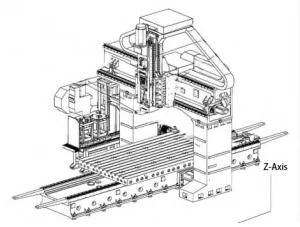
Factors such as the ram’s cross-sectional design and guideway arrangement influence this deformation, as illustrated in Figure 1.
Effective Methods for Controlling Machine Tool Thermal Stability
Controlling Heat Generation in the Drive Spindle
First, users should perform preheating of the main drive system before machining. Prior to operation, run the spindle at 100 rpm.
This is crucial for achieving thermal equilibrium in the machine tool’s primary drive system.
Under these conditions, the sliding bed and thermal elongation within the machine stabilize, minimizing significant fluctuations in other precision components.
Commence machining at this stage to ensure stable processing accuracy.
This is currently a widely adopted method. Second, employ constant-temperature oil-cooled spindle systems or water cooling.
While oil cooling reduces heat dissipation, it requires dedicated oil-cooling equipment and incurs higher costs. This method prevents spindle rusting.
Water-cooled spindles have gained widespread popularity in recent years due to their rapid cooling efficiency, lower operational costs, and environmental compliance.
Water cooling outperforms oil in cooling speed, though it necessitates regular maintenance to prevent spindle corrosion.
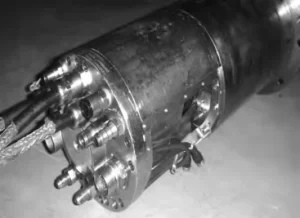
In humid southern climates, spindle rusting becomes more prevalent because manufacturers typically machine spindles from 45 steel or 40Cr. Figure 2 illustrates the cooling efficiency of water.
Controlling Heat Generation in Servo Motors and Ball Screw Drives
The primary sources of heat generation in CNC machine tools are servo motors and ball screw drives.
To address heating in ball screw drives, hollow screws are widely adopted to enhance heat transfer efficiency.
By circulating cooling oil, the temperature differential of the screw can be reduced, aligning its temperature with that of the machine tool.
Maintaining the lead screw temperature consistent with the machine tool’s thermal expansion prevents thermal effects on forces like compression or preload within the lead screw.
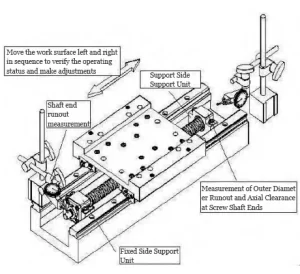
This minimizes force dissipation, ensuring the feed axis’s drive rigidity remains constant despite temperature changes and safeguarding machining accuracy, as illustrated in Figure 3.
Common Methods for Large CNC Gantry Milling Machines
1. Feed System Design and Heat Management
The first method involves installing a feed motor at the component end.
This feed motor is essentially a servo motor, a variable-speed auxiliary motor characterized by excellent controllability and positional accuracy.
However, this motor demands extremely stringent environmental conditions, necessitating precise temperature control at its location.
After adequate heat dissipation is established, the heat generated by the feed servo motor is managed either through synchronous toothed belts or by isolating the ball screw with high-precision reducers.
The second method involves using large-diameter ball screws, preferably solid rather than hollow, primarily to increase thermal storage capacity and prevent rapid temperature rise.
2. Geometric Accuracy of CNC Machine Tools
As shown in Figure 1, the geometric accuracy of a CNC machine tool reflects the geometric shape errors of its key mechanical components, such as the bed, saddle, column, and spindle head.
It also reflects the geometric shape errors that occur during assembly.
This includes the flatness of the worktable surface and the perpendicularity of movements in each coordinate direction.
It also covers the parallelism of the worktable surface in the X and Y coordinate directions, the radial runout of the spindle bore, and the axial play of the spindle.
Additionally, it involves the parallelism of the spindle axis when the headstock moves along the Z-axis centerline, the straightness of the spindle when moving in the Z-axis direction, and the rotational center of the spindle, as shown in Figure 4.

3. Long-Term Accuracy Maintenance and Temperature Control Strategies
Multiple combinations can reduce its temperature and adjust its operating state, striving to achieve optimal machining conditions for the machine tool.
This continuously enhances stability, ensures rigidity, and enables more precise machining.
Maintaining the accuracy of large gantry milling machines is a long-term process, not a task accomplished overnight.
While ensuring thermal stability, other factors affecting machine temperature can also be identified and overcome one by one.
This paper primarily combines practical experience and data insights to explore effective strategies for temperature control.