How to efficiently machine shaped parts on CNC mill-turn machines?


Gas turbines, as highly efficient and clean energy equipment, have found extensive application in sectors such as power generation and marine engineering.
The gas turbine sleeve is one of the critical components within a gas turbine.
As a high-temperature part, its helical steam seal groove structure demands exceptional gas tightness.
The machining quality directly impacts the operational efficiency and safety of the unit.
Therefore, research into the machining methods for this component is essential.
With the advancement of CNC machining technology, CNC turning has become widely applied in the processing of threaded features.
Currently, two primary methods are used for machining threaded components:
The other is form-cutting, where the tool tip follows the thread profile during machining.
For form-cutting, the large contact area between the tool cutting edge and the thread surface results in significant cutting forces during machining, making chip evacuation difficult.
Consequently, the cutting edge is prone to wear under this method.
Particularly when turning coarse-pitch threads, the high cutting forces accelerate cutting edge wear, potentially causing deviations in the thread mean diameter.
Consequently, manufacturers more widely apply this method to machine fine-pitch, high-precision threads.
In contrast, the form-cutting method employs layered cutting, resulting in lower cutting forces during the process.
Therefore, this method is more suitable for machining large-thread and coarse-pitch thread features.
CNC systems provide universal cycle cutting commands for standard triangular threads.
For example, FANUC systems offer G92 and G76 commands, while SIEMENS systems feature G33 commands.
Due to the unique thread characteristics of spiral steam seal grooves, their machining process is significantly more complex than standard triangular threads.
Consequently, CNC systems lack direct universal programming commands for machining spiral steam seal grooves.
This paper utilizes the user macro programming functionality provided by the SIEMENS CNC system for program development and application, achieving efficient machining of the thread features in gas turbine sleeve spiral steam seal grooves.
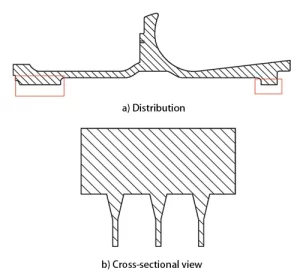
Gas turbine bushings are typical thin-walled components.
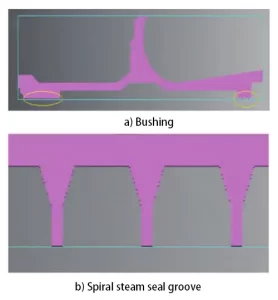
The spiral steam seal grooves on these bushings are usually symmetrical trapezoidal structures with left and right-hand threads (see Figure 1).
Conventional spiral steam seal grooves have a width of 4 mm, a lead angle of 45°, a steam seal tooth height of 6 mm, and dimensional accuracy requirements of ±0.02 mm.
Gas turbine bushings are typically fabricated from high-strength, high-temperature-resistant alloy materials such as nickel-based alloys or titanium alloys.
These materials exhibit high hardness and toughness, making them prone to work hardening during machining.
This phenomenon increases cutting forces and accelerates tool wear.
Additionally, these materials exhibit a relatively high thermal expansion coefficient, making them prone to thermal deformation during machining, which can compromise machining accuracy.
Therefore, when selecting cutting tools and setting cutting parameters, it is essential to fully consider these material characteristics to ensure machining stability and quality.
The machining challenges for spiral steam seal grooves in gas turbine shaft sleeves primarily involve the following three aspects:
The spiral steam seal groove in the shaft sleeve is a spatial structure.
During machining, the tooth profile is prone to deformation, making CNC program development highly difficult.
Dimensions such as groove width and helix angle demand high precision, necessitating strict control over machining equipment accuracy and process parameters.
The surface roughness of the groove bottom and side walls must meet 1.6μm specifications.
This requires programming that fully accounts for tool wear and how to control cutting parameters to compensate accordingly.
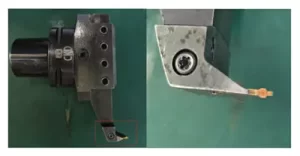
The profile turning method employs a standard width (1.2mm) straight-slot cutter (see Figure 2) to perform contouring machining based on the trapezoidal steam seal groove profile.
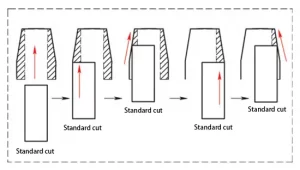
This process comprises five steps as follows, with the profile turning sequence illustrated in Figure 3.
1) Rough cut the straight slot, roughing the center section and cutting to the bottom of the slot.
2) Finish-turn the left straight section, then finish-turn the first upper straight segment on the left.
3) Finish-turn the left inclined section, turning down to the groove bottom to complete the left-side finishing.
4) Finish-turn the right straight section, then finish-turn the first upper straight segment on the right.
5) Finish-turn the right inclined section, turning down to the groove bottom to complete right-side finishing.1)
The advantages of the profile turning method are:
① Wide applicability, suitable for spiral steam seal grooves of various sizes and shapes.
② Controlling the cutting depth per pass ensures high machining accuracy.
③ Superior machining quality, yielding excellent surface finish.
However, since the profiling method requires division into multiple steps, the machining cycle is relatively long, resulting in lower processing efficiency.
In actual machining, spiral steam seal grooves are processed using the thread-cutting cycle function within subroutines.
Since this approach decomposes the machining process into multiple steps, the cutting depth per pass can be flexibly adjusted according to actual requirements.
It is particularly suitable for machining larger spiral steam seal grooves with substantial allowances.
Furthermore, when machine tool rigidity is poor and cutting resistance causes tool vibration, this method can improve cutting quality even for smaller spiral steam seal grooves.
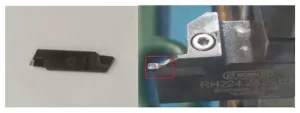
The forming turning process employs a forming cutter, as shown in Figure 4, to directly machine the shape of the spiral steam seal groove.
This method consists of two steps and is suitable for smaller spiral steam seal grooves.
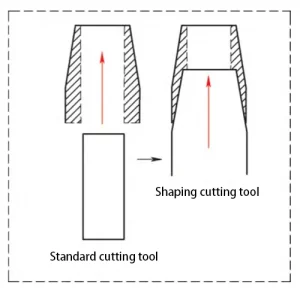
The forming turning process steps are as follows, with the steps illustrated in Figure 5.
Use a standard straight groove cutter to rough-turn the spiral steam seal groove contour, removing most of the stock.
Use a form cutter to finish-turn the spiral steam seal groove tooth profile, ensuring dimensional accuracy for groove width, lead angle, etc.
The form turning method requires only two steps, resulting in a shorter machining cycle and higher efficiency.
However, its applicability is limited due to the use of form cutters, making it suitable only for machining spiral steam seal grooves of specific dimensions and shapes.
Additionally, this method is significantly affected by tool wear, with machining accuracy decreasing as tool wear increases.
The spiral steam seal groove turning program developed for gas turbine bushings in this paper is written using a macro program approach and is compatible with SIEMENS CNC systems.
The machining of spiral steam seal grooves requires a combination of spiral turning and trapezoidal groove turning.
The developed program structure comprises two parts: a main program and a subroutine.
The main program controls the contour feed for the trapezoidal steam seal groove, while the subroutine controls the spiral cycle, including the setting of left-hand and right-hand rotation directions.
The helical cycle subroutine adjusts the tool’s movement direction based on right-hand or left-hand threads.
The right end of the gas turbine shaft sleeve features a right-hand thread, requiring downward turning with the tool; the left end has a left-hand thread, necessitating upward turning with the tool.
This subroutine is applicable in both copy turning and form turning methods.
The developed helical cycle subroutine is as follows.
L_TURNING_P2.5
N10 G00 X=R01-50 (R01: Starting inner circle for machining)
N12 Z=R70 (R70: Z-axis starting point for current turning helix)
N14 X=R31 (R31: X-axis starting point for current turning helix)
N16 G33 Z=R10 K2.5 SF=0: K=lead (R10: Z-axis endpoint of current turning helix)
N18 G00 X=R01-50
N20 M17
During thread machining operations, lead-in and lead-out distances must be set.
In the program developed herein, both lead-in and lead-out distances are configured as 2 times the pitch.
This means a safety margin of 2 times the pitch must be added to both the start and end positions of the spiral steam seal groove.
Profile turning method programs control the tool tip to machine corresponding profile lines according to different machining steps.
For example, rough turning straight grooves requires controlling parameters such as total cutting depth, depth of cut per pass, and X/Z-axis movements.
The main program for rough turning straight grooves is as follows (with tool alignment at the cutting edge):
R01=771.8 R02=777.8 R03=650 (R01: Starting inner circle for machining; R02: Final inner circle for machining; R03: Inner circle safety position)
R07=-81.1+2*2.5 R10=-234.4-2*2.5 (R07: Z-axis thread start position; R10: Z-axis thread end position)
MSG (1.2mm straight slot, depth 3mm, 45<R23<100)
R06=1
R23=60 (Depth 3mm, feed per pass 0.05mm, 60 passes; R23: Total passes in cycle)
R24=0 (R24: Current pass count)
MARK1:
IF R24>R23 GOTOF MARK10
R31=R01+2*(3*R24/R23) (R31: Current machining path X value)
R70=R07-1.2/2 ;tool width/2 (R70: Current tool tip Z start position, offset = tool width/2, aligning with cutting edge)
L_TURNING_P2.5
R24=R24+1
IF R24<=R23 GOTOB MARK1
MARK10:
G00 G90 X=R03
Z=R04 M09 M00
M30
The left-side straight line program for precision turning is as follows (aligning the cutting edge of the tool).
MSG (Upper segment 1, 1mm long, 180° segment, 15 < R23 < 21)
R06=1
R23=20 (Feed per cut: 0.05mm)
R24=0
MARK1:
IF R24>R23 GOTOF MARK10
R31=R01+2*(3*R24/R23)
R70=R07+1.1; tool holder/2
The precision turning program for the left-side bevel is as follows (aligning the cutting edge of the tool).
MSG (Upper segment 2, length 2.03mm, 10° segment, 32 < R23 < 44)
R06=1
R23=41 (Feed per cut: 0.05mm)
R24=0
MARK1:
IF R24>R23 GOTOF MARK10
R31=R01+2*(1+2.03*R24*COS(10)/R23)
R70=R07+1.1-2.03*R24*SIN(10)/R23
L_TURNING_P2.5
R24=R24+1
IF R24<=R23 GOTO MARK1
Since the right-side straight and helical programs are symmetrical to the left side, tool setting is performed using the lower cutting edge.
The program structure is similar and will not be elaborated further here.
The program for form turning methods comprises two operations: rough turning of straight grooves and finish turning of tooth profiles.
Rough turning of straight grooves follows the same procedure as contour turning.
The main program for the finishing turning of tooth profiles is as follows (with tool center point alignment):
R01=771.8 R02=777.8 R03=650
R07=-81.1+2*2.5 R10=-234.4-2*2.5
R23=120(Feed per tooth 0.025mm)
R24=0
MARK1:
IF R24>R23 GOTO MARK10
R31=R01+2*(3*R24/R23)
R70=R07
L_TURNING_P2.5
R24=R24+1
IF R24<=R23 GOTO MARK1
MARK10:
G00 G90 X=R03
Z=R04 M09 M00
M30
This paper employs VERICUT simulation software to simulate vertical lathe machining operations based on 3D models of the gas turbine sleeve and machining tools.
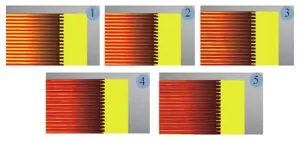
Figure 6 illustrates the simulation of five steps using the copy turning method.
Figure 7 shows the simulation results for the gas turbine sleeve.
The simulation confirms that no overcutting occurred during the program, verifying both the program’s accuracy and the machining method’s feasibility.
After software simulation of the CNC machining program for the shaft sleeve spiral steam seal groove, trial cutting operations were performed on the product.
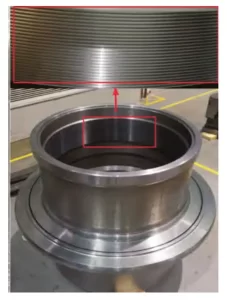
The actual machining results are shown in Figure 8.
Measurements of the machined component’s dimensions and surface precision confirmed that the accuracy fully meets the drawing specifications.
The actual machining results validate the accuracy of the selected process method and the correctness of the developed program.
This paper determines the cutting parameters for the tool during different machining steps based on the cutting process of the spiral steam seal groove, providing a reference for subsequent machining. Specific cutting parameters are listed in Table 1.
| Machining Operation | Spindle Speed (r/min) | Feed Rate (mm/r) |
|---|---|---|
| Rough Turning Non-standard Internal Thread (Straight Groove) | 12 | 2.5 |
| Rough Turning Non-standard Internal Thread (Tapered Surface) | 14 | 2.5 |
| Finish Turning Non-standard Internal Thread | 15 | 2.5 |
During the machining process of spiral steam seal grooves, in addition to the rotational speed parameters of the cutting tool and rotary table, the number of spiral cycles is equally critical.
Generally, a higher number of cycles results in improved surface quality of the workpiece, but simultaneously increases machining time.
Therefore, a trade-off must be made in selecting the number of cycles to achieve the optimal overall effect.
After this trade-off, the number of spiral cycles for each machining step in the profile machining of the spiral steam seal for the gas turbine sleeve is determined (see Table 2).
| Profiling Machining Steps | Number of Spiral Cycles (times) |
|---|---|
| Step 1 (Rough Cutting Straight Groove) | 60 |
| Step 2 (Left Straight Line) | 20 |
| Step 3 (Left Inclined Line) | 41 |
| Step 4 (Right Straight Line) | 20 |
| Step 5 (Right Inclined Line) | 41 |
This paper investigates two CNC machining methods for spiral steam seal grooves in gas turbine shaft sleeves: contour turning and form turning.
It analyzes the respective advantages, disadvantages, and applicable conditions of each method. CNC machining programs for spiral steam seal grooves were developed based on both approaches.
Through simulation and trial machining, the feasibility of the machining methods and the correctness of the programs were verified.
During trial cutting, highly adaptable cutting parameters were selected to achieve efficient and stable machining of the spiral steam seal groove, providing a more comprehensive machining solution for CNC processing of gas turbine spiral steam seal grooves.