
In the research, development, and manufacturing of aircraft engines, engineers have always pursued several core objectives.
They aim to achieve higher thrust output, improve operational efficiency, and reduce fuel consumption.
To achieve these objectives, it is typically necessary to increase the turbine inlet temperature and minimize the clearance between rotating and stationary components as much as possible.
However, under given structural and material conditions, there is a clear upper limit to the increase in turbine inlet temperature.
Therefore, engineers use air path sealing technology to reduce the clearance between the compressor and turbine blade tips and the casing.
This approach has become a key method for enhancing the engine’s overall performance.
Among these, wear-resistant sealing coatings have gained widespread application due to their outstanding advantages.
These advantages include relatively simple preparation processes, convenient maintenance and performance control, significant sealing effectiveness, and high operational stability.
This paper analyzes the structure and function of components to ensure the sealing performance of the sealing devices and the quality of product machining.
Research is conducted on process methods, tooling and fixtures, and cutting tools to ensure that the components meet design requirements.
Structural Features
The front seal assembly is installed at the large end of the fan shaft.
It achieves oil sealing by utilizing the clearance between the sealing coating and the sealing teeth.
The front seal assembly is precision cast using a hot isostatic pressing process, annealed, and then machined.
A wear-resistant coating material is sprayed onto the sealing section of the inner bore to achieve oil sealing.
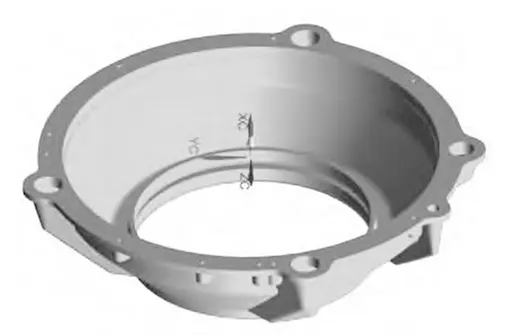
As shown in Figure 1, the front seal assembly features three precision holes (Φ28+0.0330 mm) on its large end face, with a positional tolerance requirement of 0.03 mm.
The large end mounting surface serves as the design reference for all axial dimensions.
Castings are prone to defects such as slag inclusions and localized wall thickness deficiencies, which further result in a low part acceptance rate.
Furthermore, the performance stability and dimensional accuracy of the inner bore coating directly affect the sealing reliability of the assembly.
Therefore, engineers must improve the quality of precision machining and ensure stable coating quality.
These are the core technical challenges they must address during the manufacturing process of this part.
Analysis of Challenges
Difficult to ensure the positional accuracy of precision holes and the quality of interference-fit threaded holes.
The part’s end face features three precision holes.
These holes are deep and require a large machining allowance.
Therefore, the stability of the cutting tool’s performance directly affects the part’s machining quality.
During the drilling of the pilot holes for the threaded holes, several technical challenges arise.
These include high temperatures in the machining zone, stress concentration due to the small contact area between the tool tip and the workpiece, difficulty in chip evacuation, and a narrow process parameter window.
These factors collectively exacerbate the instability of the machining process, leading to issues such as workpiece deformation and tool burnout.
In addition, the large end face of the part features 10 DG6-specification interference-fit threads with an effective depth of 14 mm and a high length-to-diameter ratio.
The thread machining tolerances are stringent, and prior to assembly, the threads must be grouped and matched to achieve a precise fit with corresponding bolts.
Each group has a tolerance band of only 0.015 mm, further increasing the difficulty of machining.
During the machining process, thread perpendicularity often deviates from specifications, resulting in failure to meet assembly tightness requirements.
Poor Coating Quality
The design specifications clearly state that the internal bore clearance prior to spraying must be 0.3 mm larger on each side than the final formed dimensions of the coating after spraying.
This clearance is intended for subsequent turning and finishing to ensure the final precision of the internal bore;
However, due to the design of the protective band in the sprayed area, the coating’s bonding area is limited, and the specified coating thickness is relatively thin.
This results in insufficient interfacial bond strength between the coating and the substrate in the protective band area.
Additionally, the thin coating itself has weak crack resistance.
These two factors act together during the subsequent turning process used to remove excess coating.
As a result, cutting forces cause stress concentration in the coating on the surface of the protective band.
This frequently leads to coating delamination, microcrack propagation, or even complete cracking, severely affecting coating integrity and the part’s machining yield rate.
Process Optimization
Precision Hole and Threaded Hole Machining Technology
During the drilling of titanium alloys, high temperatures can cause material to accumulate.
This leads to tool burn-out and the formation of built-up edges.
These effects result in dimensional deviations and rough hole wall surfaces.
To improve the quality and efficiency of hole machining, optimization can be achieved by addressing the following key aspects.
Comparative testing of drills made from different materials has shown clear performance differences.
Ultra-fine-grain cemented carbide drills maintain sharp cutting edges and exhibit lower wear rates when machining titanium alloys.
This significantly improves machining efficiency and makes them an ideal tool choice.
If conditions are limited, high-speed steel drills (such as grades M42 or B201) or standard cemented carbide drills may also be selected.
Additionally, using a cooling method suited to the characteristics of titanium alloys helps improve machining performance.
Providing sufficient and effective cooling extends tool life and further improves overall machining efficiency.
When machining threads, use a center point to secure the center hole at the tail end of the tap, and use a tapping gauge to ensure the thread hole meets perpendicularity requirements.
Ensure the tap remains sharp to prevent severe wear on the cutting edge, which can cause the threaded hole to taper and result in improper bolt seating.
This effectively resolves issues of inconsistent thread quality.
It simplifies the operation and allows the bolt to be seated correctly in a single attempt.
It also prevents part scrap caused by repeated adjustments or bolt breakage.
Optimization of Coating Quality Control
1. Coating Stress Testing Techniques
The primary objective of this test is to obtain low-stress silver-copper alloy coatings.
Whether engineers adopt new process methods, improve existing processes, or perform post-treatment on the coatings, they must accurately and intuitively determine the stress state of the coating.
This determination is key to the test. This study follows the basic methods of the Almen test, employing the peel test to determine coating stress.
> Coating Sample Preparation and Peel Test Procedure
The specific procedure involves spraying the coating onto the end face of a test plate measuring 100 mm × 50 mm × 5 mm, as shown in Figure 2.
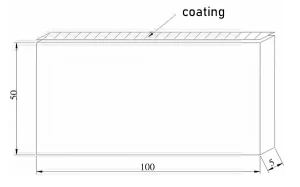
Once the sprayed sample reaches the specified thickness, the coating is peeled off the test plate surface using a blade, and the degree of coating deformation is measured.
When post-treatment of the coating is required, the coating is treated along with the test plate, and then peeled off to measure the degree of coating deformation.
> Deformation Measurement and Stress Evaluation Method
This method offers a key advantage.
It does not require measuring the specific residual stress value of the coating.
It also does not require considering the coating type or the effect of coating deformation on internal stress during the thermal spraying process, such as when using strain gauges.
Instead, the influence of residual stress on the coating stress can be directly determined based on the degree of coating deformation.
The measurement method, as shown in Figure 3, involves fixing two Φ6 mm cylinders on a 100 mm × 100 mm substrate, with a center-to-center distance of 60 mm between the two cylinders.
A straight line tangent to the two cylinders in the same direction is defined as the initial test line, with scale lines marked on both sides of the center of the initial test line, as shown in Figure 4.
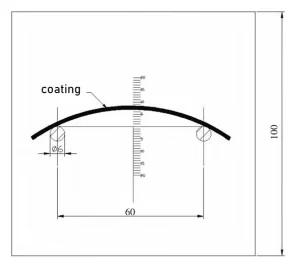
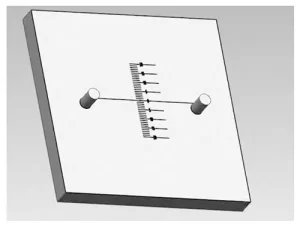
Since the strength of the peeled coating is low, this measurement method is not suitable for use with a dial gauge; instead, the arc height is determined visually and recorded.
The test uses a 1:1 printout from AUTOCAD software, and the arc height is measured against the printout.
2. Research on Coating Stress Analysis and Control Methods
To minimize or even eliminate the impact of thermal stress on coating quality, it is essential to master appropriate process methods.
Based on the characteristics of coating stress and existing process methods, the following approaches can be adopted to address residual stress in coatings:
(1) Stress-balancing technology refers to a specific process approach.
This technology uses targeted methods to alter the stress state of the coating surface.
It induces compressive stress on the surface while maintaining an overall balance between tensile and compressive stresses within the coating.
As shown in Figure 5, by applying appropriate process methods, the surface stress state of the coating is shifted from a tensile state to its opposite—a compressive state.
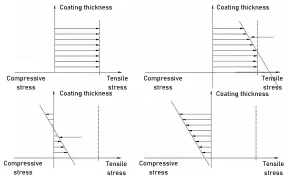
As the applied force increases, the coating as a whole can exhibit three distinct states.
(2) Stress reduction. The magnitude of residual thermal stress in a coating is directly related to its thickness; the thicker the coating, the greater the residual thermal stress.
Stress reduction involves lowering the residual thermal stress by reducing the coating thickness.
In addition to reducing coating thickness during the design process, performing rapid machining immediately after spraying is an effective means of controlling coating stress.
Machining Results
Engineers explored and studied the entire machining process of a single-point front sealing device.
Through this work, they established a technical system for the precision machining of large titanium alloy castings.
First, they optimized the machining process plan, tool selection, and clamping and positioning methods.
This effectively resolved the issue of positional deviation in precision holes.
Second, they utilized high-performance machining equipment to perform centralized multi-process machining.
This fundamentally resolved critical issues such as cumulative positioning errors caused by repeated clamping.
This technical approach simplifies the handling of complex challenges and demonstrates excellent engineering feasibility.
Comprehensive inspection and verification of the finished part revealed that all the aforementioned machining quality issues had been effectively resolved.
All critical dimensional characteristics remained consistently within acceptable limits, while the overall machining quality and reliability of the part were significantly improved.
Conclusion
In summary, this paper examines a large titanium alloy casting—a single-pivot front sealing device—and presents a systematic study on process optimization.
It addresses two core bottlenecks in the manufacturing process: precision machining and coating quality.
In the machining phase, engineers restructured the machining sequence and optimized tool selection as well as clamping and positioning schemes.
This precisely resolved deviations in the positioning of precision holes.
In the coating and subsequent machining phases, engineers optimized the design of the allowance reserved prior to coating and improved the preparation process for the protective band coating.
This effectively enhanced the interfacial bond strength between the coating and the substrate.
As a result, they completely resolved the persistent issue of cracking in the protective band coating during turning finishing.
The technical solutions developed for precision machining and coating quality control of large titanium alloy castings provide valuable engineering insights.
These findings support the manufacturing of similar complex titanium alloy components and offer significant practical application value with strong potential for broader adoption.