
Laser cladding technology enhances the hardness, wear resistance, and corrosion resistance of various metals, such as steel, iron, copper, and aluminum.
It does this by forming a new alloy layer on the surface of the metal through the deposition of specific alloy materials.
This process meets specific process requirements.
Additionally, the technology allows for cladding different powder materials.
This enables the integration of diverse properties, thereby expanding the application scope of metallurgical materials.
It is precisely these precise and efficient characteristics that give cladding technology significant application advantages.
They also highlight its development potential in the aerospace and marine industries.
Applications and Benefits in Critical Components
In these fields, engineers can apply the technology to process the surfaces of critical components, such as gas turbine blades, nozzles, and turbine discs.
It produces high-quality coatings.
These coatings are wear-resistant, high-temperature-resistant, and corrosion-resistant.
They extend the service life of components.
Post-Cladding Processing and Turning
After completing surface cladding, operators perform mechanical processing on the workpiece.
This processing ensures the cladding surface meets installation and fitting requirements.
This is typically done through grinding to achieve the required dimensional accuracy and surface roughness.
This process enables the workpiece to better leverage its high hardness, wear resistance, and corrosion resistance advantages.
Operators produce high-hardness, high-wear-resistant alloy components by laser cladding nickel-based alloy powder onto the end faces of aluminum alloy substrates.
Turning is then used to machine the shape and structure of the cladding layer and substrate material.
This results in a low-cost, high-efficiency, and high-quality turning processing method.
Product Introduction
Material and Surface Hardening of the End Cap
The product end cap component is made of 7A09/T6 aluminum alloy as the base material.
Operators surface-harden the component’s end face using laser surface cladding technology to form a wear-resistant layer.
Operators use nickel-based alloy powder as the cladding material.
After grinding, operators control the wear-resistant layer thickness at 0.9 mm and ensure a hardness of ≥400 HV.
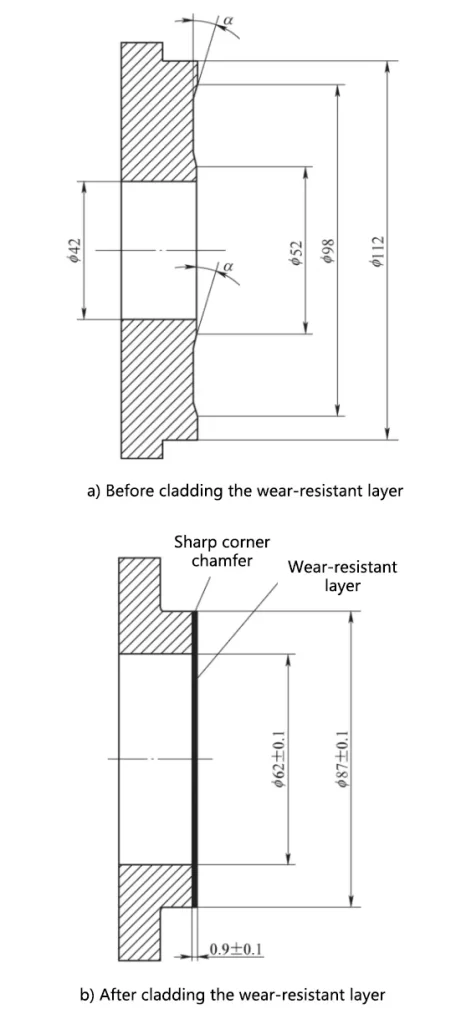
The structural components of the part before and after cladding are shown in Figure 1.
Post-Cladding Mechanical Processing
After coating the part’s surface with wear-resistant material using laser cladding, operators often perform further mechanical processing.
This is due to the high hardness of the wear-resistant material.
Operators use methods such as grinding, polishing, and cutting to enhance the part’s appearance, surface quality, and precision.
These processes help the part meet the requirements of different applications.
Machining Allowances and Structural Considerations
To ensure coating quality, the end cover part requires a single-sided machining allowance of 10 mm at the outer circumference of the workpiece’s inner hole.
Operators must apply this allowance before performing the coating.
Operators also machine a trapezoidal groove with an α° slope on the right-side step face.
This design facilitates the formation of a structurally dense wear-resistant layer during coating.
There is still a diameter allowance of 20–25 mm for the inner and outer diameters after cladding.
Because the base material is a soft aluminum alloy that is difficult to grind and has low grinding efficiency, grinding should not be used to process the inner and outer shapes.
Selection of Cutting Tools and Turning Machining Strategy
After analyzing the properties of the wear-resistant layer material, turning machining can be used to achieve efficient processing, as follows.
1) The cladding material for this part is a nickel-based alloy, with a Vickers hardness of ≥400 HV.
The conversion relationship between Rockwell hardness and Vickers hardness is 1 HRC ≈ 1/10 HV.
The Rockwell hardness of the wear-resistant layer should be ≥40.5 HRC.
This hardness falls within the medium-hardness range for current cutting tool materials.
These include cubic boron nitride (CBN), polycrystalline diamond (PCD), and ceramics.
Therefore, operators can select high-hardness, high-wear-resistant cutting tool materials for machining, such as CBN or ceramic tools.
2) The cladding material for this part is a nickel-based alloy, which is a difficult-to-machine material.
However, by selecting appropriate geometric angles, tool materials, cutting parameters, and proper machining methods, it possesses a certain degree of machinability.
3) Coated tools have higher hardness, better wear resistance, and longer service life compared to conventional carbide tools.
To meet the demands of mass production, the team proposes using CNC lathes equipped with CBN tools for turning operations.
Processing Plan A
Formulation
After determining the processing method, the team formulated Processing Plan A and conducted trial processing using CBN CNC tools on the Baoji CK50 CNC lathe.
Based on the characteristics of the wear-resistant layer material and the machining features of coated tool materials, the tools were selected.
Initially, more wear-resistant and harder CBN (cubic boron nitride) tools were chosen.
The team specifically selected the CCMT060202-2N-QLD-63A model with a 0.2 mm tool tip radius and the CCMT060404 model with a 0.4 mm tool tip radius.
The CCMT060404 model features an 80° diamond-shaped inner and outer circular insert.
The team separated roughing and finishing operations and used the same tool model for both processes.
A radial machining allowance of 1mm was left for both roughing and finishing.
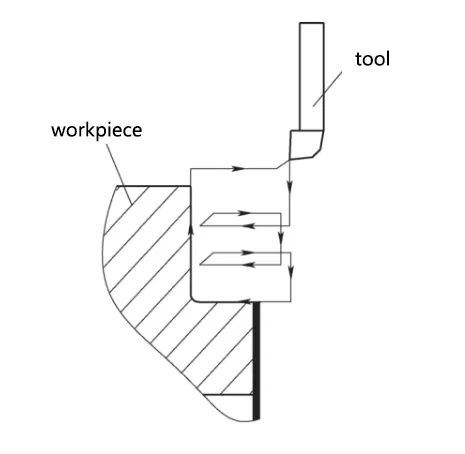
The team machined the part allowance layer using an axial, layer-by-layer cutting method.
Figure 2 shows the machining trajectory of the cladding layer tool.
Cutting Tool Selection and Machining Parameters
The cutting tool material is CBN.
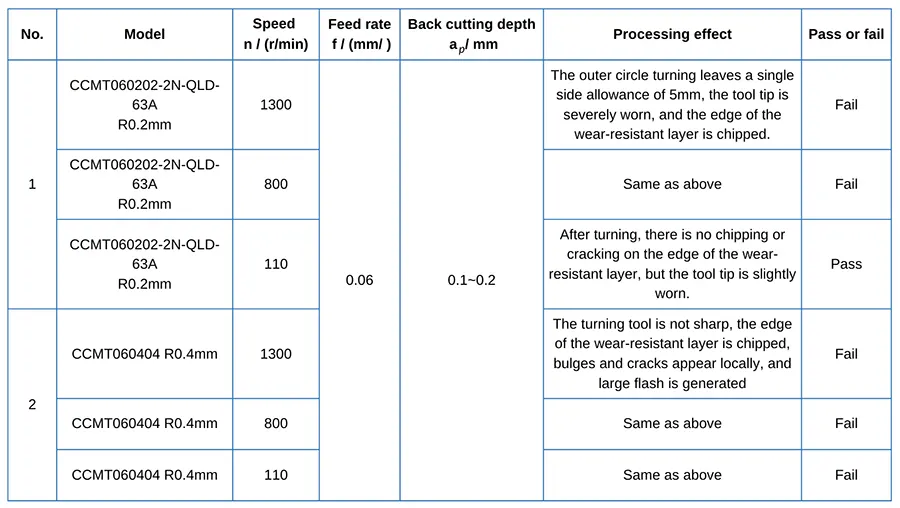
The team set the turning machine cutting parameters as follows: spindle speed n = 1300 r/min, 800 r/min, or 110 r/min; depth of cut ap = 0.1–0.2 mm; and feed rate f = 0.06 mm/r.
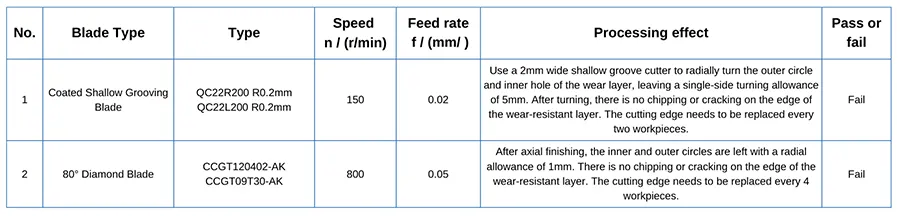
The processing parameters and results comparison of the two cutting tools are shown in Table 1.
Analysis of Machining Defects and Tool Performance
The team identified the following issues after comparing the processing results.
Tool Wear and Surface Defects
When using CBN tools for machining, wear occurs to varying degrees at different speeds, particularly noticeable at high and medium speeds.
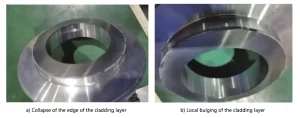
As the tool wears, cutting forces increase, leading to chipping at the edges of the wear-resistant layer, localized bulging, and cracks.
Defects in the wear-resistant layer are shown in Figure 3.
At low speeds, the tools experience much less wear, which greatly improves the processing quality.
Although a tool tip radius of 0.2 mm can prevent edge chipping, each cutting edge can only process one part, resulting in low processing efficiency and high tool costs.
When using a tool tip radius of 0.4 mm, chipping and bulging still occur during low-speed cutting.
Material Property Differences
When using axial cutting, there are significant differences in material properties.
The cladding layer has high hardness, while the base material is relatively soft aluminum alloy.
CBN tools are suitable for machining high-hardness materials but are not conducive to machining soft materials.
As a result, surface roughness on the base material is likely to occur during machining.
Tool Model Performance
Table 1 shows that both CBN insert models, CCMT060202-2N-QLD-63A and CCMT060404, were tested using identical cutting parameters.
They exhibited unsatisfactory machining results at high and medium speeds.
This occurs regardless of whether the cutting edge radius is 0.2 mm or 0.4 mm.
At low speeds (n = 110 r/min), the CCMT060202-2N-QLD-63A tool, with a 0.2 mm tool tip radius, performs better.
It outperforms the CCMT060404 tool, which has a 0.4 mm radius, in terms of machining results.
It exhibits minimal tool tip wear, the highest machining quality, and no chipping or cracks along the edge of the wear-resistant layer.
Limitations of Plan A
The CBN tool model CCMT060202-2N-QLD-63A, with a cutting edge radius of 0.2 mm, can be used for machining at lower speeds.
This allows for high-quality machining of the wear-resistant layer.
However, each insert can machine only two workpieces, which limits the total number of parts that can be processed.
Additionally, the tooling cost is very high, with each insert costing as much as 300 yuan per piece.
Through experiments and analysis of Plan A, we concluded that CBN tools experience significant wear.
This occurs during high-speed machining of wear-resistant layers formed by cladding on nickel-based alloys.
This wear can cause substantial defects in the wear-resistant layer of parts and result in failure to meet technical requirements.
Under low-speed machining conditions, selecting tools with small tool tip radii can ensure machining quality.
However, some wear still occurs, and the number of parts we can process remains very limited.
This also fails to highlight the advantages of CBN tools in high-speed machining of ultra-hard materials.
The high cost of the inserts, at 300 yuan per piece, results in high machining costs and poor economic viability, making Option A unfeasible.
Processing Scheme B
Formulation
To achieve high-quality, efficient, and low-cost processing, we reanalyzed the cladding layer, focusing on the hardness of the wear-resistant layer.
Because its Rockwell hardness was only 40.5 HRC, we needed to balance the characteristics of the wear-resistant layer.
The aluminum alloy substrate material also required consideration.
Therefore, a new processing scheme, Plan B, was formulated.
This plan considered factors such as blade selection, process method improvements, and cutting parameter determination.
A larger-angle coated insert was selected.
This helps balance the softness of the aluminum alloy substrate with the high hardness of the wear-resistant layer.
This ensured satisfactory machining results for both materials during processing.
Tool Selection and Machining Methods
Based on this, we selected a shallow-groove insert with an 18° front angle, capable of radial machining of inner and outer circles.
We also chose an aluminum-processing diamond-shaped insert with a 30° front angle.
These were models CCGT120402-AK and CCGT09T302-AK, respectively.
The machining methods were also improved, combining radial and axial cutting methods.
This allows different machining methods and paths to be selected for different materials, fully leveraging the cutting advantages of different tools.
Cutting Parameters and Multi-Tool Machining Strategy
When machining wear-resistant layers, radial cutting is selected, using low cutting speeds, small back cutting depths, and slow feed rates.
In contrast, for aluminum alloy base materials, axial cutting is chosen, employing high spindle speeds, large back cutting depths, and fast feed rates.
This reduces cutting time and improves production efficiency.
Different tools and cutting parameters are selected for rough and finish machining.
During rough machining, different tools and cutting parameters are selected for the two different materials.
During finish machining, a single insert is used with the same depth of cut and feed rate, performing multiple micro-machining operations.
A multi-tool, multi-path method is employed.
It utilizes an external cylindrical shallow groove tool, Q C22R200 R0.2mm with a front angle of 18°, and an internal bore shallow groove tool, Q C22L200 R0.2mm.
These tools are used to perform radial cutting on the wear-resistant layers at the external cylindrical and internal bore locations, respectively.
A single pass of the cutting process covers the entire wear-resistant layer, leaving a radial finishing allowance of 1mm.
For the base material aluminum alloy sections, diamond-shaped inserts with a front angle of 30° and an 80° angle are used.
These are models CCGT120402-AK and CCGT09T302-AK, respectively, and they perform axial machining on the inner and outer circle base materials.
A radial finishing allowance of 1 mm is also left.
Axial micro-machining is then performed on both the inner and outer circle base materials.
The wear-resistant layer is also machined.
This completes all machining operations on the part.
Machining Results and Parameter Optimization
Based on practical experience with Processing Plan A, using low spindle speed and small back cutting depth can achieve better processing quality.
To extend the life of the coated cutting blades, the cutting parameters for radial machining of the wear-resistant layer are set as follows.
The spindle speed is n = 150 r/min, the feed rate is f = 0.02 mm/r, and the back cutting depth is ap = 1.2 mm.
The axial cutting parameters for finishing the base material and wear-resistant layer are as follows.
The spindle speed is n = 800 rpm, the feed rate is f = 0.05 mm/r, and the depth of cut is ap = 0.1–0.2 mm.
During machining, to better extend tool life and reduce tool wear, a coolant primarily for cooling is used to ensure adequate cooling.
After finalizing the machining plan, four parts were subjected to machining tests again, achieving the required dimensions.
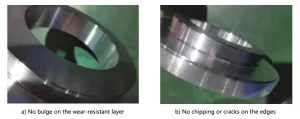
The wear-resistant layer showed no chipping or cracks, ensuring reliable machining quality that meets the technical requirements of the parts.
The test data for machining plan B of the wear-resistant layer is shown in Table 2, and the machining quality of the parts is illustrated in Figure 4.
Comparison of Processing Results for Schemes A and B
Comparison of Processing Quality
In comparison of processing quality in scheme A, defects such as edge chipping, localized bulging of the wear-resistant layer, or surface cracks were observed.
These occurred during medium-speed cutting and cladding of the wear-resistant layer.
Only under low-speed cutting conditions did the product quality meet technical requirements, with a first-time inspection pass rate of just 16.7%;
In Plan B, no defects appeared during deposition of the wear-resistant layer.
There was no edge chipping.
No localized bulging or surface cracks were observed.
The product quality met the technical requirements, with a first-time inspection pass rate of 100%.
Production Efficiency Comparison
A comparison of production efficiency between the two processing schemes shows the following.
In Scheme A, one tool is used for axial rough and finish machining of the wear-resistant layer and base material.
The turning processing time is approximately 2 hours per part.
Scheme B employs a combination of multi-tool segmented machining and axial/radial machining feed methods.
It selects different cutting parameters based on the material type, resulting in a turning time of 45 minutes per piece.
Scheme B achieves a 2.6-fold increase in processing efficiency compared to Scheme A.
Tooling Cost Analysis – Plan A
For tooling cost comparison using Plan A, a tool insert with a tool tip radius of 0.2 mm is selected.
During low-speed machining at 110 rpm, 2 qualified parts each consume 1 piece of inner and outer circle tooling.
Calculated at 300 yuan per tool insert, the tooling cost per qualified part is 300 yuan.
Tooling Cost Analysis – Plan B
If Plan B is used to process 24 products, one CCGT120402-AK and one CCGT09T302-AK tool blade are consumed for inner and outer base material processing.
Four QC22R200 R0.2mm and four QC22L200 R0.2mm tool blades are used for rough machining of the wear-resistant materials.
The finishing process consumes 3 pieces each of CCGT120402-AK and CCGT09T302-AK inserts.
The CCGT120402-AK and CCGT09T302-AK inserts cost 28 yuan per piece.
The QC22R200 R0.2mm and QC22L200 R0.2mm blades cost 55 yuan per piece.
The tooling cost for processing one qualified part under Plan B is approximately 23.08 yuan.
This cost is roughly 1/13 of the tooling cost under Plan A.
Conclusion
Selection of the Most Economical and Optimized Method
By comparing the two turning processing schemes for the company’s tailgate parts, A and B, the most economical method was identified.
The analysis also determined the most technologically optimized method.
Implementation of Scheme B in Mass Production
Scheme B was adopted in actual mass production.
It effectively overcame the processing challenges of applying a nickel-based alloy wear-resistant layer onto an aluminum alloy substrate via laser cladding.
Improvement in Product Quality and Cost Reduction
This improvement addressed initial product quality issues, such as edge chipping of the wear-resistant layer, surface bulging, and cracks.
Initially, the product qualification rate was only 16.7%.
After the improvements, the wear-resistant layer became defect-free, achieving a 100% first-pass inspection qualification rate.
This not only met the company’s mass production requirements, but it also reduced tooling costs to 1/13 of those in Plan A.
As a result, production costs were lowered, achieving the objectives of optimization and improvement.
Tooling Selection and Process Planning Insights
By comparing the turning of laser-clad wear-resistant layers on aluminum alloy surfaces, it was concluded that large-front-angle coated blades are best.
These surfaces are difficult-to-machine materials, requiring careful selection of tooling.
These blades should be combined with appropriate material selection, cutting parameters, and multiple cutting paths.
This approach also provides valuable insights for the processing and process planning of similar parts.
