
In the mechanism of tool wear, “wear” itself is not the sole cause of tool failure; “high temperatures” are the true enemy of tools.
Under the influence of high temperatures, minor tool wear can become “self-amplifying.”
That is, when a tool’s cutting edge becomes slightly dulled, increased friction during cutting may generate more heat, raising the tool’s temperature and softening its material.
This accelerates further dulling of the cutting edge.
The more severely the tool dulls, the greater the cutting friction and the higher the tool temperature—creating a vicious cycle.
Ultimately, the tool fails along a “self-accelerating curve” driven by cutting heat.
Principles and Environmental Advantages of Cryogenic Machining
Cryogenic (ultra-low temperature) machining using liquid nitrogen involves cooling the workpiece, tool, or cutting zone to extremely low temperatures during machining.
Nitrogen is the most abundant component in the atmosphere, and liquid nitrogen, a byproduct of oxygen production, is widely available.
When used as a cutting fluid, liquid nitrogen directly vaporizes back into the atmosphere upon application, leaving no pollutants.
From an environmental perspective, it represents a promising alternative cutting fluid.
This processing method significantly extends tool life.
Comparison Between Conventional Coolant and Liquid Nitrogen Cooling
The cutting fluid we refer to as “coolant” does not entirely succeed in providing cooling functionality.
While flood cooling can dissipate some heat generated during machining, its cooling effect is mediated at a distance and fails to reach the actual heat source (namely, the cutting zone beneath the chip where the tool shears the workpiece material).
Methods like internal spindle cooling channels attempt to bring coolant closer to the cutting zone, while newer technologies delivering coolant through the tool insert itself achieve significantly closer proximity.
In conventional wet cutting, coolant primarily lubricates and/or splashes onto the tool and workpiece to dissipate heat.
In cryogenic cutting, however, the coolant (liquid nitrogen) functions as a refrigerant.
While conventional coolant may be dispensed at +20°C, liquid nitrogen operates at -196°C—a temperature differential of nearly 220°C.
This extreme temperature gap transforms the tool into a heat absorber. Due to its cryogenic state, the tool acts like a sponge, drawing heat away from the cutting edge into the tool body.
This ensures cutting performance and tool life are not prematurely compromised by high cutting temperatures.
Tool Life Performance and Additional Benefits of Low-Temperature Cutting
To quantify the performance advantages of liquid nitrogen cooling, MAG conducted comparative cutting tests evaluating the impact of different cooling methods on titanium alloy machinability.
As shown below, under conventional coolant flow conditions, a tool machining at a surface speed of 300 sfm (90 m/min)—considered high-speed cutting for titanium alloys—became dull after just one minute.
In contrast, under cryogenic cutting conditions, the tool reliably sustained machining for 10 minutes before dulling.
When the cutting speed increased to 400 sfm (120 m/min), the same tool exhibited a fivefold difference in tool life.
Georgiou explains that the area between the two performance curves in the figure reflects the productivity difference between the two cooling methods.
When machining within this range, users can achieve higher cutting speeds while maintaining tool life, or obtain longer tool life at the same cutting speed, by replacing the poured cooling method with low-temperature cutting.
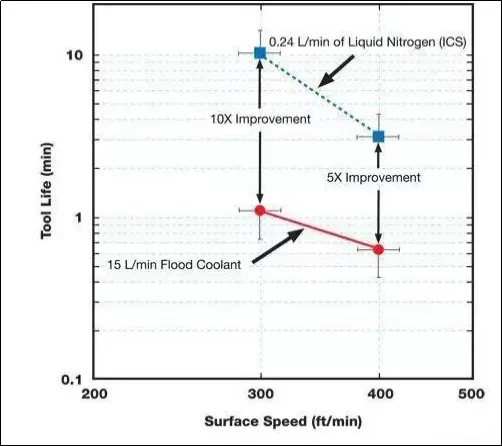
Georgiou noted that these two performance curves eventually converge.
At lower cutting speeds, the performance gap between low-temperature cutting and conventional cast-cooled cutting is most pronounced.
As cutting speed increases, this gap gradually diminishes. When cutting speed reaches an extremely high value, the difference disappears entirely.
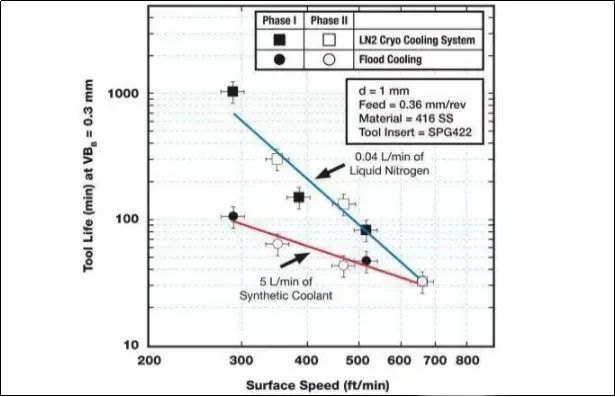
In the stainless steel cutting test shown below, when cutting speeds were below 300sfm (90m/min), tool life for low-temperature cutting was 10 times that of conventional casting-cooled cutting;
At 400 sfm (120 m/min), this advantage gradually decreased to a 4-fold difference; and at approximately 650 sfm (200 m/min), the difference ceased to exist.
Safety and Environmental Benefits of Low-Temperature Machining
Beyond its cutting performance advantages, low-temperature machining offers additional benefits.
For MAG’s R&D team, primarily focused on enhancing cutting performance, an unexpected bonus was the potential safety improvements for employees.
After low-temperature machining, machine surfaces remain free of slippery coolant residue.
This significantly reduces the risk of slip-and-fall injuries during operations where operators occasionally need to walk on large machine tool tables.
Additional benefits relate to environmental protection.
Low-temperature cutting requires no synthetic coolants, instead utilizing nitrogen extracted from the air, which ultimately returns to the atmosphere.
Consequently, no waste liquid requires disposal. Nitrogen does not pollute the air nor contaminate processed medical devices or other sensitive workpieces.