How to efficiently machine shaped parts on CNC mill-turn machines?


There are many established basic rules in mechanical drafting. ASME Y14.5-2009 specifies sixteen such rules.
All personnel must follow these rules when drafting, reading, or reviewing drawings.
Below, we will introduce these 16 basic rules one by one.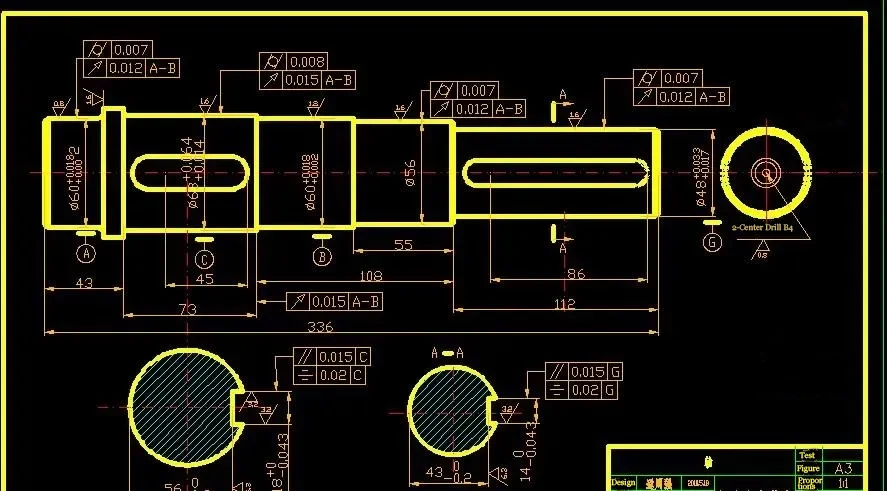
Except for reference dimensions, maximum and minimum dimensions, or raw material dimensions, all dimensions must have tolerances.
Reference dimensions generally do not have tolerances.
Why is that? Because designers usually repeat reference dimensions or include them as closed dimensions on a drawing, using them solely for reference.
Reference dimensions are not used to guide production or inspection; therefore, when you see a reference dimension on a drawing, you can simply ignore it.
On drawings, we often see dimensions labeled as “Max” or “Min.”
Do these dimensions have tolerances? The answer is yes.
For a “Max” dimension, the lower limit of the tolerance is 0, while for a “Min” dimension, the upper limit of the tolerance is infinity.
Therefore, when specifying ‘Max’ or “Min” dimensions, we must fully consider whether they will affect functionality at the limits of deviation.
For example, if we dimension a fillet as R1Max, we must consider whether the part’s function would be affected if the fillet were 0 (i.e., no fillet).
If it were affected, we must specify an appropriate lower tolerance limit.
There are also many theoretical dimensions (i.e., basic dimensions) of drawings. Do they have tolerances?
A theoretical dimension refers to a numerical value used to define the theoretically correct size, shape, contour, orientation, or position of a feature or target datum.
When we use a theoretical dimension to define a feature’s size, shape, contour, orientation, or position, the corresponding geometric tolerance of that feature defines its tolerance.
When we use a theoretical dimension to define the size, shape, or position of a reference datum, we should determine its tolerance in accordance with the ASME Y14.43 guidelines for gauge and fixture tolerances.
Therefore, theoretical dimensions also have tolerances.
We can indicate dimension tolerances on drawings in the following ways:
We must define dimensions and tolerances comprehensively so that we can fully understand all characteristics of each feature.
The characteristics of a feature include size, shape, orientation, and location.
On the drawing, we must define the dimensions and tolerances for all characteristics of each feature.
We may express dimension and tolerance values in the engineering drawing or define them in the CAD product definition database.
We must not determine dimensions by measuring the drawing or making assumptions.
Only include all dimensions necessary to describe the product.
“All necessary dimensions” means that the drawing should contain exactly the right number of dimensions—neither too many nor too few—to fully convey all characteristics of the form.
The drawing should not include any superfluous dimensions, such as closed dimensions.
As mentioned earlier, we can disregard reference dimensions; therefore, we should minimize their use in the drawing.
Reference dimensions serve no purpose other than to add clutter to the drawing.
We shall select dimensions based on the product’s function and fit requirements, and we shall ensure that they are not open to multiple interpretations.
The emphasis here is that we must base the dimensions and tolerances defined during the design process on meeting the product’s functional and fit requirements.
While we should consider manufacturability and inspectability requirements during the design process, we must not prioritize them at the expense of functional requirements.
We should not specify manufacturing processes on product drawings.
Product drawings should only specify the dimensions and performance requirements necessary to fulfill the product’s function.
The actual methods of manufacturing are the responsibility of the manufacturing engineering department.
As designers, we should give manufacturing personnel sufficient freedom.
We should focus on specifying the maximum permissible tolerance range that meets the product’s functional requirements.
This approach ensures sufficient manufacturing capability.
We should not prescribe specific manufacturing methods.
For example, for a hole, we need only specify the diameter without indicating whether it is drilled, punched, milled, turned, ground, or produced by some other process.
Regardless of the manufacturing method used, the finished product must meet the diameter tolerance requirements.
We should specify the manufacturing process on the drawing or in reference documents only when it is an integral part of the product’s characteristics.
For example, if functional requirements dictate that a hole must meet diameter tolerances without helical machining marks, the drawing may specify that the hole be ground.
While specifying the final finished dimensions, it is permissible to include non-mandatory process parameter dimensions, such as those indicating machining allowances;
We must clearly mark these dimensions as non-mandatory.
Generally, we need not indicate process parameters on drawings; however, if we include them, we must clearly mark them as non-mandatory.
As mentioned earlier, this is the responsibility of the manufacturing engineering department, and they should be given full discretion in this matter.
We should position dimensions appropriately to ensure optimal legibility.
We should place dimensions on the actual outline and mark them on visible contour lines.
This is a basic requirement of drafting, so we will not elaborate further here.
We shall mark wire, tubing, sheet metal, bars, or other raw materials produced according to dimensional specifications or product grades with linear dimensions.
These dimensions may include diameter or thickness.
We shall indicate the dimensional specification or product grade in parentheses following the dimension.
This provision applies to raw materials; each type of raw material has its own corresponding standard specifying the marking method.
Center lines and contour lines shown as right angles on drawings but without dimensioning are assumed to be 90 degrees.
On drawings, we assume many relationships to be 90 degrees;
We shall control the tolerances for these assumed 90-degree angles in accordance with the tolerances for undimensioned angles.
We may define or locate the centerline or surface of an array feature by a basic dimension.
If we show it as a right angle on the drawing without annotation, we assume it has a 90-degree basic dimension.
An array feature refers to a group (two or more) of dimensional features that share the same shape and dimensions and are distributed according to a pattern.
When we define or locate the centers of these features by a basic dimension, the corresponding geometric tolerance controls the tolerance for the default 90-degree basic angle.
When we show the centerline, center plane, or center surface as coincident on a drawing, we consider them basic dimensions with a default value of 0.
Geometric tolerances define their mutual relationships.
This is also a matter of common sense.
We should control the tolerances for these basic dimensions with a default value of 0 by the corresponding geometric tolerances;
If we do not specify geometric tolerances, the unspecified geometric tolerances listed in the General Technical Requirements section control them.
Unless otherwise specified, all dimensions refer to measurements taken at a room temperature of 20°C (68°F).
If measurements are taken at other temperatures, dimensional compensation must be taken into account.
Note that the room temperature referred to here is 20°C, not 23°C or 25°C.
Therefore, we require that we control the temperature in the measurement room at 20 °C.
This ensures that the test results accurately reflect whether the product meets the requirements.
If it is truly impossible to measure at a room temperature of 20 °C, we should consider compensating for the temperature effect on the measurement results.
This is especially important for parts that are highly sensitive to temperature.
Unless otherwise specified, all dimensions and tolerances apply to the free state.
All dimensions indicated on the drawings refer to the dimensions of the part in its free state, with all stresses released.
For non-rigid parts, we may indicate dimensions after we constrain the part as specified; we must indicate the method of constraint on the drawing.
If, in such cases, we indicate dimensions for specific parts in their free state, we must include the free-state symbol (circle F).
Unless otherwise specified, all geometric dimensional tolerances apply to the entire length, width, or depth of the feature.
I am sure everyone is already familiar with this point.
However, I would like to remind you that, due to the application of the principle of inclusion, the length, width, or depth of a feature has a significant impact on its shape control.
A 3 mm-long round bar and a 30 mm-long round bar have the same maximum allowable straightness under the same diameter tolerance.
However, their actual bending conditions are worlds apart.
All dimensions and tolerances apply only to the product level specified in the drawing.
The dimensional tolerances of a specific feature shown at one drawing level (e.g., a part drawing) do not necessarily apply to the dimensional tolerances of that feature at other drawing levels (e.g., an assembly drawing).
In other words, the dimensions on a part drawing do not necessarily apply to the assembly drawing.
For example, we may weld a bracket with an opening of 10 ± 0.5 to a platform.
Due to factors such as welding distortion and the clamping force of the welding fixture, it becomes difficult for this opening on the welded part to meet the 10 ± 0.5 dimensional requirement.
In other words, this dimension no longer applies to the welded part drawing.
Therefore, we cannot use the dimensions from a part drawing to specify the dimensions of the same feature on an assembly drawing.
If control of this feature is required on the assembly drawing, the dimension must be specified on the assembly drawing itself.
Unless otherwise specified, any coordinate system shown on drawings must be right-handed.
Each coordinate axis must be labeled and its positive direction indicated.
This requirement is rarely applied, so no further explanation is provided; simply follow it.
In conclusion, the article highlights the critical role of standardized drafting practices in ensuring accurate and effective communication of design intent.
By adhering to the sixteen rules outlined in ASME Y14.5-2009, engineers and designers can create clear, functional, and reliable drawings.
These drawings support both manufacturing and inspection.
Ultimately, these principles help maintain quality, reduce ambiguity, and promote efficiency throughout the product development lifecycle.