Comprehensive Comparison of Aluminum Alloys 6061 and 7075


Usually contains more than 12% chromium or nickel content of more than 8% of the alloy steel called stainless steel.
More Cr and Ni improve stainless steel’s properties, boosting corrosion resistance and strength above 450 ℃.
Therefore, many industries widely use it in aerospace, chemical, petroleum, construction, food industries, and daily life.
Types include martensitic, ferritic, austenitic, duplex, and precipitation-hardening stainless steel.
This austenitic stainless steel is strong, corrosion-resistant, cold-deformable, and non-magnetic.
SUS321, with machinability only 30–50% of 45 steel, is a typical difficult-to-machine material.
The cutting of stainless steel has the following characteristics:
Austenitic stainless steel (e.g., SUS321) has low hardness (HB ≤187) and high plasticity, leading to higher cutting forces.
In the same processing conditions SUS321 unit cutting force than 45 steel more than 25%.
Austenitic and austenitic-ferritic stainless steels exhibit the most severe work hardening.
They are very plastic, and the lattice will produce strong distortion during plastic deformation;
Due to poor stability, austenite partially transforms into martensite under cutting force.
Cutting heat decomposes impurities, forming hardened layers and worsening work hardening.
At high temperatures, stainless steel bonds with the tool, causing chip buildup and wear, shortening tool life.
SUS321’s poor thermal conductivity causes higher cutting force and 200–300 °C more heat than 45 steel.
Poor SUS321 machinability requires careful cutting process selection for good results.
Choosing proper tool materials is key for efficient stainless steel cutting.
Tool materials for stainless steel must have good heat and wear resistance and low stainless steel affinity.
Common cutting tools today are cemented carbide and high-speed steel.
Machining SUS321 causes high forces and chipping; They recommend YG carbide..
YG carbide is tough, wear-resistant, heat-resistant, and thermally conductive, ideal for stainless steel.
Experts usually recommend YG3X, YG8, YW1, YW2A, YW3 and other grades.
These materials feature high hardness (74–82 HRC), wear and heat resistance (850–1000 °C), strength, toughness, and thermal conductivity.
New carbide grades (e.g., 813, 758, 712) improve stainless steel machining results.
813 carbide tools (≥91 HRA, 1570 MPa) offer toughness and wear resistance, ideal for turning SUS321.
Use high-speed steel tools when workpiece shape or size hinders carbide use or causes tool damage.
Ordinary high-speed steel (W18Cr4V) has low durability and fails to meet processing needs.
New high-speed steels include cobalt-, aluminum-, and nitrogen-alloyed types like W2Mo9Cr4VCo8 and W12Mo3Cr4V3N.
Proper tool geometry selection improves tool life and workpiece quality.
With strong tools, use a larger front angle to reduce cutting force, temperature, and hardened layer depth.
High-speed steel milling cutter can choose γ0 = 10 ° – 20 °, carbide milling cutter can choose γ0 = 5 ° – 10 °;
Reamer can generally choose γ0 = 8 ° – 12 °; tap can generally choose γ0 = 15 ° – 20 ° (machine) or γ0 = 20 ° (hand).
Increasing the back angle reduces friction but weakens the cutting edge and heat dissipation.
A larger back angle is preferable when cutting thickness is small.
Roughing, generally can choose the back angle α0 = 6-10 °;
For finishing, use α0 = 10–20° and negative chamfering to improve tool wear resistance.
High-speed steel end milling cutter selection α0 = 10 ° – 20 °, end milling cutter selection α0 = 15 ° – 20 °;
Hardness alloy end milling cutter selection α0 = 5 ° -10 °, end milling cutter selection α0 = 12 ° -16 °;
α0 = 8°-12° for reamers and taps.
Generally, the main deflection angle κr = 45°-75° and the secondary deflection angle κr′ = 8°-15°.
To strengthen the cutter tip, sharpen it with a radius of rc = 0.2–0.8 mm.
Camber angle λs affects tip strength and chip flow; a negative λs increases strength.
In stainless steel machining, Ra ≤ 0.4 on tool surfaces reduces adhesion, cutting resistance, and extends tool life.
Reasonable choice of cutting amount is an important way to improve the cutting effect.
Cutting parameters greatly affect stainless steel work hardening, force, heat, and especially tool life.
Cutting speed (Vc) most affects temperature and tool life, followed by feed (f), with back draft (ap) least.
In order to ensure reasonable tool durability, can be appropriate to reduce the cutting speed.
Cutting stainless steel cutting speed can usually be selected by cutting ordinary carbon steel 40% -60%.
For large-margin roughing, increase back draft to reduce tool passes and tip contact, lowering wear.
But the amount of back draft should not be too large, otherwise it will cause vibration. Roughing, can be selected ap = 2-5mm.
Finishing, you can choose a smaller amount of backlash, but also to avoid the hardened layer, generally choose ap = 0∙2-0∙5mm.
Increasing feed raises cutting residue and chip tumor height; typically, f = 0.1–0.8 mm.
To improve surface quality and avoid the work hardening zone, use a smaller feed, but not below 0.1 mm.
It should also be noted that the feed f is inversely proportional to the back draft ap.
Stainless steel requires cutting fluid with superior cooling, lubrication, and anti-bonding due to poor machinability.
Sulfur- or chlorine-rich emulsions with good cooling are used for stainless steel roughing, grinding, drilling, and reaming.
Has good lubricating properties are mainly used for stainless steel finishing.
Adding carbon tetrachloride to oils boosts permeability, aiding SUS321 finishing.
Can be used as stainless steel reaming, tapping and other processing of cutting fluid.
High heat in stainless steel cutting requires efficient cooling, like spray or high-pressure methods.
Drills with large helix angles, inverted tapers, and chip slots improve stainless steel machining.
Shallow outer chip flutes create varied chip flow, causing natural tearing and breaking for effective removal.
In addition, the operator must correctly sharpen the drill geometry and ensure the two cutting edges are symmetrical.
A too-large drill back angle causes a “knife” effect, leading to vibration and polygonal holes.
In order to minimize the axial drilling force, the operator should sharpen the horizontal edge.
Ensure proper drill installation, keep edges sharp, and regrind promptly after dulling.
The geometric parameters of the drill bit and the amount of drilling should be reasonably selected.
Minimize drilling depth to shorten drill length and thicken the core, enhancing tool rigidity.
To prevent burning the cutting edge, operators should drill with high-speed steel bits at low cutting speeds.
Operators should keep the feed low to prevent drill bit wear and hole drilling deviation.
In the cut in and cut out should be properly adjusted to reduce the amount of feed.
Use sufficient sulfurized oil coolant at 5–8 L/min without interruption during cutting.
Table 1 shows the typical drilling parameters for SUS321 austenitic stainless steel.

Stainless steel chips resist curling and breaking, making chipformer parameters crucial.
Commonly used chipbreaker groove shape for the full arc type, it is appropriate to choose a larger front angle:
Roughing selected 10 ° – 15 °;
15°-20° for semi-finishing;
20° -30° for finishing.
At the same time, the use of smaller negative chamfer or transition edge.
In addition, the selection of feed should not be too small:
Turning (boring) SUS321 austenitic stainless steel can be selected 0∙12-0∙18mm/r;
Operators can select a feed of 0.07–0.18 mm/r for turning (boring) martensitic or ferritic stainless steel.
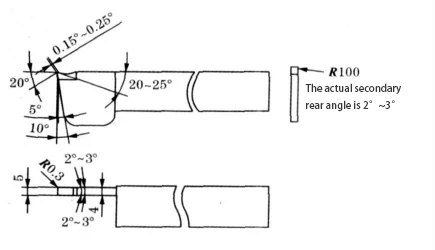
Figure 1 shows a YW1, YW2, or YG8N cut-off tool for SUS321 under 50 mm.
The main features of the tool are:
Grinding a 0.2mm negative chamfer reduces chipping and improves edge quality.
The lower part of the cutter body is fish-belly shaped to increase the rigidity of the tool.
The operator grinds the tool’s vice back angle to 2°–3° with a grinding wheel for increased rigidity.
Recommended cutting dosage:
Cut at Vc = 60–80 m/min, f = 0.12–0.15 mm/r, using cutting fluid for full cooling and lubrication.
The common cutting dosage of stainless steel is shown in Table 2.
Figure 1 Stainless steel cutting tool
Table 2 Common cutting dosage of stainless steel (workpiece material: SUS321; tool material: YG8)

Note:
Mill stainless steel at 40%–60% carbon steel speed with fz ≥ 0.10 mm to reduce temperature.
In addition, when the hardness of stainless steel is high, the milling dosage should be lower;
When the side eating amount is larger, the milling speed should also be selected lower.
Milling stainless steel recommended cutting dosage is shown in Table 3.

Problems often encountered when reaming stainless steel include:
Hole surfaces may develop grooves, roughness varies, and flared reamers wear easily.
Reamer wear is the main problem when reaming SUS321 and similar steels in nitric acid.
Stainless steel reamers are made of Al- or Co-alloyed HSS, with 8°–12° rake and clearance angles, and ≤3 m/min speed.
Such as carbide reamer reaming SUS321 austenitic stainless steel, reaming speed <12m/min;
Reaming unquenched 2Cr13 martensitic stainless steel reaming speed> 12m/min.
Operators should monitor reaming to ensure chips are normal, like foil or short screw rolls.
Powdery or fragmented chips indicate uneven reaming;
Needle-like or fragmented chips indicate that the reamer has dulled and requires sharpening;
If the chips are spring-like, it means that the reaming allowance is too large.
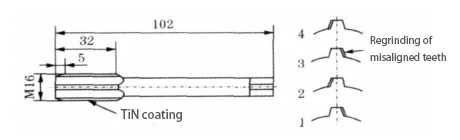
Tapping stainless steel causes high force, fast wear, low productivity, and defects.
Ensure bottom hole accuracy by using matched taps, coatings (e.g., TiN), and corrected tooth grinding (see Figure 2).
Before tapping, grind tap teeth from the first tooth’s left to right edge along the thread.
The second tooth is left on the right edge and the left edge is sharpened, and so on.
This design reduces friction, prevents jamming, and enlarges the bottom hole for a greater rake angle.
Cutting fluid should use quenched black oil lubrication effect is better.
White corundum grinding wheels are generally used for grinding stainless steel.
To prevent passivation during bore grinding, use single crystal or microcrystalline corundum wheels.
Austenitic stainless steel adheres more than martensitic, so use a silicon carbide grinding wheel.
Grinding hardness ≥ 275HB martensitic stainless steel can be used CBN grinding wheel;
Ultra-fine grinding can choose fine-grained graphite grinding wheel.
Grinding wheel size and hardness affect adhesion; higher hardness increases adhesion.
Practice shows grinding wheel hardness J–M suits medium grain sizes 36, 46, and 60.
Ceramic bond is generally used, but resin bond suits grinding wheels for stainless steel cutting and grooving.
Choose grinding wheels with relatively loose structure (usually 5–8) to prevent clogging.
Grinding speed:
Use a higher grinding wheel speed than for carbon steel to improve performance.
But on the other hand, too high a grinding speed will make the wheel clogging.
Practice has proved that the grinding speed to not more than 25m / s is appropriate.
Grinding depth:
Should be slightly smaller than when grinding ordinary carbon steel.
For rough grinding, choose 0.02–0.05mm; for fine grinding, choose 0.005–0.01mm.
Feed:
External grinding depth: rough (1/6–1/4)B, fine (1/10–1/8)B; use larger values for less rigid workpieces.
For internal grinding, use (1/4–1/3) B rough and (1/8–1/6) B fine; choose larger values for shallow holes.
The use of emulsions containing extreme pressure additives can achieve higher surface quality.
Microemulsion cutting fluid is a new water-based extreme pressure fluid ideal for grinding stainless steel.
SUS321 stainless steel has a wide range of uses, and there are many examples of cutting processing.
Here are only a few processing examples for reference.
Workpiece 900×720mm, processed with YG8 carbide tool; γ0=15–18°, α0=6–8°, κr=75°, λs=-5–8°.
The cutting dosage is Vc=28m/min, ap=0∙3-0∙5mm, f=0∙16mm/r.
One tool needs 28 sharpenings for fine-turning, leaving obvious tool marks.
YG8N tools at 42.4 m/min need 5 grindings for 3.2 μm Ra and minimal marks.
The thread specification is M20×2∙5. It is processed by YG8 carbide tool:
Vc = 10m / min f = 2 ∙ 5mm / r ap = 0 ∙ 3-0 ∙ 4mm tool sharpening a processing can not be a piece.
813 carbide tools at 36 m/min double efficiency and tool life, cutting over two parts per grind.
Cutting amount: Vc = 90-100m/min ap = 3-4mm fz = 0-15mm/z.
The indexable end milling cutter is used.
The cutter material is YW4, and the geometric parameters of the cutter are: γ0 = 5° α0 = 8° κr = 75° λs = 5°.
Tool endurance is 41min.
The tool material is YG6 and YG10H carbide respectively.
Geometric parameters of the tool: γ0 = 20° α0 = 8° κr = 75° λs = -3°.
Cutting dosage: Vc = 20m/min ap = 3mm f = 0∙32mm/r.
Under the same conditions, YG6 tool lasts 15 min with poor chip breakage and sticking.
the durability of YG10H tool is 60min with good cutting quality.
Processing practice has proved that the basic principle of cutting stainless steel materials is:
Use tough, sharp tools with optimized geometry, proper cutting parameters, and coolant.
Optimize cutting parameters to enhance quality, cut costs, and increase efficiency.