How to efficiently machine shaped parts on CNC mill-turn machines?


Integrated blade discs are core components of aircraft engine compressors and turbines.
By replacing the traditional tongue-and-groove joint between blades and the disc with an integrated design, they can reduce weight by approximately 30% and improve aerodynamic efficiency by more than 15%, making them a hallmark technology of advanced aircraft engines.
However, the manufacturing of integral disk blades faces severe challenges:
The blades are thin (2–3 mm), subject to significant bending and torsional stresses, feature complex geometries, and have narrow flow channels (minimum spacing of 12.5 mm); the materials used are predominantly difficult-to-machine titanium alloys and superalloys.
In five-axis CNC machining, the blade is in a cantilevered state with extremely low rigidity.
Under the combined effects of cutting forces and cutting heat, it is highly prone to elastic deformation (up to 0.1–0.3 mm) and chattering, which severely affects machining accuracy and surface quality .
This paper proposes a comprehensive deformation control method integrating “prediction, suppression, and compensation,” providing a systematic solution for the high-precision manufacturing of integral blade discs.
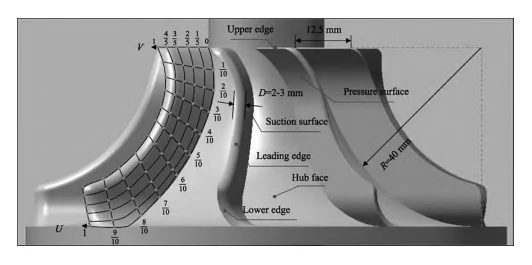
This study focuses on the integral blade disk of a specific type of aircraft engine compressor (Fig. 1).
The material is Ti-6Al-4V titanium alloy, with a hub diameter of Ø100 mm, blade lengths ranging from 45 to 75 mm, and a total of 47 blades.
The blade thickness is 2–3 mm, the blade profile is a complex, spatially twisted free-form surface, and the minimum spacing between adjacent blades is 12.5 mm.
Sources of machining deformation include elastic deformation caused by cutting forces, machine tool geometric errors, tracking errors, as well as cutting heat and residual stresses, among other factors.
During 5-axis milling, the overhang length of the ball-nose end mill reaches 60 mm or more; the cutting forces acting on the thin-walled blade cause bending deformation.
As material is progressively removed during machining, the blade’s rigidity continuously decreases, and the deformation exhibits a gradient distribution along the blade’s height.
A five-axis machine tool contains 41 geometric errors, of which the three linear axes (X, Y, and Z) each have 6 position-related errors, and the two rotary axes (A and C) each have 6 position-related errors, totaling 30 errors;
Additionally, there are 3 errors related to perpendicularity between linear axes and 8 position-independent errors associated with the rotary axes, totaling 11 errors.
These errors accumulate through the motion chain, causing the actual position of the tool relative to the workpiece to deviate from the commanded position.
Tracking errors arise from servo system response lag and accumulate to form trajectory errors during the frequent direction changes required when machining complex surfaces.
Furthermore, titanium alloys have low thermal conductivity, and the concentration of cutting heat leads to localized thermal expansion; residual stresses in the blank redistribute after material removal, causing stress-relief deformation.
These sources of error are mutually coupled; the magnitude of the cutting force is related to the cutting depth, and the actual cutting depth is affected by deformation; geometric errors and tracking errors alter the actual tool path, affecting both cutting depth and cutting force.
ABAQUS software establishes a three-dimensional finite element model of the integral blade disc. C3D10+ node quadratic tetrahedral elements with a mesh size of 0.25 mm define the mesh.
The model constrains all degrees of freedom in the contact area between the blade and the hub, and the analysis uses a static explicit module.
The simulation discretizes the continuous machining process into 66 cutting positions.
The model sets the coordinate origin at the root of the upper edge of the blade.
The V-axis runs parallel to the upper edge, and the U-axis runs parallel to the blade root.
Six points distribute at equal intervals along the V-direction, and 11 points distribute at equal intervals along the U-direction, forming 66 uniformly distributed points as load application locations.
The empirical formula shown in Equation (1) calculates the milling force:
[FtFrFa] = η[KtKrKa]D(Z,θ,φ,ζ)L(Z,θ,φ,ζ) (1)
In the equation, Ft, Fr, and Fa represent the tangential force, radial force, and axial force, respectively, in N;
η is the axial depth-of-cut correction factor;
Kt, Kr, and Ka are the tangential, radial, and axial milling force coefficients, respectively, which are related to the cutting speed vc, radial depth of cut ae, axial depth of cut ap, and feed per tooth fz;
D is the instantaneous chip cross-sectional area; L is the instantaneous contact length between the cutting edge and the workpiece; Z is the number of teeth;
θ is the rake angle; φ is the cutting action angle; ζ is the tool lag angle.
An L4(416) orthogonal experiment calibrates the milling force coefficients, and multiple linear regression establishes a prediction model.
The model applies the three components of the milling force to the nodes in the tool–workpiece contact area as uniformly distributed loads.
The simulation calculation adopts a helical milling method, prioritizing the machining of the pressure surface, and then machining the suction surface after correcting the stiffness of the finite element model by removing material from the already machined area.
The kinematic model incorporates the geometric errors and tracking errors of the five-axis machine tool.
The model calculates the tool axis vector trajectory and the tool center position trajectory.
These trajectories account for multiple sources of errors.
Finite element simulation enables quantitative prediction of machining deformation, providing a basis for subsequent control.
Prediction alone cannot solve the deformation problem. The machining process must apply measures to actively suppress deformation.
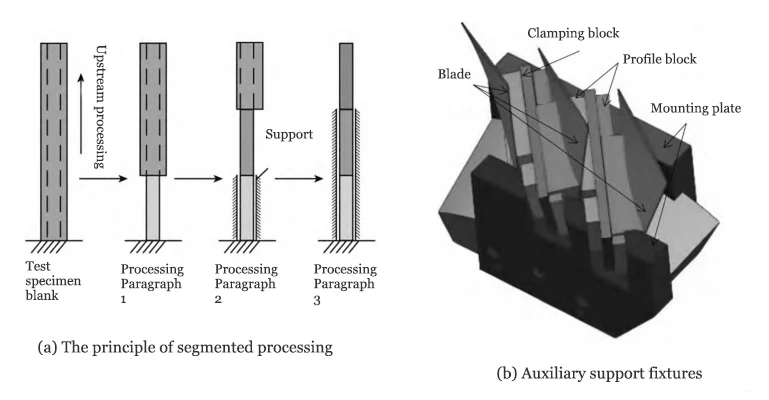
The process employs a reverse segmented processing strategy together with light-curing auxiliary support technology.
The strategy and support technology actively control deformation during the manufacturing process.
Reverse segmented machining divides the blade into three segments along the height direction, machining sequentially from the blade root (Segment 1) to the blade tip (Segment 3).
The process completes each segment first. The system immediately adds auxiliary supports on both sides of that segment.
The machining process then proceeds to the next segment.
A three-section auxiliary support fixture was designed (Fig. 2), comprising a contouring block, a clamping block, and a mounting plate.
The process CNC-machines the contour block according to the blade profile.
The manufacturer uses 45 steel quenched to HRC 45–50 to produce the contour block.
The design maintains a uniform clearance of 0.2–0.3 mm between the contour block and the blade.
The clamping block features a wedge-shaped structure with a 15° wedge angle and a downward clamping stroke of 10 mm.
The front and rear mounting plates are secured with M6 bolts.
The gaps were filled with the light-curing resin Somos WaterShed XC11122, which has a viscosity of 500 cP at room temperature.
After application, it was cured by irradiating it with a UV light source (wavelength 365 nm, power 36 W) for 2–3 minutes to cure; after curing, the elastic modulus is 1.5 GPa and the compressive strength is 60 MPa.
After machining, immerse the workpiece in an acetone solution for 20–30 minutes; remove the resin after it has softened.
Cutting parameters are set according to the material; see Table 1 for machining parameters for different materials.
| Material | Spindle Speed (r/min) | Feed per Tooth (mm) | Radial Depth of Cut (mm) | Axial Depth of Cut (mm) |
|---|---|---|---|---|
| Ti-6Al-4V | 1,700–2,400 | 0.15 | 0.1–0.2 | 0.2–0.3 |
| Stainless Steel 1Cr13 | 2,000–3,000 | 0.2–0.3 | 0.1–0.3 | 0.2–0.5 |
| Aluminum Alloy LD7 | 4,000–8,000 | 0.3–0.6 | 0.3–0.6 | 0.3–2.0 |
Table 1. Machining Parameters for Integral Blisks of Different Materials
Rough machining of the grooves combines five-axis point drilling with 3+2 positioning cavity milling.
The process starts by drilling pilot holes in the grooves with a diameter of 8 mm and a depth of 2 mm below the hub surface; the A and C axes align the drill axis with the groove direction.
The process then performs 3+2 positioning cavity milling with the A-axis set to 90° and the C-axis set to 0°, using a three-axis approach to rough-mill the groove and leaving a 0.5 mm finishing allowance. Ø10 and Ø8 cylindrical end mills perform this operation.
The process performs blade finishing using five-axis interpolation, selecting an Ø8 cylindrical ball-end mill as the tool and using a step distance of 0.15 mm.
The simulation optimizes the tool axis vector; it initially sets the tool axis perpendicular to the blade surface.
When interference occurs, the system adjusts the tool axis to tilt 5°–10° toward the open direction of the flow channel until no interference occurs and the tool axis vector transitions smoothly.
The process clears the root fillet of the blade using a conical ball-nose cutter with a cutter head radius of R2 and a cone angle of 4°.
Reverse segmented machining and light-curing support technology can significantly reduce machining deformation.
However, due to factors such as fluctuations in cutting forces, material inhomogeneity, and machine tool errors, residual deformation errors still exist after machining.
To ensure that the final machining accuracy meets the design tolerance requirements, compensation and correction of these residual errors are necessary.
To address residual deformation errors that cannot be eliminated during the machining process, a multi-iterative compensation method is employed to calculate the compensation amount, combined with a reverse geometric model reconstruction strategy to achieve precise compensation.
Let the initial nominal radial cutting depth be ae0, and the machining position be (ui, vj).
The initial deformation at this position is obtained through finite element simulation.
During the first compensation, the compensation amount is given by Equation (2), and the increase in nominal cutting depth is given by Equation (3):

In the equation, γ represents the compensation term; δ represents the deformation; and the superscript denotes the iteration number.
The milling force is recalculated based on Equation (1), and the result is substituted into the finite element model to obtain the new deformation.
The residual error after the first iteration is given by Equation (4):

In the equation, Δ represents the residual error in mm.
For the nth compensation, the compensation amount is given by Equation (5), and the nominal cutting depth is given by Equation (6):

Calculate the displacement δnui,vjand the residual error as shown in Equation (7):

The iteration terminates when Δmui,vj<σ, where σ is the allowable tolerance, set to m1 μm; m is the number of iterations at termination.
A reverse reconstruction geometric model compensation strategy is adopted.
Based on the compensation values obtained from the finite element simulation at 66 points, cubic spline interpolation is performed on the discrete points across each blade cross-section to fit a new cross-sectional contour curve that incorporates the compensation information.
After fitting the six V-shaped cross-sections, a new 3D surface model of the blade is generated through sweeping operations.
The new model is imported into Cimatron software to re-plan the toolpaths; the software automatically performs toolpath generation, interference checking, collision detection, and toolpath optimization, and generates NC code through post-processing.
A specific type of Ti-6Al-4V titanium alloy monolithic blade disk was selected as the test specimen.
The blank was a near-net-shape forged part that was turned to form the outer shape of the blade disk, with a machining allowance of 3 mm left on one side.
The machining equipment used was an IMF30v vertical five-axis CNC machining center with a maximum spindle speed of 12,000 rpm and a FANUC 31i-B5 CNC system.
Tool selection: Ø10 and Ø8 solid carbide end mills were used for rough machining, Ø8 solid carbide end mills for finishing, and a tapered ball-nose cutter (cutter head radius R2, taper angle 4°) for undercut finishing.
The cutting fluid used is an emulsion containing sulfur-chlorine extreme-pressure additives at a concentration of 8%.
Two comparative experiments verify the effectiveness of the comprehensive deformation control scheme proposed in this paper.
The experimental group adopted the comprehensive control scheme proposed in this paper, employing reverse segmented machining (from the blade root to the blade tip), adding light-cured auxiliary supports, and using multiple iterative compensation (3 iterations) along with reverse model reconstruction to generate toolpaths.
A HEXAGON TIGO SF coordinate measuring machine performs the measurements, with a measurement range of 500 mm × 500 mm × 500 mm and a resolution of 0.1 μm.
The measurement process covers the 66 finite element simulation points on the pressure and suction surfaces of the blade. Each point undergoes three measurements, and the process uses the average value of the three results.
After machining, both sets of blades undergo deformation error measurement.
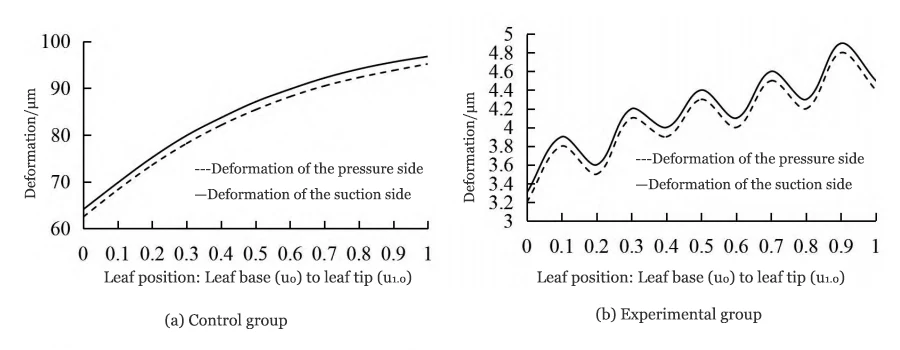
The control group uses traditional machining methods. The pressure side reaches a maximum deformation error of 95.2 μm.
The suction side reaches a maximum deformation error of 96.8 μm. The deformation exceeds the design tolerance requirement of ±10 μm.
Twelve out of 47 blades become unusable due to excessive deformation.
All measurement points show errors within 5 μm, and all 47 blades pass inspection.
Compared with the control group, the reduction rate of deformation error reached over 95%.
Figure 3 shows the distribution pattern of deformation errors measured at the position of maximum blade overhang (blade tip cross-section v1) along the U-direction of the blade.
The control group exhibits a distinct gradient distribution. The deformation in the root region is approximately 63 μm.
Material removal reduces the blade’s stiffness gradually. The deformation continuously increases along the height direction.
The deformation reaches a peak of approximately 95 μm at the tip region.
Cumulative deformation is a typical problem of the traditional forward segmented machining method. Each machining segment causes additional deformation in the previously machined area.
The deformation accumulates layer by layer during the machining process. The accumulated deformation eventually exceeds the tolerance range.
The deformation distribution in the experimental group was completely different: the deformation error remained within a stable range of 3.2–4.9 μm across the entire blade height, with no trend of cumulative increase.
The reverse segmented machining strategy eliminates the cumulative effect. The photopolymerization-assisted support provides rigid constraints.
Multiple iterative compensations correct residual errors. The synergistic effect of these three technologies enables effective control of deformation.
The authors validated the integrated control scheme described in this paper in the mass production of 32 integral blade discs for a specific engine model.
All blade discs maintained surface accuracy within ±6 μm, achieving a 100% pass rate.
The process reduced subsequent grinding allowances by 75% and shortened the machining cycle per unit from 18 days to 13 days, demonstrating the effectiveness and stability of this scheme in engineering practice.
This paper addresses the challenge of deformation control in the five-axis CNC machining of integral aeroengine blade discs.
By combining physical suppression with software compensation, it proposes a comprehensive “prediction-suppression-compensation” three-pronged control strategy.
By predicting deformation distribution through finite element simulation, the scheme suppresses deformation during the machining process via reverse segmented machining and photopolymerized supports.
Multiple iterative compensations combined with reverse reconstruction models eliminate residual errors, forming a complete closed-loop deformation control system.
Experimental validation demonstrates that this approach reduces blade deformation error from 28 μm to below 5 μm, achieving a 95% reduction rate, with all blade surface accuracies meeting the design tolerance requirements.
Future systems can achieve adaptive closed-loop control of deformation by combining online measurement technology to improve machining accuracy and efficiency further.