How to efficiently machine shaped parts on CNC mill-turn machines?


Geometric tolerances (form and position tolerances, GD&T) are the core technical standard for controlling the geometric accuracy of mechanical parts.
They standardize how shape, contour, direction, position, and runout errors are marked and constrained on engineering drawings.
This article systematically sorts out the complete classification, corresponding graphical symbols, and usage rules of the five major geometric tolerance categories.
It also covers common tolerance modifiers, including MMC, LMC, the independence symbol, the continuous feature symbol, and the diameter symbol.
Furthermore, it elaborates on two core foundational tolerance principles: the Inclusion Principle (Rule #1) and the Principle of Independence.
It covers their core definitions, distinctive characteristics, practical engineering applications, inspection methods using go/no-go gauges, applicable boundaries, and exceptional scenarios.
By clarifying the correlation between dimensional tolerances and geometric errors, the text provides clear theoretical and operational guidance for mechanical drawing marking, part design and quality inspection.
| Application | Tolerance Category | Tolerance Name | Symbol | Datum Required |
|---|---|---|---|---|
| Single Feature | Form Tolerance | Straightness | — | No |
| Single Feature | Form Tolerance | Flatness | ▱ | No |
| Single Feature | Form Tolerance | Circularity (Roundness) | ○ | No |
| Single Feature | Form Tolerance | Cylindricity | ⌭ | No |
| Single Feature or Related Features | Profile Tolerance | Profile of a Line | ⌒ | Yes or No |
| Single Feature or Related Features | Profile Tolerance | Profile of a Surface | ⌓ | Yes or No |
| Related Features | Orientation Tolerance | Angularity | ∠ | Yes |
| Related Features | Orientation Tolerance | Parallelism | ∥ | Yes |
| Related Features | Orientation Tolerance | Perpendicularity | ⊥ | Yes |
| Related Features | Location Tolerance | Position | ⌖ | Yes or No |
| Related Features | Runout Tolerance | Circular Runout |  * * | Yes |
| Related Features | Runout Tolerance | Total Runout |  * * | Yes |
There are four symbols for shape tolerances: straightness, flatness, roundness, and cylindricity. Since shape tolerances are used solely to control shape errors, they do not require a reference when annotated on drawings.
There are two symbols for profile tolerances: line profile and surface profile.
Contour tolerances may or may not include a reference when annotated on drawings (to control shape, relative position, dimensions, etc.).
There are three symbols for directional tolerances: inclination, parallelism, and perpendicularity.
Annotations for directional tolerances on drawings must include a reference.
Position tolerances on drawings may be specified with or without a reference (to control relative position).
There are two symbols for runout tolerances: circular runout and total runout.
Runout tolerances on drawings must be specified with a reference.
Here are just a few examples to illustrate.
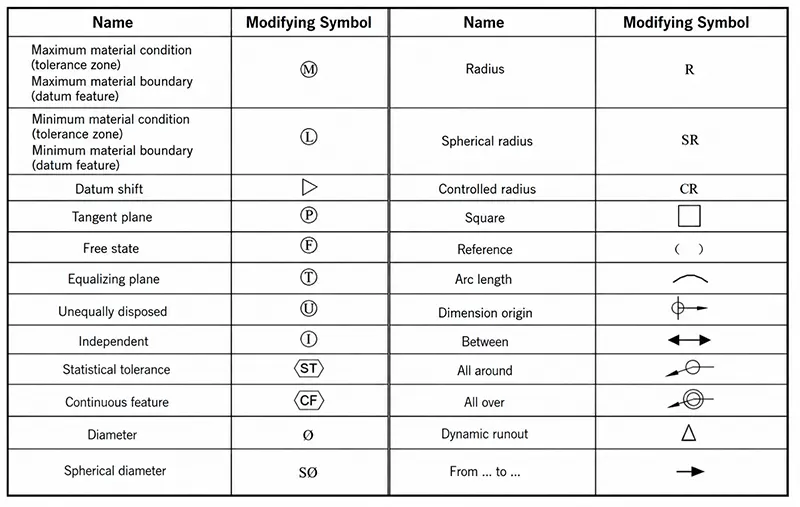
An example of a maximum material condition symbol is shown in Figure 1-29.
The maximum material condition symbol can be placed after the tolerance or after the datum;
When placed after the tolerance, it is called the Maximum Material Condition (MMC), and when placed after the datum, it is called the Maximum Material Boundary (MMB).

An example of a least measurement symbol annotation is shown in Figure 1-30.
The least measurement symbol can be placed either after the tolerance or after the datum.
When it is placed after the tolerance, it indicates the Least Measurement Condition (LMC).
When it is placed after the datum, it indicates the Least Measurement Boundary (LMB).

The independence symbol may only be placed after a dimensional tolerance to indicate that the tolerance is based on the principle of independence.
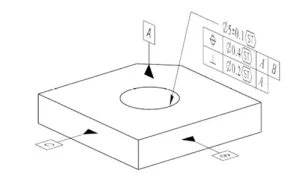
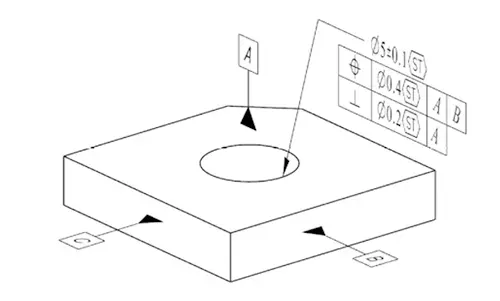
An example of a statistical tolerance symbol annotation is shown in Figure 1-31.
The statistical tolerance symbol “ST” may be placed after dimensional or geometric tolerances.
When the statistical tolerance symbol is used, the drawing must include the following annotation:
“Elements marked with the statistical tolerance symbol must be subject to statistical process control during manufacturing.”
A continuous feature refers to treating two or more broken features, or broken features with standard dimensions, as a single feature or a single feature with standard dimensions.
The continuous feature symbol CF may be applied in the following three situations.
(1) It is placed after the dimensional tolerance of a feature with standard dimensions.
(2) It is placed near a geometric tolerance applied to a broken surface feature.
(3) It is annotated near the reference feature symbol, where the reference feature symbol is applied to the discontinuous feature.
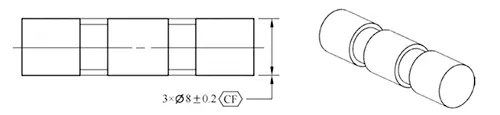
Example of Continuous Feature Symbol Annotation (1):
As shown in Figure 1-32, the continuous feature symbol is applied to the dimensional tolerances of three discontinuous standard-dimensioned shaft features.
This indicates that the three discontinuous standard-dimensioned shaft features are to be treated as a single standard-dimensioned feature.
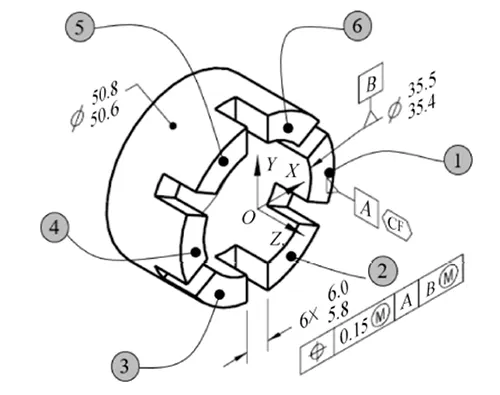
Example of Continuous Element Symbol Annotation (2):
As shown in Figure 1-34, the continuous element symbol is applied to datum element A.
This indicates that the six broken plane elements are treated as a single large plane element. The resulting large plane element then serves as datum element A.
This is equivalent to treating the six planes as a single, unbroken whole.
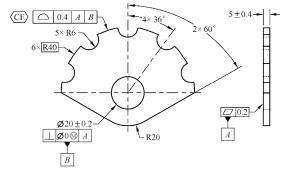
Example of Continuous Element Symbol Annotation (3):
As shown in Figure 1-33, the continuous element symbol is applied near the profile tolerance frame.
This indicates that the six disconnected surfaces are treated as a single surface. The combined surface must lie within the profile tolerance zone of 0.4.
This is equivalent to treating the six surfaces as a single, large surface for control purposes, as if they were not disconnected.
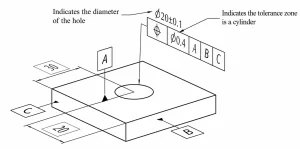
Examples of diameter symbol notation are shown in Figure 1-35.
The diameter symbol Ø may be placed before the dimensional tolerance to specify the diameter of holes and shafts.
When the diameter symbol Ø is placed before the geometric tolerance, it indicates that the tolerance zone is cylindrical.
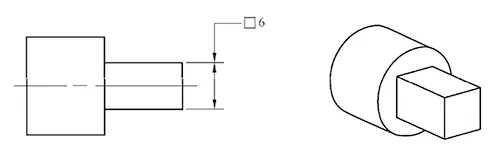
An example of a square symbol annotation is shown in Figure 3-14.
The square symbol □ is placed before the dimension to define a square dimension.
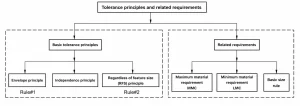
Tolerance principles and related requirements essentially explain the relationship between dimensional tolerances and geometric tolerances.
Examples of GD&T tolerance principles and related requirements are shown in Figure 1-37.
They primarily include basic tolerance principles and related requirements: the basic tolerance principles consist of the Inclusion Principle (Rule #1), the Independence Principle, and the Principle of Independence from Feature Dimensions (Rule #2);
The related requirements include the Maximum Entity Requirement, the Minimum Entity Requirement, and the Basic Dimensional Rules.
The Principle of Inclusion explains the relationship between dimensional tolerances and geometric tolerances.
It refers to the fact that the geometric error of a single standard dimensional feature is controlled by the specified dimensional tolerance, with the specific requirements as follows.
(1) The surface of a standard dimensional feature must not extend beyond the maximum material condition (MMC) boundary.
(2) When the actual local dimension of a standard dimensional feature is equal to the Maximum Material Condition (MMC) dimension at every point, no form error is permitted.
When the actual local dimension deviates from the MMC, a local form error is permitted, and its value is equal to the difference between the actual local dimension and the MMC dimension.
(3) When a standard dimensional feature is machined to the Minimum Material Condition (MMC), the maximum form error is permitted.
(4) When geometric tolerances are applied, and the regular dimensional element is required to have an ideal shape at the minimum material condition, the regular dimensional element need not be required to have an ideal shape at the maximum material condition.
(5) The principle of inclusion applies only to individual regular dimensional elements.
The principle of inclusion ensures the assembly of individual regular dimensional elements, such as bore-shaft fits.
When the principle of inclusion is applied to external dimensional elements, such as a shaft, its maximum material condition boundary is equal to its maximum limit dimension (i.e., the shaft’s maximum solid dimension).
For internal dimensional elements such as holes, the application of the principle of inclusion means that the maximum solid boundary corresponds to the minimum limit dimension, i.e., the hole’s maximum solid condition.
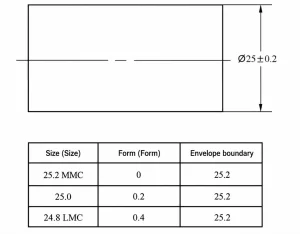
When the principle of inclusion is applied to external dimensional features, such as a shaft, the shaft must have an ideal form when its diameter is at the maximum material size (i.e., the maximum limit dimension).
This requirement applies to form characteristics such as straightness, roundness, and cylindricity.
When the actual diameter of the shaft is less than the maximum limit dimension (i.e., the maximum material size), corresponding form errors are permitted.
The allowable form error is equal to the difference between the actual shaft diameter and the maximum limit dimension (i.e., the maximum material size).
An example of the relationship between the dimensional and shape tolerances of a shaft is shown in Figure 1-38.
When the principle of inclusion is applied to internal dimensional features, such as a hole, the hole must have an ideal form when its diameter is at the maximum material size (i.e., the minimum limit dimension).
This requirement applies to form characteristics such as straightness, roundness, and cylindricity.
When the actual diameter of the hole is greater than the minimum limit dimension (i.e., the maximum material size), corresponding form errors are permitted.
The allowable form error is equal to the difference between the actual hole diameter and the minimum limit dimension (i.e., the maximum material size).
An example of the notation showing the relationship between the size of a hole and its geometric tolerances is shown in Figure 1-39.
(1) The actual contour of the element under measurement must not exceed the maximum solid inclusion boundary at any point along a given length;
That is, the actual fit dimensions of the element must not exceed the maximum solid dimensions.
(2) When the actual dimensions of a feature at every point are equal to the maximum solid dimensions, the feature must have an ideal shape; no shape errors are permitted.
(3) When the actual dimensions of a feature deviate from the maximum solid dimensions, local shape errors are permitted.
The amount of deviation may be compensated for by the shape error; that is, the shape error equals the amount of deviation.
(4) When the actual feature is in the minimum solid state, the permissible shape error reaches its maximum value.
(5) The actual dimensions of a feature at any point must not exceed the dimensional tolerance range.
(6) Dimensional tolerances not only limit the actual dimensions of a feature but also control its form errors.
(7) Under the principle of inclusion, surface form tolerances do not exceed dimensional tolerances.
The principle of inclusion is generally applied to bore-shaft fits to ensure the fit characteristics.
This is particularly true for fits with tight tolerances, such as precision fits with minimum clearance or maximum interference.
To ensure that a bore-shaft fit has a certain amount of clearance and interference, the actual mating surfaces of the bore and shaft must not exceed their respective maximum solid inclusion boundaries.
The principle of inclusion effectively ensures this functional requirement.
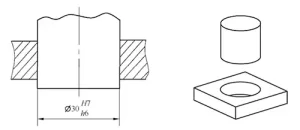
An example of the application of the principle of inclusion in bore-shaft fits is shown in Figure 1-40.
The maximum solid dimensions of both the bore and the shaft are 30.
Under the principle of inclusion, the actual surfaces of the bore and the shaft will not exceed their respective maximum solid inclusion boundary dimensions of 30, thereby ensuring the functional fit specified by the dimensions.
When the principle of inclusion is applied to standard dimensional features, its boundaries correspond to the ideal geometric shape of the standard dimensional feature.
Common boundaries of the principle of inclusion are as follows.
(1) A cylindrical surface, such as when the principle of inclusion is applied to a circular hole or a circular shaft.
(2) Two parallel planes, such as when the principle of inclusion is applied to a slot or a plate (dimensional features with two mutually parallel planes).
(3) A spherical surface, such as when the principle of inclusion is applied to a sphere.
The maximum material condition (MMC) boundary applies to the entire length, width, and depth of the dimensional element.
The principle of inclusion ensures the fit function by guaranteeing that local surfaces do not exceed the ideal boundary defined by the MMC.
The Principle of Inclusion controls only the form tolerance of individual standard dimensional elements;
It does not control the directional and positional tolerances of standard dimensional elements.
The perpendicularity, symmetry, and positionality of standard dimensional elements must be controlled using the corresponding directional and positional tolerances.
In the principle of inclusion, dimensional tolerances control only form tolerances.
An example of a drawing annotation (for holes) is shown in Figure 1-41.
The dimensional tolerances Ø10±0.2 and Ø8±0.2 control only the form tolerances of the two holes—that is, their cylindricity, roundness, or straightness.
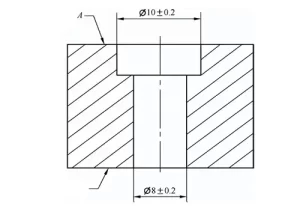
It is not possible to control the coaxiality relationship between the two holes, nor the perpendicularity tolerances of each hole relative to planes A and B.
Under the principle of inclusion, dimensional tolerances control only geometric tolerances.
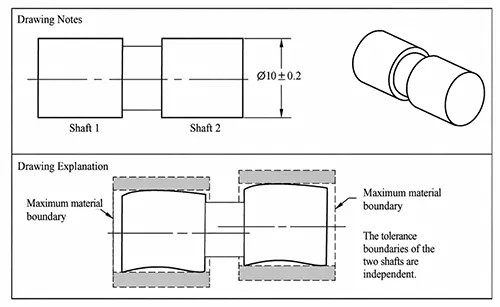
An example of a drawing annotation (shaft) is shown in Figure 1-42: two shafts with a diameter of 10 are ideally coaxial.
According to the principle of inclusion, both Shaft 1 and Shaft 2 have a maximum material boundary.
The size of this boundary is equal to the maximum material size. The actual outer surface of each shaft must not exceed its maximum material boundary.
When the actual diameter of the shaft is less than the maximum solid dimension, corresponding shape errors are permitted, and the maximum shape error will not exceed its own dimensional tolerance.
Therefore, the principle of inclusion controls the form errors of Shaft 1 and Shaft 2;
However, the maximum solid inclusion boundaries of Shaft 1 and Shaft 2 are independent, and the two inclusion boundaries do not need to maintain a positional (coaxial) or directional (parallel) relationship with each other.
As shown in Figure 1-42, the coaxiality relationship between Shaft 1 and Shaft 2 is not controlled.
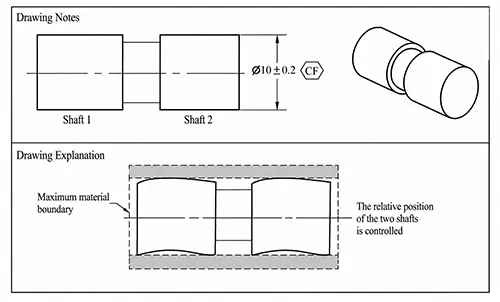
An example of dimensioning for a continuous feature (CF) and the principle of inclusion is shown in Figure 1-43.
The two shafts, each with a diameter of 10, are ideally coaxial; the drawing includes the continuous feature symbol (CF) after the dimensional tolerances.
According to the definition of the Continuous Element symbol, the two shafts should be treated as a single continuous shaft for overall control.
Under the principle of inclusion, both shafts must be enclosed by a single maximum material boundary with a size of 10.2.
The actual outer surfaces of the shafts must not extend beyond this boundary.
When the actual cross-sectional size of both shafts is 10.2 at every point (i.e., at the maximum material size), each shaft must have an ideal form.
In addition, their relative positions must also be ideal. Therefore, no coaxiality error is permitted.
When the size of the non-associated actual mating envelope of one shaft is less than the maximum material boundary size of 10.2, a coaxiality error (i.e., a positional error between the two shafts) is permitted.
The allowable coaxiality error is equal to the difference between the size of the non-associated actual mating envelope and the maximum material boundary size.
In summary, by adding the continuous element symbol (CF) to dimensional elements, the relative positions of several consecutive dimensional elements can be controlled under the principle of containment.
There are two important dimensions to verify under the principle of inclusion.
(1) Verify the non-associated actual inclusion mating surface of the part;
Its dimension must be less than or equal to, or greater than or equal to, the maximum solid inclusion boundary dimension to ensure assembly performance.
For external dimensional features, such as shafts, the non-associated actual mating envelope is the minimum circumscribed cylindrical surface.
Its size is less than or equal to the maximum material boundary size.
For internal dimensional features, such as holes, the non-associated actual mating envelope is the maximum inscribed cylindrical surface.
Its size is greater than or equal to the maximum material boundary size.
(2) Verify that the actual local two-point dimensions at any cross-section of the part do not exceed the dimensional tolerance range to ensure that the dimensions remain within tolerance.
When measuring two-point dimensions, the selected cross-section must be perpendicular to the axis of the non-associated actual inclusive mating surface.
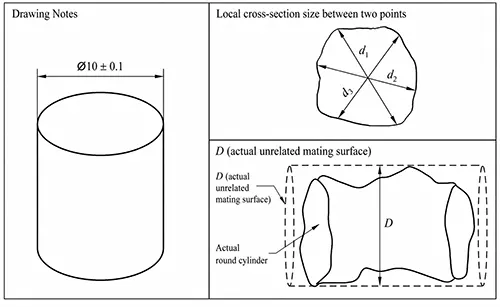
An example of dimensioning based on the principle of inclusion for a shaft is shown in Figure 1-44.
In the figure, the size D of the shaft’s non-associated actual mating envelope must be less than or equal to the maximum material boundary size of 10.1.
The two-point sizes d1 to d3 of the actual local cross-section must lie within the dimensional tolerance range of Ø10 ± 0.1.
The most common method for verifying the principle of inclusion in engineering is the go/no-go gauge method.
When using a go gauge, the dimension of the part’s actual non-associated inclusion fit surface must be less than or equal to the maximum solid inclusion boundary;
When using a no-go gauge, the part’s actual local dimensions must not exceed the dimensional tolerance range.
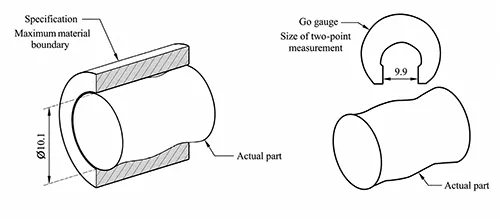
For the shaft shown in Figure 4-8, an example of the go/no-go gauge method for verifying the principle of inclusion is shown in Figure 1-45.
A go gauge is a sleeve with a diameter equal to the shaft’s maximum solid dimension of 10.1.
If the actual shaft passes through the go gauge sleeve without obstruction, it indicates that the shaft’s actual outer surface does not exceed the maximum solid boundary of 10.1.
When measuring the shaft’s actual local dimensions with a snap gauge (stop gauge), if the snap gauge stops at any cross-section of the shaft, it indicates that the shaft’s actual local cross-sectional dimensions do not exceed the dimensional tolerance range.
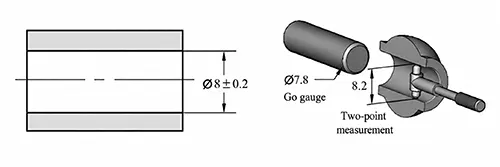
An example of inspection annotation based on the principle of hole tolerance is shown in Figure 1-46.
For the hole shown in the figure, the size of the non-associated actual mating envelope must be greater than or equal to the maximum material boundary size of 7.8.
The two-point sizes of the actual local cross-section must lie within the dimensional tolerance range specified in the drawing.
The go/no-go gauge method can be used to inspect the dimensions of the hole shown in Figure 1-46.
When using a go gauge to inspect a part’s non-associated actual clearance fit surface, the dimension must be greater than or equal to the maximum solid clearance boundary.
The go gauge has a cylindrical diameter of 7.8, and its length must be greater than or equal to the length of the hole.
As long as the Ø7.8 go gauge passes through the actual hole, it indicates that the actual surface of the hole does not exceed the maximum solid clearance boundary.
The go-no-go gauge is used to inspect the actual local dimensions of the part; the go-no-go gauge has a diameter of 8.2.
As long as the go-no-go gauge cannot pass through the actual hole, it indicates that the actual local dimensions of the hole are within specifications.
The go-no-go gauge should theoretically be measured using the two-point method.
In the following situations, the requirements of the principle of inclusion may be disregarded; that is, the shape of a dimensional feature does not need to remain in an ideal state when the feature is at its maximum size.
(1) Tolerances are designated with a free-state modifier.
(2) Dimensions of standard parts, such as bars, pipes, and plates, must first meet the geometric feature requirements specified in the relevant standards before machining.
(3) When an independent symbol is appended to a dimensional tolerance, indicating that the independent principle applies.
(4) When straightness controls the shape error of a rule dimension, such as the straightness of a centerline.
(5) When flatness controls the shape error of a rule dimension, such as the flatness of a center plane.
(6) When an average diameter is used for dimensioning.
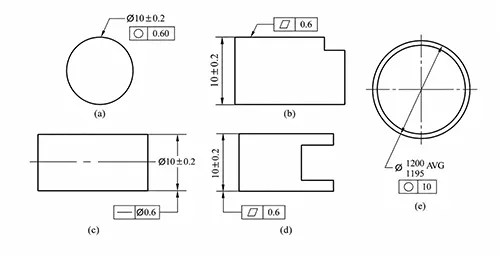
Examples of annotations where the principle of inclusion does not apply are shown in Figure 1-47.
In Figure 1-47(a), the roundness tolerance is followed by a modifier symbol indicating a free state, meaning it is not subject to the inclusion principle;
That is, the roundness tolerance value may exceed the dimensional tolerance value.
In Figure 1-47(b), the notation following the dimensional tolerance indicates that the independent principle applies; the form tolerance may exceed the dimensional tolerance and is not subject to the inclusion principle.
In Figure 1-47(c), the shape error of the centerline of the shaft controlled for straightness is specified such that even when the shaft is at its Maximum Material Condition (MMC), a shape error of 0.6 is permitted;
The ideal shape does not need to be maintained, and the requirements of the principle of inclusion need not be followed.
In Figure 1-47(d), the flatness control specifies the shape error of the plate’s center face.
The drawing notation indicates that even when the plate is at its Maximum Material Condition (MMC), a shape error of 0.6 is permitted;
The shape does not need to be maintained in an ideal state, and the requirements of the principle of inclusion need not be followed.
In Figure 1-47(e), adding “AVG” after the dimension indicates the average dimension, and the principle of inclusion need not be followed.
The principle of independence explains the relationship between dimensional tolerances and geometric tolerances.
When standard dimensional features, such as holes and shafts, are not used for mating, the default principle of inclusion imposes stricter design requirements and increases product costs.
In such cases, the principle of independence should be applied; this principle is expressed by adding a notation after the dimensional tolerance.
The principle of independence is explained as follows:
Each dimension, shape, orientation, and location specified on the drawing is independent and must meet the requirements separately.
Under the principle of independence, the dimensional tolerances specified on the drawing control only the local actual dimensions—that is, the dimension between any two points at a local cross-section—and do not control the shape errors of the feature itself.
For example, the diameter tolerance for a cylinder controls only the local actual dimensions at each cross-section of the cylinder;
It does not control shape errors (i.e., straightness, cylindricity, or circularity of the cross-section).
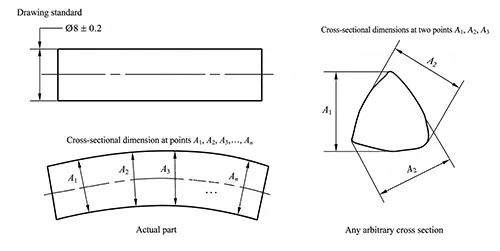
An example of dimension and shape relationship annotations for a shaft under the principle of independence is shown in Figure 1-48, “Example of Dimension and Shape Relationship Annotations for a Shaft Under the Principle of Independence.”
In the cylindrical shaft shown in Figure 1-48, the shape does not need to remain ideal when the dimensions are at their maximum;
Even if the dimensions of each cross-section equal the maximum dimension of 8.2, the shaft may be bent—that is, shape errors are permitted.
This is because, under the principle of independence, the shaft’s dimensions do not control shape errors, and product inspection does not measure shape errors.
The shaft is considered acceptable as long as the dimension between any two points on any cross-section falls within the dimensional tolerance range specified on the drawing.
(1) Dimensional tolerances control only the actual local dimensions of a feature; they do not control its form tolerances.
(2) Form tolerances may be greater than or less than dimensional tolerances.
(3) When inspecting a product, dimensional tolerances are verified using the two-point method (caliper method).
1. Cases with no fit requirements:External dimensions of parts, pipe dimensions, and process-related structural dimensions, such as clearance groove dimensions, thread tapers, fillets, and chamfers.
Dimensions of holes and shafts that do not require a fit, such as process holes and vent holes.
2. Cases where fit accuracy requirements are not high: Holes and shafts that fit together but have a relatively large clearance.
For example, a hole with a minimum diameter of 12 and a shaft with a maximum diameter of 10 can be assembled even if the hole and shaft are at their maximum dimensions and exhibit slight bending deformation or imperfect shapes.
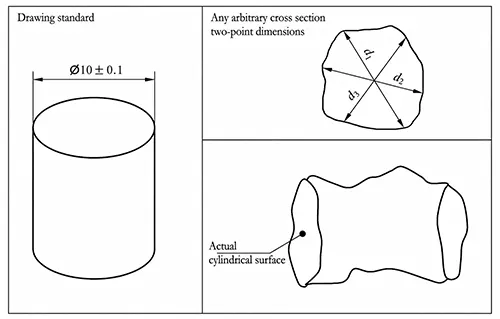
To verify the principle of independence, it is sufficient to measure the actual local sizes using a two-point measurement method, such as a vernier caliper or an internal micrometer.
The measured actual local sizes must lie within the tolerances specified on the drawing.
An example of inspection annotations for the independence principle is shown in Figure 1-49.
As illustrated, dimensions d1 through d3 must fall within the dimensional tolerance of Ø10±0.1.
In summary, all geometric tolerance symbols and modifier symbols follow unified drawing annotation rules.
These rules distinguish whether datums are required for different tolerance types. They also define variable tolerance zones under special material boundary conditions.
The Principle of Inclusion and the Principle of Independence are two complementary fundamental rules governing the relationship between dimensional and geometric tolerances.
The Principle of Inclusion prioritizes assembly fit by restricting form errors within the dimensional tolerance through the maximum material boundary.
It is widely used for mating hole-and-shaft features and can be verified using go/no-go gauges.
In contrast, the Principle of Independence separates size control from form control. This reduces manufacturing costs for non-mating components.
Understanding these symbols and the two core principles enables engineers to select appropriate tolerance annotation schemes according to the functional requirements of a part.
It also helps them accurately control geometric deviations and standardize manufacturing and inspection processes.
As a result, the quality of mechanical assemblies can be ensured.