How to efficiently machine shaped parts on CNC mill-turn machines?


In machining, thread tapping is one of the most common processes.
The tap holder—the “intermediary” connecting the machine tool spindle to the tap—often directly determines machining efficiency, thread quality, and even tap life.
Faced with different types of tap holders, such as synchronous, telescopic, and reversible models, many professionals find themselves struggling to make a choice.
Today, in this article, we’ll clearly explain the principles, pros and cons, and suitable applications of the four mainstream tapping chucks.
We’ll also take a closer look at several common head clamping methods, as well as two often-overlooked yet crucial details: ER collet selection and sealing caps.
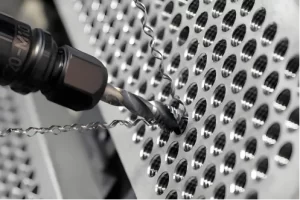
Principle: Relies entirely on the precision of the machine tool spindle to achieve “one revolution equals one thread pitch”; the chuck itself provides no axial compensation.
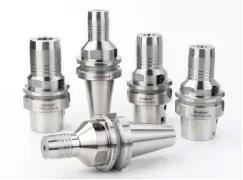
Mainstream chucks: ER spring collet chucks, hydraulic chucks, heavy-duty chucks, etc.
Advantages: High thread accuracy, excellent rigidity, suitable for high-speed cutting, and high efficiency.
Disadvantages: Extremely high demands on the machine tool; no overload protection, making taps prone to breakage; rapid tap wear.
Applications: Modern CNC high-volume, high-efficiency machining (e.g., 3C casings, aluminum alloy parts).
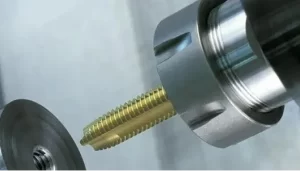
Principle: An internal spring or cushioning mechanism provides several millimeters of axial extension to compensate for feed errors.
Common Brands: Emoc-Franken KSN Series, Dai-Showa ATE Series, Domestic Floating Tap Holder Series
Advantages: Low requirements for machine tool accuracy; effectively absorbs impact to prevent tap breakage (especially in blind holes); supports quick-change systems.
Disadvantages: Unstable thread depth; not suitable for precision blind holes; low rigidity; not suitable for high-speed cutting; average precision.
Applications: Conventional machine tools (e.g., bench-top vertical drill presses, radial drill presses), CNC machining centers with poor precision and rigidity, deep holes, or difficult-to-machine materials (such as stainless steel).
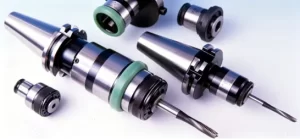
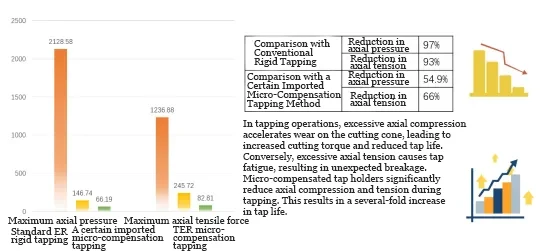
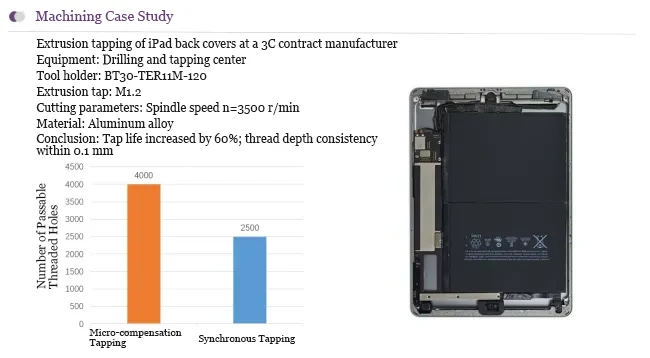
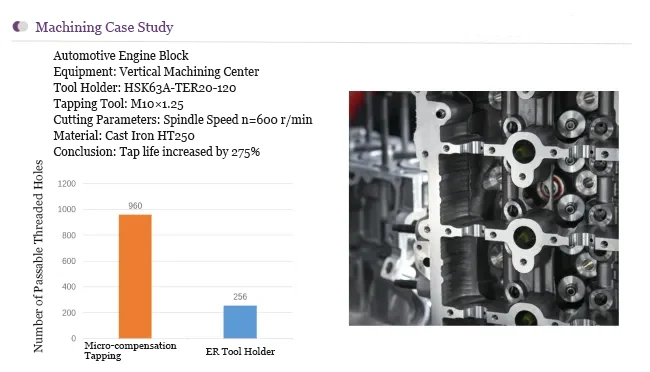
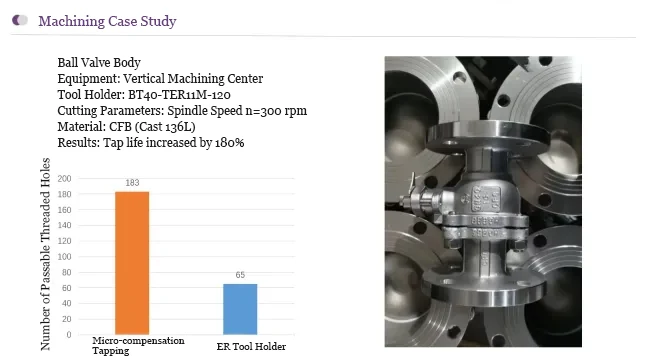
Principle: Based on rigid synchronization, these toolholders incorporate a micron-level axial compensation mechanism that actively absorbs synchronization errors and acceleration/deceleration shocks.
Leading Brands: Chenglin CNC’s MCP-TER series (CN110421389B), Emoc-Franken Synchro series
Advantages: Combines high precision with protective features to extend tap life;
Offers greater tolerance for machine tool synchronization performance; ensures smoother machining.
Disadvantages: Complex structure and high cost; still requires the machine tool to have synchronization capabilities.
Applications: High-value-added, difficult-to-machine materials (aerospace high-temperature alloys, medical implants, die steel) and batch production where overall cost-effectiveness is prioritized.
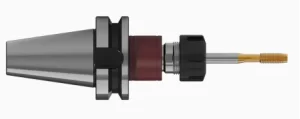
Principle: The spindle rotates in one direction throughout the entire process, while an internal clutch in the holder switches the tap’s rotation between forward and reverse.
Advantages: The spindle does not need to stop and start to reverse direction, resulting in high efficiency; protects the spindle;
Features built-in overload protection; reduces energy consumption.
Disadvantages: Complex structure and high cost; requires regular maintenance; not suitable for high-precision CNC machines (may introduce errors).
Applications: Standard drill presses, radial drill presses, tapping machines; equipment retrofitting or repair shops.
Note: While rarely used in modern CNC machining, it remains a valuable tool for older equipment and certain specialized machines.
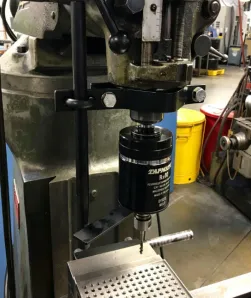
Understand the key differences at a glance.
| Tool Holder Type | Machine Tool Requirements | Thread Accuracy | Tap Protection | Machining Efficiency | Typical Applications |
|---|---|---|---|---|---|
| Rigid Synchronization | Very High | High | Poor | Very High | High-speed, high-volume production |
| Tension-Compression Floating | Low | Medium | Good | Average | Older machines, deep-hole tapping |
| Micro-Compensation Synchronization | Relatively High | Very High | Good | High | High value-added parts, difficult-to-machine materials, optimal overall performance |
| Reversible Type | Low (Non-Synchronous) | Medium | Fairly Good | High | Drilling machines, tapping machines |
Quick reference guide for selecting tap holders (30-Second Quick Match).
| Core Requirement | Recommended Solution | Reason in One Sentence |
|---|---|---|
| Efficiency, through-hole drilling, high-volume production | Rigid synchronous tool holder + ER collet holder | Provides the highest rigidity, fastest machining speed, and lowest cost. |
| Prevent drill breakage, blind-hole drilling, aging machines | Micro-compensation synchronous tool holder or telescopic floating tool holder | Micro-compensation protects drills while maintaining accuracy, making it the preferred choice; telescopic floating holders are suitable for machines without synchronization capability. |
| Frequent model changes, high-mix low-volume production | Any tool holder body equipped with a quick-change self-locking chuck | Enables rapid drill replacement and eliminates tool-setting and alignment time. |
| High value-added products, difficult-to-machine materials | Micro-compensation synchronous tool holder + hydraulic chuck | Offers the best balance of precision and tool protection, resulting in superior surface quality. |
| No spindle synchronization function available | Reversible tapping chuck | Allows standard drilling machines to perform tapping operations when no other solution is available. |
| Pursuing overall cost-effectiveness and reducing per-part cost | Micro-compensation synchronous tool holder | Although the initial investment is higher, the cost difference is typically recovered within about three months through longer tool life and reduced scrap rates. |
Many people tend to confuse “toolholder type” with “clamping method.”
Simply put, the toolholder type determines the compensation mechanism (rigid, floating, etc.), while the clamping method determines how the tap is secured.
A single toolholder body can be paired with different clamping systems.
Below are the three most common tip clamping methods for tapping toolholders.
| Holder Type | Working Principle | Advantages | Disadvantages | Typical Applications |
|---|---|---|---|---|
| Spring Collet Chuck (ER Holder) | A nut compresses the spring collet, causing it to contract and securely grip the cutting tool. | • Highly versatile; can hold drills, end mills, taps, and other tools.• Affordable and easy to source accessories.• Accuracy is sufficient for most standard machining operations. | • Torque is transmitted only through friction, so large taps may slip.• Clamping force is lower than that of power chucks. | Conventional tapping, small thread sizes (M6 and below), and cost-sensitive applications. |
| Quick-Change Self-Locking Chuck | Steel balls or jaws lock onto the tap shank. Torque is transmitted through the internal drive slots of the chuck and the square end of the tap. | • No need to loosen a nut; one-click tap replacement greatly improves efficiency.• Some models include overload protection to prevent tap breakage. | • Rigidity and accuracy are lower than those of spring collet chucks.• Designed only for tapping and cannot hold other cutting tools. | Frequent tap changes (such as high-mix, low-volume production) and maintenance workshops. |
| Hydraulic Chuck | Tightening a pressure screw compresses an internal oil chamber, causing a thin-walled sleeve to deform uniformly and clamp the tool. | • Highest clamping accuracy (runout ≤ 0.003 mm).• Uniform clamping force that does not damage taps.• Excellent vibration damping, improving surface finish quality. | • High cost.• Risk of oil leakage after seal aging. | High-precision tapping, superior surface-finish requirements, and micro-thread machining (M1 and below). |
Summary: Spring collets (ER system) are the most common choice for general tapping applications and offer the best value for money.
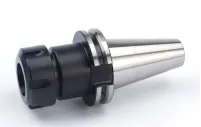
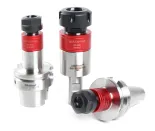
For frequent tool changes, consider using a quick-change self-locking chuck.
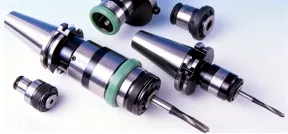
For high-precision or micro-machining, consider using a hydraulic tool holder; for heavy-duty tapping, a heavy-duty collet chuck is recommended.
In both cases, however, the shank diameter tolerance of the tap should ideally be controlled to h6.
This is a practical consideration within the ER collet system that directly impacts the success of machining operations.
The answer is: when tapping small threads (typically M6 and smaller, especially M3 and smaller).
Because the cutting torque for small threads is very low, the radial friction of the ER collet is sufficient to reliably drive the tap without slipping.
The vast majority of factories use standard ER collets for tapping small threads due to their low cost and versatility.
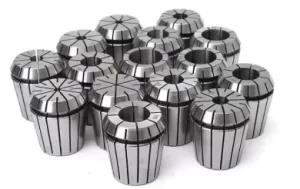
When working with larger threads (M8 and above) or difficult-to-machine materials (such as stainless steel or titanium alloys), it is essential to use a specialized tapping spring with a square groove.
Standard ER collets rely solely on friction and are highly prone to slipping when reversed under high torque, which can result in tap damage or workpiece scrap.
Specialized tapping collets feature a square groove structure that mates with the square shank at the end of the tap, reliably transmitting torque (forward drive) and preventing slippage.
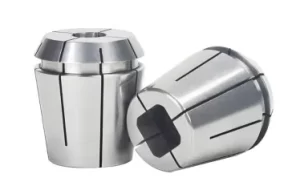
In short: Friction is sufficient for small threads, but large threads require positive drive.
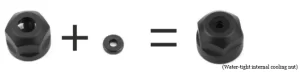
The sealing cap (also known as a dust seal) is an often-overlooked yet critically important component in the ER spring collet system.
It primarily serves the following three functions:
When using a tap with an internal cooling hole, the sealing cap blocks the gap created by the snap ring, forcing high-pressure coolant to spray out through the tap’s central bore directly into the cutting zone, ensuring effective cooling and lubrication.
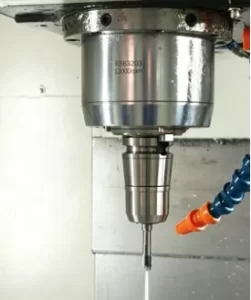
Tiny metal chips and dust can enter the tool holder’s precision clamping mechanisms (such as the tapered surface and hydraulic oil chambers) through gaps in the retaining ring, leading to reduced clamping accuracy and permanent failure of the tool holder.
The sealing cap acts as a “dust cover” to protect the tool holder.
In modern high-volume production, many companies adopt MQL (Minimum Quantity Lubrication) technology to enhance environmental sustainability and efficiency.
Lubricant is precisely sprayed in the form of a fine mist through the internal cooling channels of the spindle, tool holder, and tap.
This requires that the entire internal cooling channel maintain excellent sealing and unobstructed flow;
Otherwise, the oil mist will leak through gaps in the retaining rings, leading to insufficient lubrication at the machining site, accelerated tool wear, and increased costs.
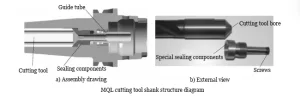
Therefore, when using MQL technology, a sealing cap is also standard equipment.
At the same time, it is necessary to ensure that the internal cooling channel design complies with relevant standards to guarantee adequate lubrication in the cutting zone.
Summary: Whether using traditional emulsion cooling or MQL micro-lubrication, the sealing cap is an indispensable component.
It serves not only as a “dust cover” for the tool holder but also ensures precise cooling and lubrication.
Simple summary: Small threads rely on sufficient friction, while large threads must use positive drive.
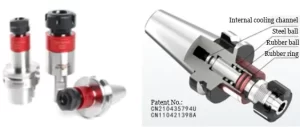
The 360-degree uniform floating design significantly reduces axial stress on the tap, extending tap life and improving machining stability.
Utilizing volume-compression rubber springs as elastic elements, three rubber spring specifications are available to accommodate varying penetration pressures when tapping different materials.
The floating parameters for each specification have been precisely calculated and tested, providing a controllable and stable floating force.
This ensures uniform thread depth and improves machining accuracy.
A combination of steel and rubber balls ensures stable torque transmission and provides cushioning during tap engagement, protecting both the tap and the workpiece.
A micrometer-level bore-shaft fit strictly controls tap runout, ensuring high precision and quality in thread machining.
In short: Friction is sufficient for small threads, but large threads require positive drive.
New CNC machines + high-precision/difficult materials → Micro-compensation synchronous tool holders + spring collets (large threads with tapping retaining rings + sealing caps).
New CNC machines + standard high-volume production → Rigid synchronous tool holders + spring collets (small threads with standard retaining rings; large threads with tapping retaining rings + sealing caps).
Frequent tap changes → Quick-change self-locking collets.
High precision/fine threads → Hydraulic chucks.
Older machines/standard drill presses → Reversible or telescopic floating tool holders + spring collets + sealing caps.