How to efficiently machine shaped parts on CNC mill-turn machines?


Have you ever found yourself in this situation: holding a mechanical drawing, staring at the squares and lines on it with a blank look on your face—even though you can understand each drawing, you have no idea what the part actually looks like when put together?
Today, using this drawing, I’ll explain the three core views in mechanical drafting clearly and thoroughly.
After reading this, you’ll be able to understand part drawings at a glance!
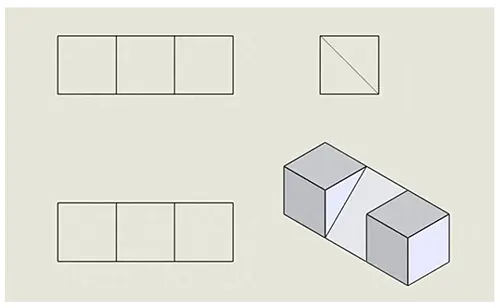
Simply put, the three views are like taking three “ID photos” of a part—capturing a three-dimensional part as a two-dimensional drawing from three mutually perpendicular directions.
▪ Front View: The view from directly in front, showing the part’s length and height; it is the part’s “front-facing photo.”
▪ Top View: The view from directly above, positioned directly below the front view. It shows the part’s length and width and is the part’s “top shot.”
▪ Left View: The view from the left side, positioned directly to the right of the front view.
It shows the part’s height and width and is the part’s “side view.”
Just like the isometric projection in this image, where the front and top views are three blocks arranged side by side, while the left view is a square with a diagonal line.
Only when these three views are combined can the part’s true shape be fully reconstructed.
In mechanical drafting, there’s an “ironclad rule” for three-view drawings—memorize it and you’ll never go wrong: Lengths Aligned, Heights Level, Widths Equal.
▪ Lengths Aligned: The length directions of the front view and top view must be aligned.
As shown in this figure, the two three-square blocks at the top and bottom have exactly the same length.
▪ Height Alignment: The height dimensions of the front view and the left view must align;
The height of the front view is equal to the side length of the square in the left view.
▪ Width Equality: The width dimensions of the top view and the left view must be equal;
The front-to-back width of the top view is equal to the side length of the left view.
Many beginners make mistakes when drawing or reading drawings because they fail to follow these three rules—either the lengths are not aligned or the widths are not equal—resulting in parts that simply cannot be assembled.
Look at the left view in the upper right corner—the diagonal line inside that square.
Many people mistakenly think it’s a drawing error, but it’s actually the key to this drawing!
This diagonal line represents the inclined face on the part.
When you view the part from the left, that inclined plane appears as a straight line in the two-dimensional projection.
Now look at the isometric view in the lower right corner.
That slanted surface corresponds to the diagonal line in the left-side view, while in the front and top views, this surface looks no different from a regular square.
This also tells us that looking at just one view is completely insufficient to determine the part’s true shape—you must examine all three views together.
Drawing conclusions based on a single view: As shown in this image, the front and top views look just like ordinary three-block cubes, but the diagonal line in the left view reveals that this is no ordinary cube.
Many people look only at the front view and assume the part is straight, only to find that the machined result is completely wrong.
Reversing View Positions: The left view should not be placed to the left of the front view; it must be positioned directly to the right of the front view.
The top view must be directly below the front view. If the positions are incorrect, the entire drawing becomes chaotic.
Ignoring Hidden Lines: If there are hidden contours behind a part, they must be indicated with dashed lines.
This is a crucial detail in three-view drawings—don’t overlook it.
First, locate the front view to identify the part’s front-facing features;
Refer to the top view to determine the part’s length and front-to-back width;
Then, examine the left view to confirm the part’s height and side structure, paying special attention to details such as diagonal lines and dashed lines.
The three-view projection is the foundation of mechanical drafting.
Whether you’re a lathe operator, a milling machine operator, a drafter, or someone who reads drawings, you can’t do without it.
Once you’ve solidified this foundation, reading complex assembly drawings and part drawings will become much easier.
In summary, the three-view drawing system is the fundamental language of mechanical drafting.
By combining the front, top, and left views in strict projection alignment, a flat drawing can accurately represent a complex three-dimensional part.
Once you internalize the rules of “length alignment, height correspondence, and width equality,” the logic behind orthographic projection becomes clear and consistent rather than abstract.
More importantly, mastering three-view interpretation is not just about reading drawings correctly—it directly affects manufacturing accuracy, assembly feasibility, and communication efficiency across design and production.
With consistent practice, you will gradually move from “decoding lines and shapes” to instantly visualizing the actual part in 3D, which is the true goal of engineering drawing literacy.