How to efficiently machine shaped parts on CNC mill-turn machines?
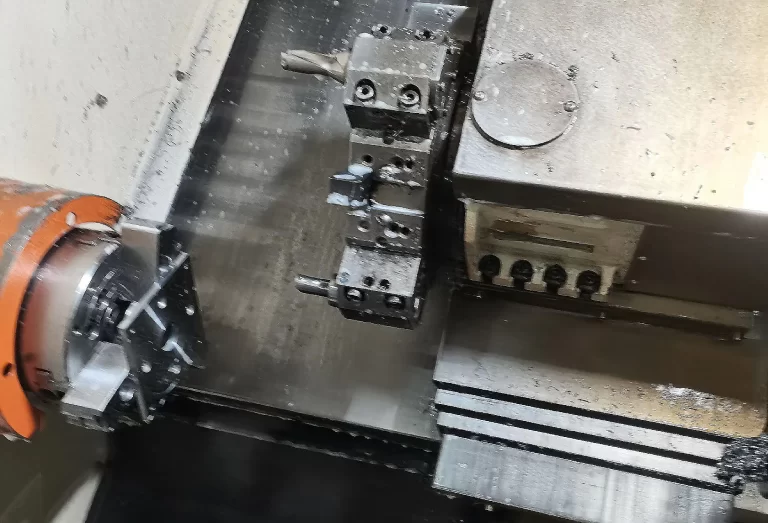


Threaded connections play a wide role in mechanical equipment, and their machining quality directly affects equipment safety, reliability, and service life.
CNC lathes offer high precision, high efficiency, and flexibility, and they play a critical role in the batch machining of threaded parts.
However, in actual production, factors such as tool wear, machine vibration, inappropriate cutting parameters, and surface treatment processes can easily lead to out-of-tolerance critical dimensions—such as thread mean diameter and pitch—or surface defects, resulting in wasted resources.
Therefore, thread repair holds significant economic value.
Currently, many small and medium-sized enterprises rely on manual expertise, using dies, taps, or conventional lathes for repair.
This approach suffers from high labor intensity, low efficiency, and significant quality fluctuations, making it difficult to ensure consistency in batch repairs.
Existing research largely focuses on machining new threads and optimizing tools, while studies on the secondary precision repair of existing threads remain limited.
A systematic CNC repair technology framework has yet to emerge.
In response to these needs, this paper systematically investigates the entire process of thread repair on CNC lathes, analyzes the applicability of different thread repair commands, compares two efficient tool-setting methods, and, based on batch repair case studies, summarizes scalable thread repair programs and operational guidelines.
This provides enterprises with practical technical references and supports the refinement of process theory.
The CNC system achieves thread cutting on CNC lathes through precise electronic synchronization of spindle rotation and tool axial feed.
Based on position feedback from the spindle encoder, the CNC system generates a specific pulse for each revolution of the spindle.
The system then controls the Z-axis servo motor according to a preset electronic gear ratio, causing the tool to move by one thread pitch.
The encoder’s zero-position signal ensures consistent phase alignment for each tool pass, thereby guaranteeing the continuity of the thread profile.
Thread machining quality is influenced by a combination of factors, including tool geometry, cutting path, cutting parameters, and workpiece material.
Thread repair is more complex than machining new threads, and its unique characteristics are primarily reflected in three aspects:
First, repair is subject to contour constraints.
Since the workpiece surface already has an incomplete thread profile, the tool must be precisely aligned with the existing spiral groove; otherwise, it is prone to profile damage or repair failure.
Second, re-cutting involves intermittent machining, resulting in significant fluctuations in cutting forces.
Combined with uneven stock distribution and increased cutting impact, this places higher demands on tool strength and machine tool rigidity; third, re-cutting requires restoring the thread to acceptable dimensions, necessitating extremely precise fine-tuning of the final dimensions and demanding higher precision control.
These unique characteristics make the thread re-cutting process—particularly tool setting techniques—the core and most challenging aspect of the entire re-cutting operation.
CNC systems offer a variety of thread cutting commands, such as G32, G92, and G76.
The selection of commands for rework must be based on the specific circumstances.
As the most basic threading command, G32 is used to execute a single-pass cut from the starting point to the end point.
Its primary advantage lies in its high flexibility, allowing the programmer to fully control the entry point, cutting path (such as straight, helical, or alternating left-right), and exit point.
This command is suitable for machining and reworking special threads such as constant-pitch threads and non-standard thread profiles (e.g., trapezoidal threads, square threads), and helps in gaining a deeper understanding of the basic logic of thread formation.
However, the programming process is relatively cumbersome; machining a complete thread often requires writing dozens of program blocks, involves significant computational effort, and is prone to errors, resulting in lower production efficiency.
In terms of applicability for rework, G32 is primarily used for reworking single parts, small batches, or special threads, and can also be used for thread finishing.
It is typically employed when other threading commands cannot meet path control requirements.
G92 is a fixed cycle command. By simply setting the thread’s end point coordinates and pitch, the system automatically completes the “feed-in, cutting, retraction, and return” cycle.
Its greatest advantage lies in simplified programming: with fewer program blocks and clear logic, it is easy to inspect and modify, and programming efficiency is significantly higher than that of G32.
However, this command typically uses a straight-in feed method, causing both cutting edges of the tool to participate in the cutting process simultaneously.
This can easily lead to poor chip evacuation, high cutting forces, and vibration, which accelerates tool wear.
Additionally, thread profile interference is likely to occur during the machining of threads with large pitches.
In terms of applicability for rework, G92 is particularly suitable for batch rework of threads with a pitch of 3 mm or less and moderate precision requirements.
Due to its simple program structure, it is easy to interrupt, inspect, and adjust tool offset values at any time during the rework process.
As a powerful composite thread cutting cycle command, G76 allows users to set multiple parameters—such as finishing allowance, minimum depth of cut, helix angle, and final depth of cut—in a single program block.
The system then automatically executes an optimized step-by-step cutting process, typically employing the helical approach to complete the machining.
Its advantages include simple programming, and the helical approach enables single-edge cutting, which features low cutting forces, smooth chip evacuation, and excellent heat dissipation.
This helps achieve higher surface quality and extends tool life; simultaneously, its intelligent depth-of-cut allocation strategy balances machining efficiency with tool protection.
The drawbacks of this command include relatively complex parameter settings, requiring a precise understanding of each parameter’s meaning, and the fact that the cutting path is automatically generated by the system, resulting in less flexibility compared to G32.
In terms of applicability for rework, G76 is suitable for thread machining with large pitches, high precision, and high surface quality requirements (such as trapezoidal threads and worm threads), but it is not typically used in batch rework.
In batch thread reworking, it is necessary to comprehensively consider reworking efficiency, quality requirements, operational convenience, and compatibility with tool setting methods.
For common thread reworking tasks, the G92 command is typically the preferred choice due to its ease of programming and adjustment.
The principle of the axial dynamic tool setting method involves fine-tuning the Z-coordinate of the thread starting point in the program to precisely align the tool tip axially with the center of the existing thread groove on the workpiece.
This is typically achieved by adjusting the tool offset value.
The operational procedure for this repair method is as follows: First, perform a rough tool setting.
Then, run the repair program automatically in single-segment mode while closely observing the relative position of the tool tip and the workpiece’s thread groove.
If misalignment occurs, pause the program, make minor adjustments to the Z-axis offset (or wear value) in the CNC system’s tool compensation interface, and re-run the program for observation.
Repeat this “test cut—observe—adjust” cycle until the tool tip precisely lands at the center of the thread groove.
The advantages of this method include no special requirements for the machine tool or fixtures, high flexibility, and the potential to achieve high tool setting accuracy in theory.
However, the entire process relies heavily on the operator’s observational judgment and experience, often requiring multiple test cuts.
Furthermore, reworking each part necessitates re-performing Z-axis tool setting, which is time-consuming and results in low rework efficiency.
Therefore, this method is primarily suitable for reworking single pieces, small batches, or non-standard threads, as well as when other auxiliary positioning methods are unavailable.
This is a rapid positioning method based on circumferential phase synchronization, which can significantly improve tool setting efficiency during batch rework.
The specific procedure for the zero-point marking method is shown in Table 1.
| Step | Name | Method |
|---|---|---|
| 1 | Set Reference | At any position on the machine tool table, use a marking tool to draw a clear zero reference line. |
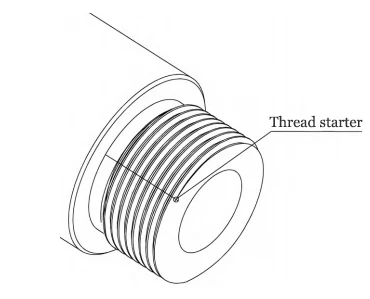
| 2 | Workpiece Marking | On the cylindrical surface of each part to be repaired, manually scribe a clear axis line along the threaded path, which serves as the starting position line for threading, as shown in Figure 1. |
| 3 | Alignment | When mounting the workpiece, manually rotate it so that the threaded starting line on its surface aligns with the zero reference line on the machine table in the same radial cutting plane. |
| 4 | Machining | After alignment, regardless of how many times the workpiece is replaced, as long as each alignment is correct, the circumferential phase of the thread starting point remains fixed. |
Table 1. Zero Reference Line Method Operation Procedure
The advantage of this method lies in its ability to achieve fast and accurate circumferential positioning, eliminating the need for repeated trial cuts and tool setting, which significantly improves the efficiency of batch processing.
At the same time, it is simple to operate, highly repeatable, and facilitates standardized operations.
However, this method requires marking the workpiece prior to the preceding process or before rework, which adds auxiliary time and places high demands on the operator’s alignment accuracy and sense of responsibility during clamping.
Therefore, it is suitable for batch production and the rework of threaded parts with high consistency requirements, serving as a key technology for improving the efficiency of batch rework.
Even after completing the initial alignment using the methods described above, slight deviations may still occur during the actual tool setting process.
Table 2 shows common relative positions between the tool tip and the thread root, along with corresponding adjustment strategies.
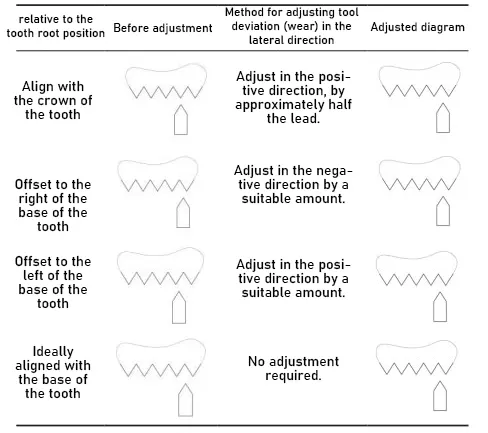
Techniques for fine-tuning primarily include:
First, the visual reference method. When the tool tip is far from the root of the thread and difficult to judge with the naked eye, apply red lead or mark the thread surface with a marker.
Observe the contact between the tool tip and the marked area to assist in precise tool setting;
Second, the micro-test cut and inspection method: after initial tool alignment, perform an extremely shallow test cut (e.g., 0.05 mm cutting depth in the X direction), then use a thread micrometer, three-point gauge, or go/no-go gage for inspection.
Based on the measurement results, simultaneously fine-tune the tool offset values:
X-axis offset is used to control the mean diameter, with each adjustment not exceeding 0.05 mm;
Z-axis tool offset is used to control tip centering, with each fine adjustment of 0.1 mm to gradually approach the optimal dimensions.
For reworking internal threads, the machining principles are the same as for external threads; however, due to limited visibility inside the hole, it is even more necessary to rely on the coloring method or test cuts, combined with plug gauge inspection, to make repeated adjustments.
In practice, the thread root coloring method can be used to assist with tool setting: apply color evenly to the thread root, and during the test cut, observe the contact between the cutting marks and the colored area to determine the actual position of the tool tip and make further fine adjustments.
This analysis examines the thread repair process for a company’s transmission tower studs following hot-dip galvanizing.
The part drawing of the stud is shown in Figure 2.
According to the technical specifications, the threads are to be machined as hot-dip galvanized threads, and it is permissible to apply rust-preventive oil to the threads after galvanizing.
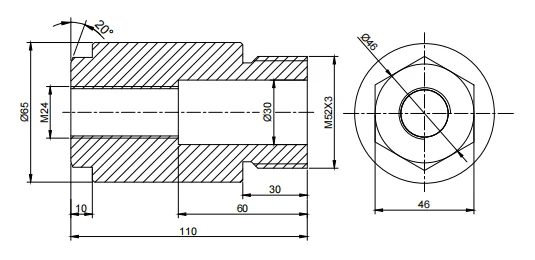
This stud is machined with an M24 internal thread at one end and an M52×3 external thread at the other.
After hot-dip galvanizing, zinc nodules partially fill the thread grooves, particularly affecting the M52×3 external thread, resulting in failure to pass the go gauge and rendering the part unfit for assembly.
The original repair process involved using a tap to restore the internal threads and a die to manually restore the external threads.
Manual restoration of the external threads presented issues such as high labor intensity, low efficiency (averaging about 3 minutes per part), poor thread quality, and a low pass rate (only about 70%).
The equipment selected is a CNC lathe equipped with a FANUC system, using carbide threading inserts as cutting tools with a 60° cutting edge angle, and a spindle speed set to 400 rpm.
The tool setting process employs the zero-point reference method:
First, mark a zero-point reference line on the chuck. Then, before clamping all studs, mark a thread starting line uniformly at the starting position of the M52×3 external thread.
During clamping, ensure the starting line on the workpiece aligns accurately with the zero-point reference line on the chuck.
During the re-machining of the M52×3 external thread, select the G92 command for step-by-step cutting.
This program structure is simple and clear, facilitating repeated checks of the tool tip position and real-time adjustments to the tool offset during the first-piece debugging phase using the “M1” pause function.
It also helps effectively control cutting forces and re-machining allowances.
The specific re-machining reference program is shown in Table 3.
| Program Segment | Description |
|---|---|
| O0092 | Program number |
| T0303 | Threading tool |
| M3 S400 | Spindle forward rotation, speed 400 r/min |
| G0 X53 Z5 | Rapid positioning to tool start point |
| G92 X52 Z-28 F3 | Trial threading (air cut), measure tool tip position |
| M1 | Optional stop, adjust tool offset No. 03 based on measurement |
| T0303 | Reapply tool offset |
| G92 X51 Z-28 F3 | Trial threading again, continue measuring tool tip position |
| M1 | Optional stop, adjust tool offset No. 03 based on measurement |
| T0303 | Reapply tool offset |
| G92 X50 Z-28 F3 | Start formal threading cut |
| X49 | Second pass |
| X48.5 | Third pass |
| X48.1 | Fourth pass |
| X48.1 | Finishing pass |
| G0 Z260 | Retract tool along Z-axis |
| M30 | End of program |
Table 3. Reference Program for Repairing M52×3 External Threads
The rework process includes:
① Preparation. Complete the layout marking and ensure the two marked lines align during clamping.
② Tool setting and test cutting for the first part.
Use the coloring method to assist with tool setting, run the empty cutting program segment in Table 3, and adjust the Z-axis tool offset by visual inspection.
Then perform a test cut with minimal material removal and use a thread ring gauge to inspect the workpiece. Adjust the X-axis and Z-axis tool offsets finely until the process meets the requirements.
③ Batch rework. After confirming the parameters for the first piece, record the current tool offsets.
For subsequent parts, under uniform clamping standards, disable the M1 command and directly use these tool offsets for batch machining.
④ Quality control. Conduct regular inspections during the rework process to ensure consistent rework quality.
After adopting the CNC rework method, all performance metrics showed significant improvement.
① Quality: The reworked threads feature clear profiles, low surface roughness values, and good dimensional consistency, with the first-pass inspection pass rate consistently exceeding 99%.
② Efficiency: The process reduces the average rework time per part to less than 30 seconds, achieving an efficiency increase of over 80% compared to manual methods.
③ Cost and Labor Intensity: The process reduces reliance on operator skill, alleviates labor intensity, and eliminates die wear, resulting in a significant reduction in overall costs.
Theoretical analysis and practical verification support the following process optimization recommendations to ensure the quality and efficiency of CNC thread repair.
1) Ensure thorough preparation before rework. Standardize the workflow using the “zero-point reference line method” to ensure the chuck’s zero-point reference line is clearly visible.
Provide standardized training to operators to ensure accurate workpiece marking and consistent clamping alignment.
2) Implement a first-piece verification system.
For batch rework, strictly follow the procedures for first-piece test cutting, inspection, and parameter fixation. Do not proceed with batch operations until the first piece meets the acceptance criteria.
3) Optimize tool offset adjustment.
For Z-axis tool offset adjustment, prioritize positive micro-adjustments, with each adjustment not exceeding 0.1 mm, to prevent interference between the tool and the workpiece’s machined surface.
Additionally, establish a tool life management system to regularly inspect and promptly replace worn tools.
4) Optimize cutting parameters. Select appropriate cutting parameters based on the material type and heat treatment condition of the remanufactured workpieces.
When machining galvanized parts, to optimize machining quality and prevent zinc layer adhesion to the tool, set the cutting linear speed to a lower range of 50–70 m/min, then calculate the spindle speed using the formula n = 1000v/(πd).
During trial cutting and tool setting, reduce the spindle speed to approximately 200 rpm to facilitate observation of the tool tip position.
5) Implement quality control throughout the entire process.
In addition to performing first-piece inspections, the process establishes a reasonable sampling frequency for batch production; it recommends inspecting 1 piece out of every 10.
The process uses comprehensive inspection methods, such as thread plug gauges, thread micrometers, and the three-point measurement method, and records data properly to ensure quality traceability.
This study addresses the prominent issues in thread reworking encountered in actual production and systematically explores the application methods and process systems of CNC lathes in thread reworking.
By comparing the process characteristics of thread cutting commands such as G32, G92, and G76, the study clarifies the principles for selecting the appropriate command in reworking.
The proposed “axial dynamic tool setting method” and “zero-point reference line method” provide precise tool setting solutions suitable for different batch sizes.
Using typical batch rework examples, the study validated that the rework process—centered on the G92 command and the zero-position reference line method—offers advantages in terms of feasibility, efficiency, and stability.
Practical results demonstrate that this process system can significantly improve the dimensional consistency, surface quality, and machining efficiency of reworked threads, effectively reducing scrap rates and production costs.
It provides a reliable and standardized technical approach for thread component rework in enterprises and holds significant value for widespread application.
Although this study has achieved certain practical results, several limitations remain that warrant further in-depth exploration.
1) High reliance on experience and insufficient automation.
Current tool setting methods still heavily depend on the operator’s experience and subjective judgment, requiring a large number of test cuts, which limits further improvements in rework efficiency.
In the future, automated and intelligent tool setting solutions based on machine vision, laser tool setting, and other technologies could be explored.
2) Research on adaptability to materials and coatings is insufficient.
The case studies in this research primarily focused on hot-dip galvanized carbon steel parts.
There has been no systematic analysis of how different substrate materials and surface coatings affect rework process parameters, and there is a lack of a universally applicable parameter database.
Subsequent research should address these shortcomings, focusing on the development of smarter, more efficient, and more adaptable thread rework technologies and equipment to advance technological development and engineering applications in this field.