How to efficiently machine shaped parts on CNC mill-turn machines?


Manufacturers widely use blade-type parts in the aerospace, automotive, metallurgical, and petroleum industries.
Multi-blade parts have a complex structure and require high processing accuracy.
Additionally, their blade surfaces are spatial free-form surfaces with complex shapes and thin blades.
Because of these factors, vibrations and deformations are likely to occur during processing.
Therefore, formulating an efficient processing plan is of great significance for ensuring product quality and improving resource utilization.
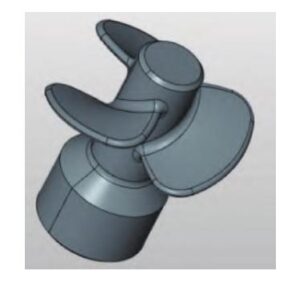
The designer utilized Inventor software to create the part model, as shown in Figure 1.
Along with impeller-type parts, this part features a multi-blade structure with surfaces mainly composed of spatial free-form shapes.
The average thickness of the blades is 3 mm, and the minimum distance between adjacent blades is 7.5 mm.
Requirements for geometric tolerance, dimensional accuracy, and surface roughness must be met for the lower end shaft.
A five-axis machining center can machine it without requiring five-axis interpolation.
Five-axis machines have low efficiency, and the machining mode affects machine accuracy.
The analysis indicates that this part should be processed using a three-axis machine with the A-axis fixed at 90°.
Considering the advantages of smooth turning processes, simple clamping, minimal changes in cutting force, and ease of maintaining part accuracy, the operator processes the lower shaft via turning.
Meanwhile, the operator processes the blades and blade shaft using a four-axis machine.
After comprehensive analysis, engineers propose processing the part using a combination of turning and CNC milling.
The machining process for the part in this case primarily involves turning and CNC machine programming.
Among these, CNC programming is a critical component of the part’s machining process.
It not only determines the subsequent machining sequence but also has a significant impact on product quality.
Using its dedicated impeller machining module, the hyperMILL software can significantly improve machining efficiency when creating machining paths.
Although the software provides convenience for programming, it is still necessary to reasonably optimize the parameters in each process.
This helps ensure processing quality and improves processing efficiency.
Taking the case part as an example, the machining process parameters for turning are shown in Table 1.
Considering the part structure and material properties, operators select end mills and ball-nose mills for the CNC milling process, using hard alloy as the tool material.
The CNC milling process parameters are shown in Table 2.
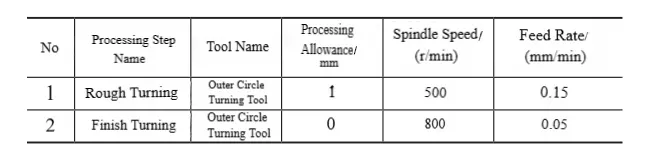

Programming primarily focuses on the blade machining section, as the turning process is relatively simple.
The operator imports the STEP part model into the hyperMILL software.
Then, the operator creates the blank, defines the machining coordinate system, and creates new tools to complete the programming.
The primary purpose of rough machining is to quickly remove excess material and improve overall CNC machining efficiency.
For end face machining, the operator selects an end mill.
The operator uses a ball-nose milling cutter for axis-based rough machining of the blades and shafts.
When the stock allowance is large, the operator selects the layer cutting method.
During software programming, the operator selects 2D milling cavity machining for the upper end face and uses an end mill 10 as the machining tool.
To avoid tool-workpiece friction, reduce the risk of tool chipping, and enhance machining process stability, the machining path uses climb milling.
The vertical step distance is set to 2 mm, the diameter coefficient is 0.5, and the machining tolerance is ±0.01 mm.
After machining the end face, the operator rotates the part 90° and performs rough machining using the 5X shape offset in the five-axis surface milling method.
The operator positions the tool perpendicular to the Z-axis, sets the safety mode to radial, assigns a safety radius of 60 mm and a retraction radius of 50 mm, and machines the cavity from the inside out.
Climb milling is chosen as the cutting mode by the operator.
The tool path radius is 0.05 mm, and the machining tolerance is ±0.05 mm.
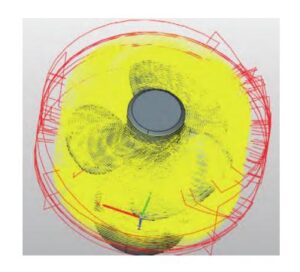
Figure 2 illustrates the rough machining tool path.
Semi-finishing uses a finishing strategy with five-axis surface milling.
The safety allowance for the parameters of each side wall of the blade is 0.1 mm.
A safety distance of 2 mm is set, the retraction radius is chosen as 50 mm, the safety radius is 60 mm, and the machining tolerance is ±0.01 mm.
The operator must optimize the toolpath to minimize unnecessary tool jumps during machining.
First, select one blade for machining.
Once the toolpath meets the requirements, use a circular array method to machine the remaining two blades.
This effectively addresses the issue of multiple unnecessary tool jumps.
Semi-finishing includes machining the blade, shaft, and the leading and trailing edges of the blade.
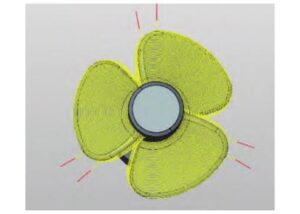
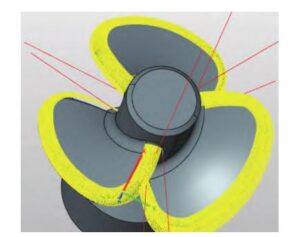
The semi-finishing toolpath for the blade is shown in Figure 3.
When using conventional programming methods, machining the trailing edge of the blade is a challenging task.
Therefore, the designer selects 3D ISO machining for the trailing edge of the impeller during the process design phase.
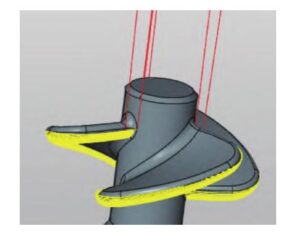
Since the blade has a curved surface, the toolpath generated by this method is a three-axis toolpath.
To prevent tool-to-blade interference, the generated toolpath must undergo five-axis cavity milling (5X) re-machining.
This machining strategy effectively avoids tool collisions.
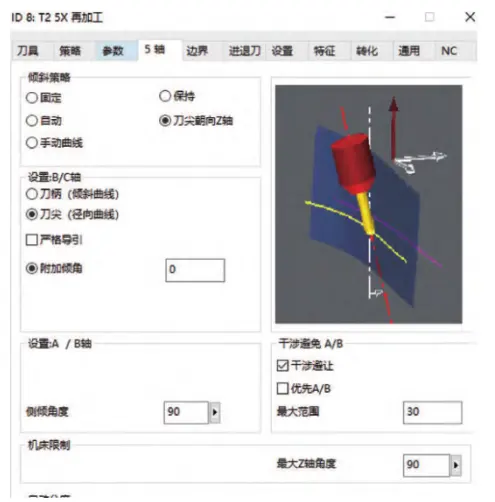
In this process, the machining area selects the tool path. The machining mode is set to ‘hold position,’ and the safety mode is set to ‘radial.’
The operator sets the retract radius to 60 mm, the safety radius to 20 mm, and selects the 5X advanced parameters.
Figure 4 displays the 5X re-machining parameter settings interface.
The semi-finishing path for the blade leading edge is shown in Figure 5, and the semi-finishing path for the blade trailing edge is shown in Figure 6.
The key to finishing lies in the design of the toolpath trajectory.
Reasonable settings can effectively reduce processing errors.
In addition, the reasonable selection of tool angle and diameter is the key to improving CNC processing efficiency and quality.
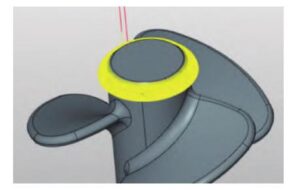
The operator applies 3D contour finishing for end face chamfering.
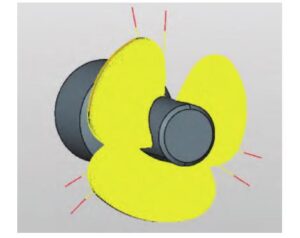
For blade finishing, the operator chooses the method of first processing individual blades and then performing conversion settings to reduce unnecessary tool jumps.
The end face chamfering machining path is shown in Figure 7, the blade finishing path is shown in Figure 8, and the blade shaft finishing path is shown in Figure 9.
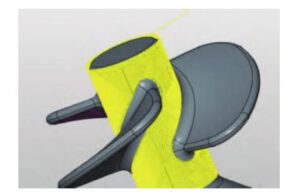
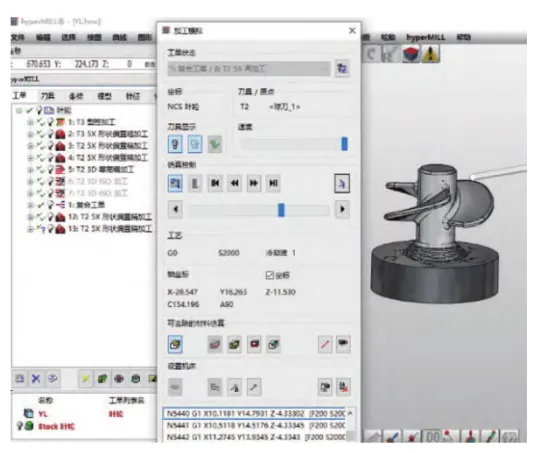
To preview the machining process and results and avoid potential machining errors, internal machine tool simulation is used for machining simulation.
The simulation interface is shown in Figure 10.
Through simulation, it was found that the original speed was too slow.
During the actual machining process, the spindle speed was appropriately adjusted.
The rough machining speed was set to 12,000 rpm, the ball-nose cutter radius machining speed was set to 8,000 rpm, and the finishing speed was set to 8,000 rpm.
After verifying the CNC program simulation, the operator performs post-processing to generate machine tool machining codes, enabling on-site machining of the parts.
Aluminum alloy is primarily used in the manufacture of aerospace components .
The test blank selected is an F100mm aluminum alloy, and the test machine tool is a DMU65.
This machine tool has excellent rigidity and stability.
It offers superior milling performance, outstanding machining performance, and extremely high machining accuracy, meeting the test requirements.
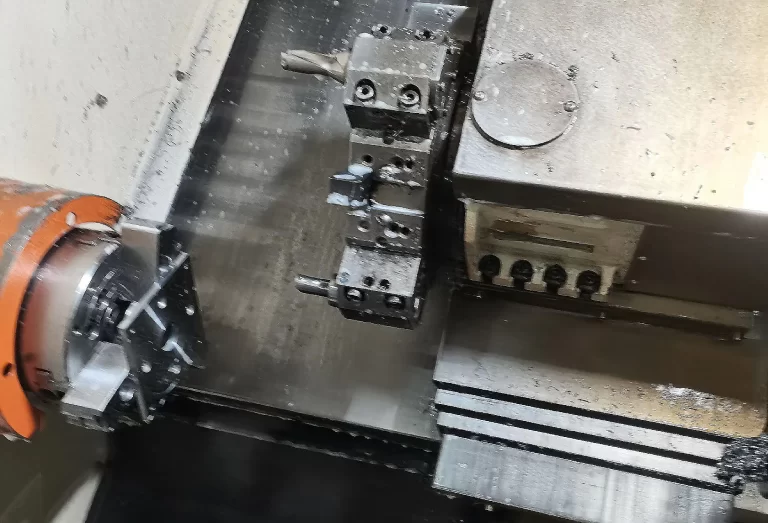
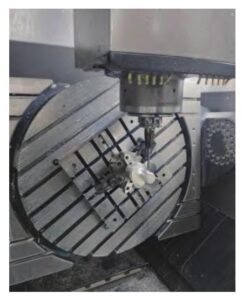
After clamping the part with a chuck, it is mounted on the rotating center of the turntable, accurately positioning the part’s edges, center, and machining coordinate system.
The operator uses a dial indicator to correct the part before machining, ensuring it meets coaxiality requirements.
The operator aligns the workpiece coordinate system, turntable coordinate system, and spindle coordinate system to improve positioning and machining accuracy.
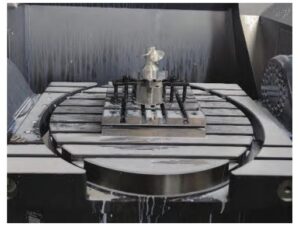
Figure 11 shows the machining site, and Figure 12 displays the actual part.
During this trial production process, we used a Japanese Daishowa Optoelectronics edge finder.
It has excellent performance and provides assurance for improving machining efficiency and quality.
The rapid tool change device on the machine tool helps the operator improve machining efficiency.
By analyzing the part structure and developing a machining strategy that combines turning and milling, the dimensional accuracy of the shaft meets technical requirements.
Additionally, the surface quality of the shaft also meets the required standards.
Using hyperMILL software for programming, each blade is machined individually.
The operator significantly reduces the number of tool changes by reusing the conversion settings for subsequent blades.
Using a 3D ISO 5X re-machining strategy effectively avoids tool interference issues during the machining of the blade trailing edge.
Through simulation and actual on-site machining, the feasibility of the solution has been proven.
The successful implementation of this solution provides a new design approach for the machining of similar parts.