What impact does CNC tool selection have on the CNC machining process?
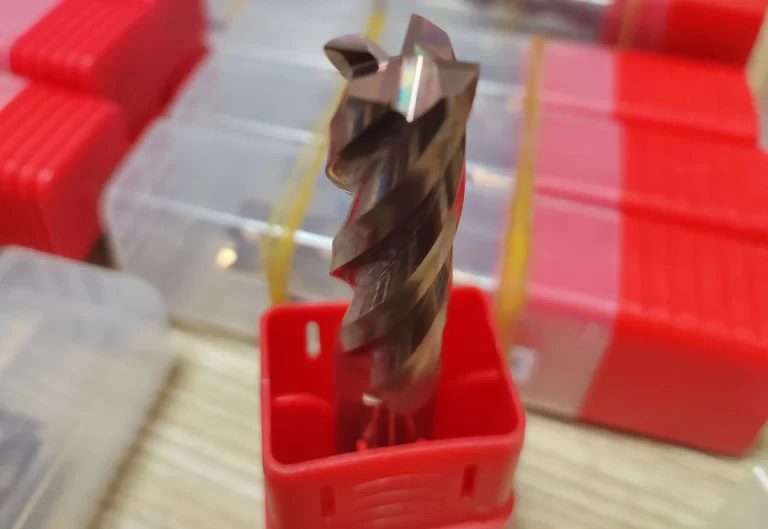


Solid carbide end mills are typically classified by the number of cutting edges into four categories: 2-flute, 3-flute, 4-flute, and 6–8-flute.
Different numbers of cutting edges result in significant differences in the core-to-thickness ratio, chip-carrying capacity, rigidity, and chip evacuation performance;
Therefore, the appropriate type must be selected based on a comprehensive evaluation of the material being machined, the machining stage, and process requirements.
| Number of Flutes | Core Thickness Ratio | Chip Flute Area Ratio | Advantages | Disadvantages |
|---|---|---|---|---|
| 2 Flutes | 55–60% | Approx. 25% | Smooth chip evacuation, large axial feed capacity, versatile | Relatively low rigidity |
| 3 Flutes | 50–60% | Approx. 15% | Smooth chip evacuation, less prone to chatter, good rigidity | Difficult to measure the outer diameter |
| 4 Flutes | 60–70% | Approx. 10% | High rigidity, high machining efficiency, good surface quality | Poor chip evacuation |
| 6–8 Flutes | 80–85% | Approx. 5% | Extremely high rigidity | Difficult chip evacuation |
General-purpose, suitable for rough machining and soft materials.
Core-to-thickness ratio of 55–60%, with the largest chip-carrying capacity (25%) and the strongest chip evacuation capability.
Applications: Grooving, side milling, hole machining, and plunge milling.
Suitable Materials: Adhesive materials such as aluminum alloy and copper, as well as soft materials such as wood and acrylic.
Features: Large chip-carrying capacity and smooth chip evacuation, suitable for deep grooving and longitudinal feed.
Note: Low rigidity; prone to bending during high-feed operations, which limits machining accuracy.
Balanced design that optimizes both chip evacuation and rigidity.
Combines the advantages of both 2-flute and 4-flute designs: the cutting-edge arrangement minimizes chatter, and the geometric design enhances core-thickness rigidity.
Applications: Grooving, side milling, heavy-duty cutting, and finishing.
Suitable Materials: General-purpose materials such as steel, cast iron, and stainless steel.
Features: Smooth cutting performance; suitable for both side milling and grooving; versatile for a wide range of woodworking applications.
High-efficiency finishing type; shank-to-tooth ratio of 60–70%; high rigidity.
Delivers higher productivity and lower surface roughness while maintaining the same feed rate per tooth.
Applications: Shallow slot milling, side finishing, machining of high-hardness materials.
Suitable Materials: Hardened steel, die steel, high-hardness materials.
Features: Smooth cutting with low noise and vibration; however, chip evacuation is poor, making it unsuitable for deep grooving.
High-rigidity finishing cutters with a core-to-shank ratio of 80–85% and chip flutes accounting for only 5% of the total length, offering the highest rigidity.
Applications: Finishing the side surfaces of high-hardness materials.
Suitable Materials: Hardened steel and die steel with a hardness of HRC 50 or higher.
Features: Extremely high rigidity and excellent machining accuracy;
However, chip evacuation is difficult, so they should not be used for deep grooves or large cutting depths.
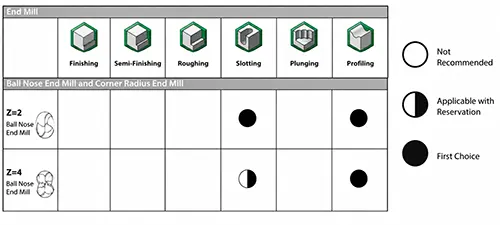
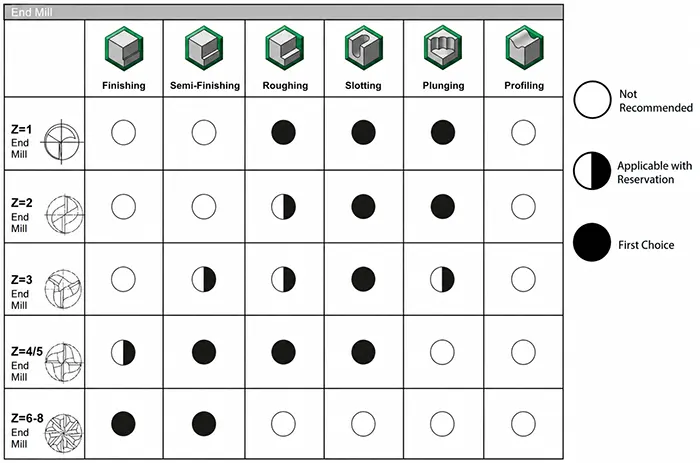
| Machining Stage | Recommended Number of Flutes | Depth of Cut | Description |
|---|---|---|---|
| Roughing | 2–4 flutes | ap 2–3 mm | Fewer flutes and large chip gullets for rapid material removal |
| Semi-Finishing | 3–4 flutes | ap 0.5–1.5 mm | Balances chip evacuation and surface quality |
| Finishing | 4–6 flutes | ap 0.1–0.3 mm | More flutes provide stable cutting; surface roughness can reach Ra 0.1 μm |
| Material Type | Recommended Number of Flutes | Reason |
|---|---|---|
| Aluminum Alloys, Copper | 2 flutes | Ductile materials require large chip gullets for chip evacuation; 2 flutes provide optimal chip removal |
| Wood, Acrylic | 2–3 flutes | High material removal rates require efficient chip evacuation; single- and double-flute spiral cutters are commonly used |
| Carbon Steel, Alloy Steel | 3–4 flutes | Balances rigidity, machining efficiency, and surface quality |
| Mold Steel (HRC 40–55) | 4 flutes | High rigidity ensures stable cutting; 4 flutes provide high efficiency and long tool life |
| Hardened Steel (HRC 55+) | 4–6 flutes | Requires extremely high rigidity; 6–8 flutes are mainly used for side finishing |
| Stainless Steel, Titanium Alloys | 4 flutes (variable pitch) | Variable helix angles provide good chatter resistance and are suitable for difficult-to-machine materials |
Variable Pitch Design: When machining difficult-to-cut materials such as stainless steel and titanium alloys, using a 4-flute end mill with varying helix angles (e.g., 38°/41°) can significantly improve vibration resistance and achieve excellent surface quality.
Rear Wave-Formed Edge Design: 4-flute end mills with rear wave-formed edges provide smooth cutting, low noise, and minimal vibration, making them ideal for high-efficiency, heavy-duty cutting.
| Number of Flutes | Selection Recommendation |
|---|---|
| 2 Flutes | Best for chip evacuation; suitable for aluminum alloys, wood, acrylic, and deep-slot roughing |
| 3 Flutes | Balances chip evacuation and rigidity; suitable for general-purpose machining and resists chatter |
| 4 Flutes | Prioritizes rigidity and high efficiency; suitable for finishing and hardened materials |
| 6–8 Flutes | Extremely high rigidity; mainly used for side finishing of hardened materials |
The fewer the teeth, the better the chip evacuation, making it suitable for rough machining and soft materials;
The more teeth, the higher the rigidity, making it suitable for finish machining and hard materials.
When selecting a tool, a comprehensive assessment should be made based on the tool diameter, machine tool rigidity, and cutting parameters.