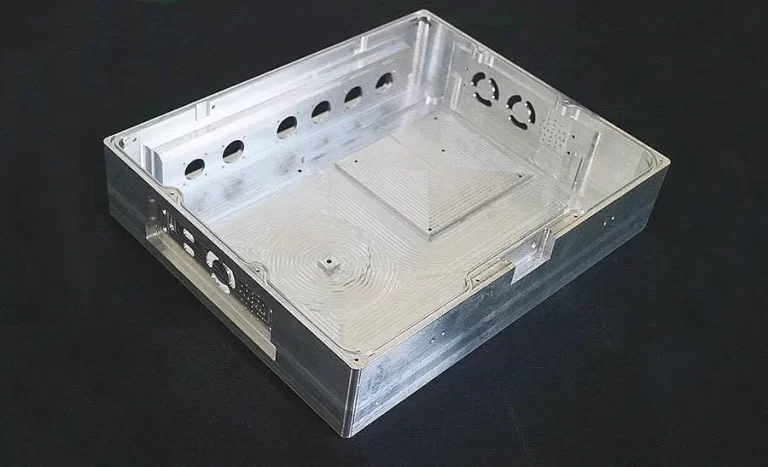
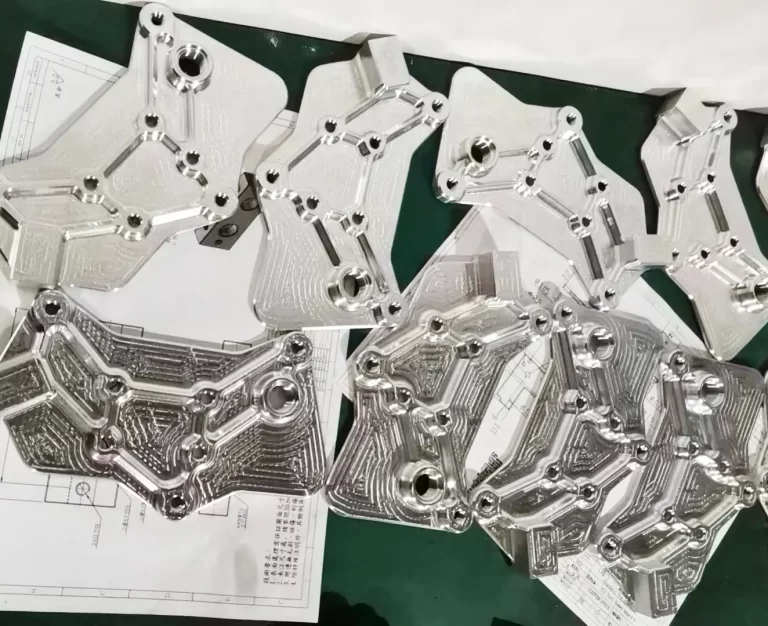
How to efficiently machine shaped parts on CNC mill-turn machines?
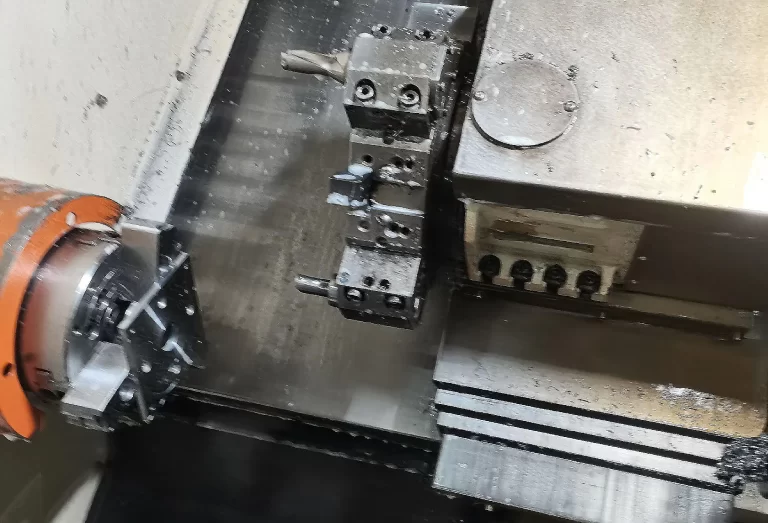


With the capability of one-time forming of complex curved surfaces and multi-sided workpieces, 5-axis machining centers have become core equipment for high-end manufacturing.
Based on differences in rotary axis layout, motion modes, and overall machine architecture, we can classify 5-axis machining centers into six typical structures.
These structures vary greatly in load capacity, rigidity, precision, applicable workpieces and operating scenarios.
This paper systematically sorts out the structural features, core strengths and typical applications of each type, providing clear references for equipment selection.
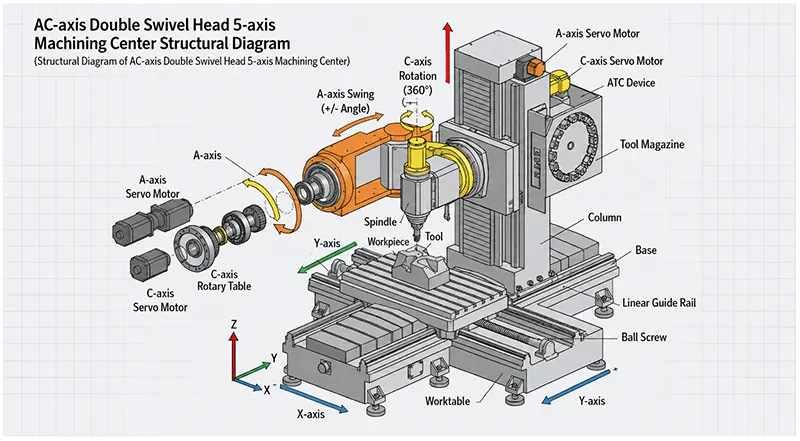
The spindle head can swing forward, backward, left and right to realize universal head movement.
The worktable boasts outstanding load capacity, suitable for processing large and heavy workpieces.
The flexible swinging spindle enables efficient machining of hard-to-process structures such as deep cavities, steep walls and complex mold cavities, with high freedom in adjusting spindle vector angles.
Aerospace components (wing girders, ribs, frame structural parts), large mold manufacturing, heavy machinery component processing, etc.
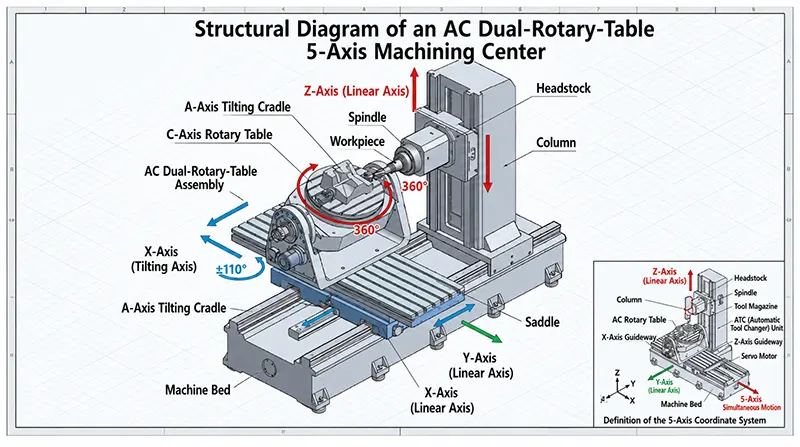
Two rotary axes (A axis and C axis) are integrated into the worktable.
Workpieces rotate synchronously with the table, while the spindle only makes linear movements with a fixed cutting direction.
The spindle head features a simple structure and high rigidity, and the equipment procurement cost is relatively low.
Its motion logic is straightforward, making programming and commissioning easier with stable precision performance.
It specializes in high-efficiency machining of small precision parts.
Small precision molds, impellers, small complex structural components, precision mechanical parts, etc.
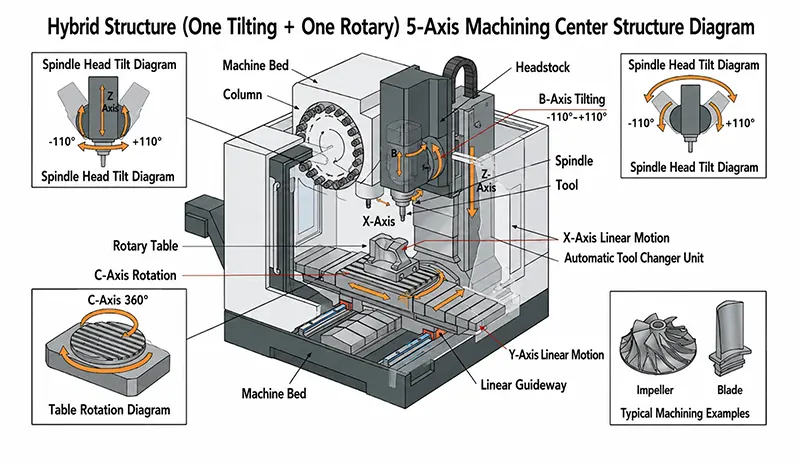
It adopts a combined layout of one swivel axis and one rotary axis.
One rotary axis (e.g., the B axis for forward and backward swinging) is mounted on the spindle head, while the other rotary axis (e.g., the C axis for horizontal rotation) is installed on the worktable.
It combines the flexibility of the double swivel head type and the stability of the dual rotary table type, featuring a wide range of applicability.
It can process medium-sized workpieces and flexibly adjust spindle directions, delivering strong versatility and adaptability.
Blade components, medium-sized molds, general complex structural parts, etc.
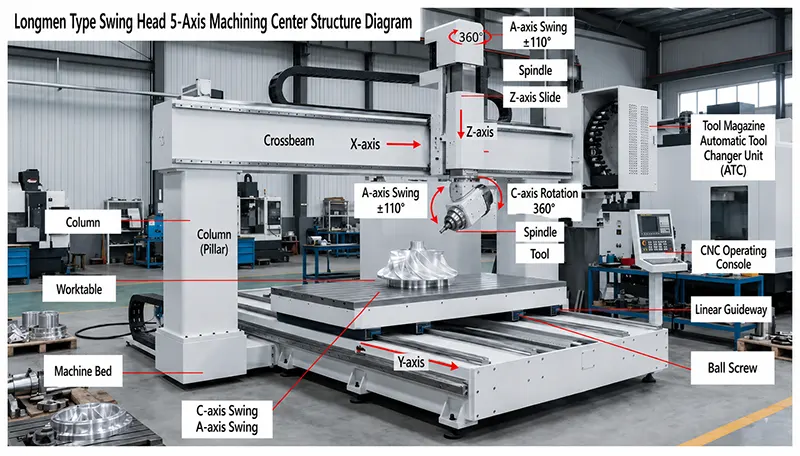
The whole machine uses a gantry frame structure. The spindle and rotary axes are mounted on the crossbeam, and the worktable moves along the machine bed.
It is subdivided into fixed crossbeam and moving crossbeam types to meet different stroke requirements.
It offers ultra-large travel space for extra-large workpieces.
The complete machine has excellent overall rigidity and supports heavy-duty and high-power cutting.
The compact spatial layout reduces floor space and improves site utilization efficiency.
Wind power equipment, shipbuilding, large aerospace structural parts, heavy equipment components, and other oversized workpiece processing.
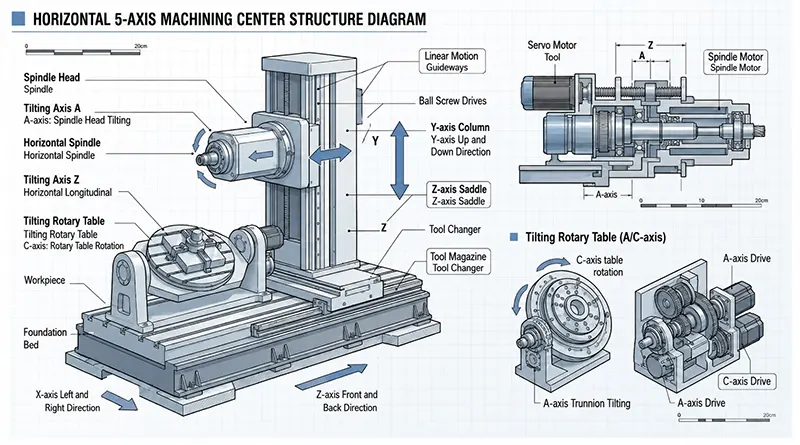
The spindle is arranged horizontally, and the worktable rotates or swings to achieve 5-axis linkage.
Common forms include spindle swinging plus worktable rotation, dual rotary worktables, etc.
Smooth chip removal makes it especially suitable for deep cavities and workpieces with complex inner chambers.
It delivers stable cutting performance and fits automated mass production lines with outstanding processing efficiency and dimensional consistency.
Automotive engine cylinder blocks, gearbox housings, construction machinery components, multi-cavity complex shells, etc.
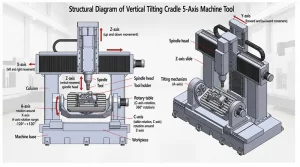
The worktable adopts a tilting cradle design that can rotate around both Axis A and Axis C.
The spindle is vertically arranged, and the worktable features a large rotation range, allowing one-clamp multi-sided machining of workpieces.
It covers a wide processing range and adapts well to complex, special-shaped parts.
The worktable has moderate load capacity with balanced precision and stability, meeting the machining demands of medium-sized workpieces and precision manufacturing.
Mold manufacturing, precision mechanical parts, medical devices, small structural components for high-end equipment, etc.
There is no absolute superior or inferior among 5-axis machining centers of different structures; they only differ in scenario adaptability.
During actual equipment selection, a comprehensive evaluation shall be carried out based on factors including workpiece size and weight, structural complexity, precision requirements, production batch size, and automation level of production lines.
Selecting the most matching structural form can achieve the optimal balance of efficiency, precision, and manufacturing cost.